


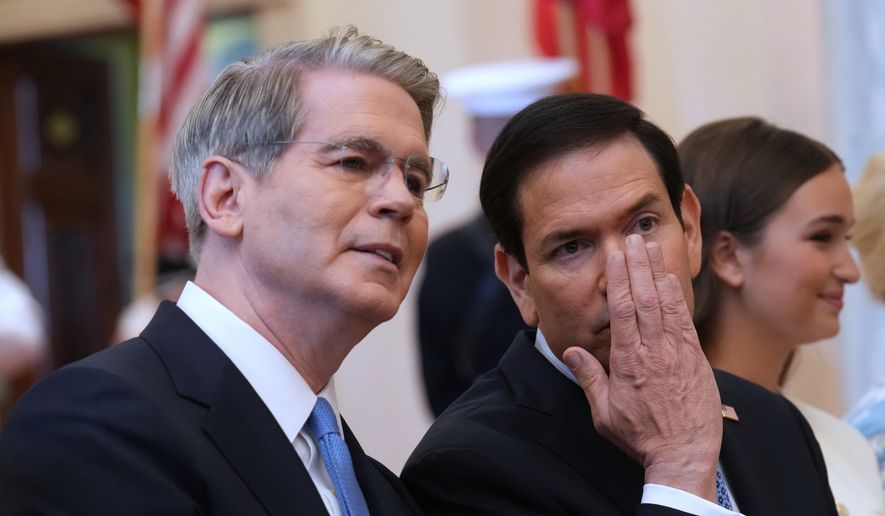

Secretary of State Marco Rubio said President Trump is expected to raise the issue of adopting guardrails on artificial intelligence during talks with Chinese President Xi Jinping but said little progress has been made ahead of next week’s meeting in China.
Mr. Rubio told reporters in Paris on Tuesday that since the matter was raised during the Washington summit between the two leaders in September, “technical level” talks have been held on the topic.
Mr. Trump and Mr. Xi are slated to meet on the sidelines of the Asia-Pacific Economic Cooperation meeting set for Nov. 18 in Shenzhen, China.
People were interested in these podcasts
“I’m sure it’ll be an issue among all the leaders that are at APEC, not just the U.S. and the Chinese on a bilateral basis,” Mr. Rubio said of the AI guardrails.
But the secretary suggested that so far discussions have been limited. “Obviously, we’ve heard their perspective, they’ve heard ours, but that’s still a work in progress,” he said.
Separately, Treasury Secretary Scott Bessent said in a speech Tuesday that Washington and Beijing should have no illusions about bridging differences on AI guardrails.
AI talks in Shenzhen will seek a mechanism for sharing risks and to “prevent a misunderstanding between our two systems,” Mr. Bessent said in New York.
Another goal is to exchange best practices in assessing and testing advanced AI models before release and keeping humans in the loop, he said.
“As SI advances, so will the need to engage in new areas of risk management — and to demonstrate how two nations can reconcile the demands of competition with the responsibilities of leadership,” Mr. Bessent said, using the administration’s favored acronym for AI — super intelligence.
“As we do so, we should harbor no illusions about the differences between the United States and China. As I stated earlier, our interests will not always coincide. And our approach to every challenge, likewise, will not always converge,” he said.
Mr. Bessent, who will travel to Shenzhen with Mr. Trump, made no mention of the unfolding Nvidia scandal involving CEO Jensen Huang and his affair with an alleged Chinese intelligence agent, Alice Huang.
However, Mr. Rubio was asked if China’s apparent diversion of advanced Nvidia AI chips through a company linked to Ms. Huang has him concerned about trust issues with China on AI.
Megaspeed, a company Ms. Huang has worked for, purchased more than $4.5 billion in Nvidia chips and the FBI is investigating whether some embargoed chips were diverted to China, The New York Times reported.
Mr. Rubio sidestepped the question, saying “the Chinese system is always going to act in the interest of the Chinese system.”
The U.S., he said, will always pursue “what’s good for America” whether the issue is AI guardrails or overall bilateral relations with China.
“And that will often put us in conflict or in disagreement with other countries, including China,” Mr. Rubio said.
Contact the author
Please read our comment policy before commenting.