


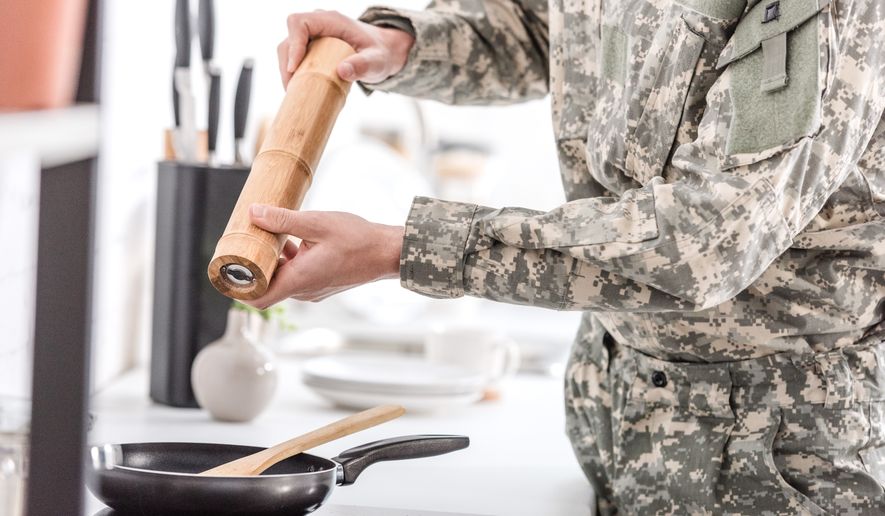

If cooks could kill, as the saying goes, these guys would be among the most lethal.
The Army’s cooks — known officially since 2015 as 92G culinary specialists — have been redesignated as “tactical field feeding specialists” under Defense Secretary Pete Hegseth’s push to promote a more assertive warrior mentality across all aspects of the U.S. military.
The change, which became official with an October ceremony at the Tactical Field Readiness Training Center at Fort Lee, Virginia, is intended to reflect that military cooks are not just ladling out food to hungry troops in the field; they are also soldiers in their own right.
People were interested in these podcasts
“When we change a [military occupational specialty] title in the Army, we do it not for superficial rebranding or administrative convenience. We do it because the character of war has changed,” said Col. Stacy Moore-Callaway, commandant of the Army’s Quartermaster Corps. “Our operational imperatives have shifted, and the battlefield demands that our doctrines, our titles, and our soldiers’ mindsets instead reflect the brutal reality of large-scale combat operations.”
As the Army prepares for the possibility of large-scale military operations against near-peer adversaries such as China and Russia, it must evolve with the changing mission, said Sgt. Maj. Paul Denson of the Army’s Installation Operations Directorate, who enlisted as a culinary specialist.
“A well-fed warfighter is a lethal, agile, and adapted soldier that will win in a prolonged close fight,” Sgt. Maj. Denson said in a statement. “We’re not simply producing food; we’re sustaining warfighters. A tactical field feeding specialist has to understand food production, nutrition, and food safety.”
Tactical feeding is the primary operational justification for having cooks in the military. Civilian contractors who work the line at the garrison dining facility do not follow the troops into battle.
Army officials said their cooks must understand logistics, tactical operations and the dangers of carrying out a mission in a contested environment. A tactical field feeding specialist is responsible for ordering supplies, managing inventory and preparing meals in the field.
“When we look at modern battle spaces that are taking shape around the globe, we know that we must shift the mindset of every single soldier in our formation towards survivability and true lethality,” Col. Moore-Callaway said.
Reaction to the name change has been mixed, with some calling the move “silly but harmless” while others say it could prove beneficial to the Army. Some compared it to past Pentagon plans, such as rebranding mess halls as “Warrior Restaurants.”
“If they are broadening their actual scope, then this might be a good thing. Get them more involved in the specifics of logistics and survivability in the field might not be a bad move,” a commentator on Reddit posted. “Maybe the MOS name change carries a little less connotation of unimportance or insignificance, and thus people who would otherwise turn their noses up at it might be on board.”
The notion that “an army marches on its stomach” has been attributed to both Napoleon and Frederick the Great. The perspective is the same no matter who said it: A hungry army is less effective than a well-fed one.
Contact the author

Please read our comment policy before commenting.