


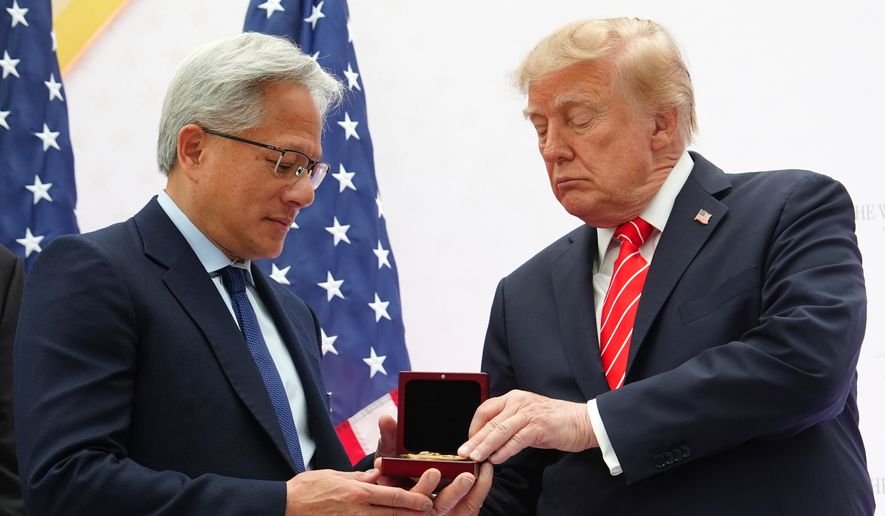

President Trump is standing by one of his closest corporate allies, Nvidia CEO Jensen Huang, over his extramarital relationship with a suspected Chinese spy, a striking contrast to the years of ridicule he heaped on former Democratic congressman Eric Swalwell, who was caught up in a similar espionage controversy.
The Nvidia scandal has drawn particular scrutiny because the firm manufactures advanced artificial intelligence chips that are central to the technological competition between Washington and Beijing. Mr. Huang has also become a close adviser to Mr. Trump, advocating policies that would allow his company greater access to China’s enormous technology market.
Speaking with reporters this week, Mr. Trump repeatedly praised Mr. Huang as a “high-quality person” and an “amazing guy,” despite the unfolding scandal. The president said Mr. Huang was “suffering greatly” and was duped by Alice Huang, a Chinese businesswoman whom U.S. officials concluded was a Beijing intelligence operative having an affair with the Nvidia CEO.
People were interested in these podcasts
“I asked him that question: ’Did you have any idea that she was a spy?’” Mr. Trump said. “He said, ’I had no idea that she was a spy,’ and I really believe him.”
Mr. Trump also said Mr. Huang is “definitely suffering,” adding the tech titan “loves” his wife and family.
The president’s sympathetic response stands in stark contrast to his years of mocking Mr. Swalwell, California Democrat, over his ties with a suspected Chinese spy. Mr. Swalwell, a fierce critic of Mr. Trump, came under scrutiny after revelations that Christine Fang, also known as Fang Fang, a suspected Beijing intelligence operative, cultivated a relationship with him as part of an effort to gain access to American politicians.
Over the span of years, Mr. Trump repeatedly mocked Mr. Swalwell on social media and in interviews. He posted on social media an article about Mr. Swalwell’s position on parental involvement in education and wrote, “he wants his lover spy to make those decisions. A real loser!”
Mr. Trump also said Mr. Swalwell had shown poor judgment by “falling desperately in love with a Chinese spy,” demanded his removal from the House Intelligence Committee, and said, “that Chinese girl played him like a sucker.”
The White House declined to comment.
The contrasting reactions underscore how Mr. Trump treats controversies involving political adversaries differently from those involving people he considers his allies, even when the underlying allegations raise similar national security questions.
“President Trump defends the people he likes and trashes the people he doesn’t and sometimes people can move between those camps,” said Barrett Marson, a GOP political strategist.
“Huang has built such an incredible business, which Trump admires, and [has] given Trump enough money to his various causes to earn his support. But as we all know with Trump, loyalty is a one-way street and if the flame gets too hot, Huang can find himself on the outs pretty quickly,” he said.
Mr. Trump isn’t the only one whose reaction appears to depend on who is embroiled in the controversy. Democrats rallied around Mr. Swalwell but have taken a noticeably different approach to the allegations about Mr. Huang, demanding more information about the national security consequences.
House Minority Leader Hakeem Jeffries, New York Democrat, in 2023 pushed for Mr. Swalwell to continue serving on the House Intelligence Committee despite Republican objections over his ties to Ms. Fang. In a letter to then-House Speaker Kevin McCarthy, California Republican, Mr. Jeffries argued that removing the embattled lawmaker from the sensitive committee was unjustified.
On Monday, Mr. Jeffries said that lawmakers needed a dedicated intelligence briefing on the Huang allegations.
“We’re going to need a full briefing, specifically as it relates to the Nvidia issue, so we can all get to the bottom of what has happened and what the implications are in terms of America’s national security,” Mr. Jeffries said.
Republicans are not uniformly following Mr. Trump’s lead, either.
Three Republican committee chairmen — Reps. Brian Mast of Florida, John Moolenaar of Michigan and Rick Crawford of Arkansas — have requested a closed-door briefing from Mr. Huang on Nov. 18, seeking to determine whether sensitive American technology or national security interests were compromised.
Their demands underscore the difference between the president’s personal confidence in Mr. Huang and the scrutiny the company faces on Capitol Hill, which is only expected to increase once Democrats take control of Congress.
Nolan Higdon, a professor of presidential history at the University of California Santa Cruz, said Mr. Trump’s defense of Mr. Huang goes beyond just sticking up for an ally.
“Trump’s political interests are tied to the economics of the AI boom,” he said. “Trump has really kind of rode an economy that’s resting upon a lot of speculation around AI. That’s why he’s been hesitant to regulate the industry.”
The close ties have drawn renewed scrutiny following revelations about Mr. Huang’s relationship with Ms. Huang, raising questions about the extent of the executive’s influence over U.S. technology policy. There is no public evidence that the alleged intelligence operation influenced the administration’s decisions.
“This could be something where the Trump administration looks like a failure. There’s some reporting that says Nvidia was part of the conversation about the U.S. making a determination of whether or not to sell technology to China. That’s going to be a question that comes up,” Mr. Higdon said.
Mr. Huang has developed a close personal and professional relationship with Mr. Trump, emerging as one of the president’s most influential advisers on technology and artificial intelligence. The Nvidia chief executive has become a frequent presence in Washington, accompanied Mr. Trump aboard Air Force One during a trip to China in May and attended a White House state dinner for Chinese President Xi Jinping in September.
The New York Times reported that Mr. Trump was warned about Mr. Huang’s affair with the alleged Chinese spy just before the tech executive boarded the flight to China. The White House disputes the reporting.
Nvidia also reportedly committed $25 million toward Mr. Trump’s planned White House ballroom. In October, the president awarded Mr. Huang the National Medal of Science, the nation’s highest scientific honor. Their relationship has grown so close that Mr. Huang has a direct line to the president, and the two regularly discuss technology policy.
The relationship has also coincided with a series of favorable policy decisions for Nvidia, particularly regarding its efforts to sell advanced artificial intelligence chips to China. Mr. Trump has backed away from proposed restrictions on Nvidia chip exports and allowed the company to sell chips to China, with the U.S. government collecting a 25% cut of the sales.
Mr. Trump has also purchased as much as $1.6 million in Nvidia stock and sold up to $1 million in shares, according to his financial disclosures, although the White House maintains that independent financial managers oversee his investments.
Mr. Huang acknowledged Sunday that he had been unfaithful to his wife following reports of his relationship with Ms. Huang. The two are not related.
Nvidia’s board has launched an independent investigation into whether the company’s chief executive was targeted by a foreign intelligence operation and whether sensitive corporate information was compromised. Mr. Huang has pledged to cooperate.
Mr. Swalwell’s entanglement with Chinese intelligence dates to his early political career, when Ms. Fang cultivated relationships with rising California politicians. She participated in fundraising activities for Mr. Swalwell and helped place an intern in his congressional office.
Federal investigators warned Mr. Swalwell about Ms. Fang in 2015, prompting him to sever ties with her and cooperate with authorities. He was not accused of providing classified information, and the bipartisan House Ethics Committee closed its investigation in 2023 without finding wrongdoing.
In April, unrelated sexual misconduct allegations prompted Mr. Swalwell to drop out of California’s gubernatorial primary, and he also quit Congress later that month.
Please read our comment policy before commenting.