


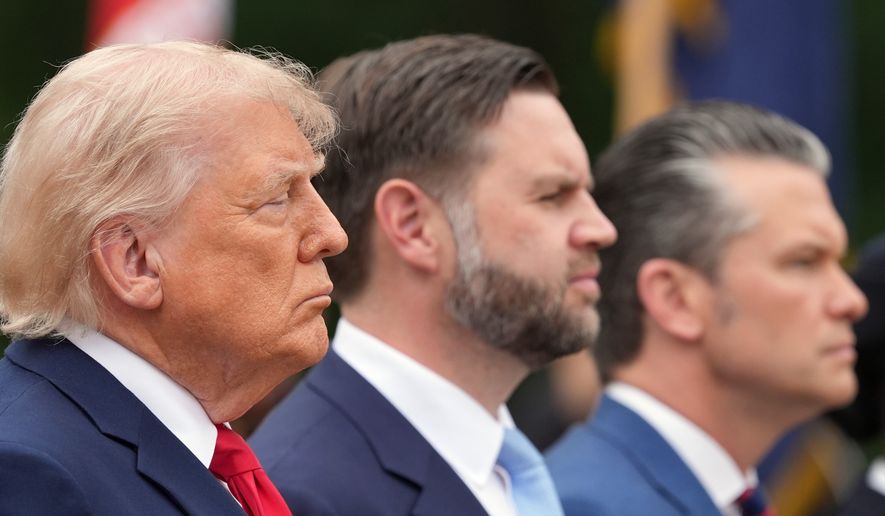

A behind-the-scenes rivalry between Vice President J.D. Vance and Defense Secretary Pete Hegseth, which sources say has been brewing since the early days of the Trump administration, could be coming to a head as Republicans seek someone to blame for the Iran war and the party’s disastrous showing in the midterm elections last week.
The election aftermath has seemingly put Mr. Vance and Mr. Hegseth on opposite sides of a Republican Party that is increasingly split over the Iran conflict, which will be a central issue in the 2028 Republican presidential primary.
Mr. Vance is widely expected to run for president. Mr. Hegseth has been mentioned as a possible contender, though he has denied any intention of seeking the White House.
People were interested in these podcasts
Either way, other Republicans could portray Mr. Hegseth as the de facto architect of an unpopular war that cost their party the House and Senate and deeply undermined their focus on energy prices, affordability and other domestic issues.
Publicly, Mr. Hegseth, 46, and Mr. Vance, 42, have gone to great lengths to downplay any friction. The vice president publicly backed Mr. Hegseth ahead of the House’s ill-fated effort Tuesday to impeach him.
When asked about his relationship with the vice president this week, Mr. Hegseth said “politics is not really my thing” and that Mr. Vance is a “crucial member of the team” making military decisions. Mr. Vance has publicly backed Mr. Hegseth on numerous occasions, dating back to his January 2025 tiebreaking vote in the Senate to confirm the defense secretary.
Yet Pentagon insiders, former senior military officers and other sources familiar with the matter describe the relationship between the two men as nuanced and at times tense. Specifically, much of the tension, sources say, stems from Mr. Vance’s close relationship with former Army Secretary Dan Driscoll, a fellow Yale Law School alumnus.
Mr. Driscoll resigned in September amid deep tensions between Mr. Hegseth’s office and Army leadership. Months earlier, Mr. Hegseth fired Army Chief of Staff Randy George.
Early in the Trump administration, Mr. Driscoll spoke directly to Mr. Vance about Army modernization and restructuring efforts, one former senior military officer said. Those conversations angered Mr. Hegseth, sources said, as the defense secretary felt Mr. Driscoll was going over his head and intentionally leaving him out of the loop.
“That did not land well at all,” one source said.
Mr. Vance and Mr. Driscoll would discuss issues beyond just the Army, according to two Pentagon officials familiar with the matter. Service secretaries typically focus mainly on their own branch, leaving military operations to the heads of the regional military combatant commands around the world.
The tension between Mr. Driscoll and Mr. Hegseth was exacerbated in November 2025 when Mr. Driscoll was sent to represent the U.S. at Russia-Ukraine peace talks in Abu Dhabi. It was highly unusual for a military service secretary, not the defense secretary, to attend such a meeting.
Sources told The Washington Times that Mr. Hegseth and members of his inner circle felt that Mr. Driscoll’s close relationship with Mr. Vance had given the Army secretary excessive power beyond his station.
In a statement to The Times, chief Pentagon spokesman Sean Parnell downplayed any animosity between Mr. Vance and Mr. Hegseth.
“Secretary Hegseth is grateful for the vice president’s leadership as a key member of the administration’s national security team. They are completely aligned in executing President Trump’s ’peace through strength’ vision for our military,” he said.
Another senior administration official turned fire on Mr. Driscoll.
“Since Day 1, Secretary Hegseth has been the chief architect of modernization at the Department of War. Dan Driscoll is a total nonfactor when it comes to these reforms,” the official said.
Mr. Driscoll, through a spokesperson, declined to comment for this report.
The vice president’s office also declined to comment.
Driving Army reforms
Under Mr. Driscoll, the Army began a host of major reforms. The former businessman quickly formed a partnership with his military counterpart, Gen. George.
They started multiple programs to leverage modern technology for the military. Projects included nuclear microreactors on military bases, a major counter-drone initiative across government, a new “Amazon for drones” digital storefront and a plan to bring modern off-the-shelf communications equipment to troops.
In some instances, those Army programs expanded into militarywide efforts, such as deploying nuclear microreactors to bases.
Mr. Driscoll, who recently announced he would join OpenAI as the artificial intelligence company’s senior counselor for national security modernization, has previously suggested tension and disagreements with Pentagon leadership.
“I viewed my role as to advocate as hard as I could for leaders who I thought were good,” he told Rolling Stone magazine shortly after his resignation. “My job was to push as hard as I possibly could for people and then accept the results when it didn’t go the way that I thought it should. And that’s OK. That’s the system functioning as it was designed.”
Two paths on Iran
After the midterm losses, some in the Republican establishment are searching for a responsible party.
A senior Republican on the Senate Armed Services Committee said that although Mr. Vance blamed the Iran war for the election disaster — a sentiment the vice president detailed in a lengthy social media post last week — Mr. Hegseth was following the president’s orders.
“It’s hard to push the secretary of defense in front of the bus when the commander in chief is his boss and makes all the final calls,” the senior Republican told The Times.
“I just don’t think you can separate Pete’s role from the president’s in terms of the final decision-making,” they said.
Mr. Vance defended Mr. Hegseth this week ahead of the House vote to impeach the defense secretary, which was tabled on a 211-204 vote.
“Has Pete Hegseth committed impeachable crimes? The question is absurd, and the answer is: obviously not,” Mr. Vance said.
“The irony is that legislators are most angry at Pete on the issues where he’s most correct: repositioning forces away from Europe/Ukraine and reorganizing the general officer corps,” he said, referring to Mr. Hegseth’s push to shrink the number of generals and admirals in the U.S. military and shift some American troops from Europe.
“This isn’t about Iran; this is about the fact that Pete took on the bureaucracy at the Pentagon,” Mr. Vance said about the impeachment vote.
Prepping for 2028
The vice president had a blunt take on the Iran conflict after the midterms.
“The reason we lost is the war,” he said in his Nov. 4 social media post.
He was careful not to directly criticize Mr. Trump or Mr. Hegseth. The comments from Mr. Vance were widely viewed as an early effort to distance himself from the Iran war in preparation for his 2028 White House campaign.
Mr. Hegseth took a very different tack in framing the conflict.
“Regardless of how people feel about the war, I believe it is a courageous and historic effort that will ensure Iran never gets a nuclear weapon,” he said in a defiant speech at the Pentagon last week.
If he runs, Mr. Vance also would be trying to buck history. Vice President George H.W. Bush was elected president in 1988, but the last previous sitting vice president to do that was Martin Van Buren in 1836.
Mr. Vance, or any other sitting vice president, inevitably occupies a tough spot, having to avoid disloyalty while saying he could do better than the current administration at delivering on its mandate.
Conservative leaders say the war, its duration and its impact on consumer prices stressed the Republican coalition that propelled Mr. Trump and Mr. Vance into the White House.
“The Trump-Vance coalition was put together on a lot of issues, but two of the most central ones were that there would be no new wars and that prices would go down,” Heritage Foundation President Kevin Roberts told The Daily Signal news outlet last week.
That this would lead to political defeat “is just Politics 101 in any representative government,” he said.
Correction: Due to an editing error, a previous version of this article incorrectly stated the location of the Russia-Ukraine peace talks that then-Army Secretary Dan Driscoll attended in November 2025. It was in Abu Dhabi.
Contact the author


Please read our comment policy before commenting.