


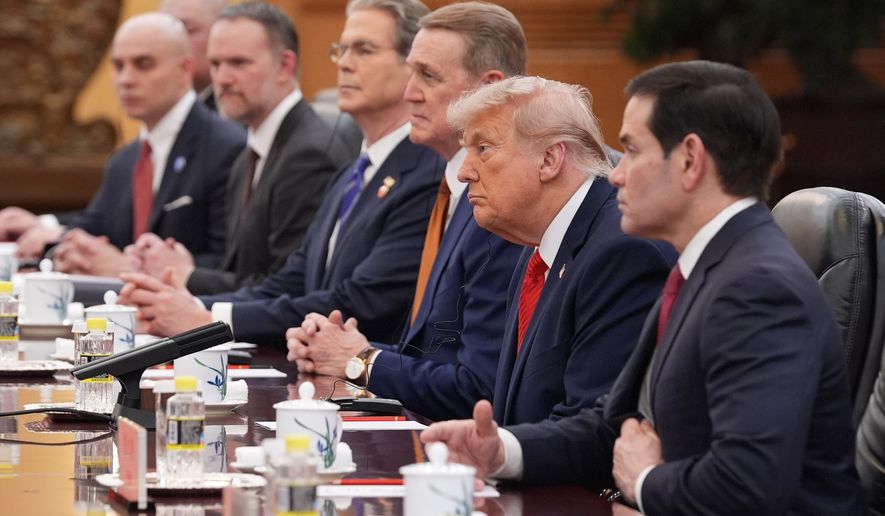

Chinese President Xi Jinping told President Trump on Thursday that he wants the Strait of Hormuz to reopen without tolls or military control, as tensions reignited at the Middle East choke point that carries one-fifth of the world’s oil supply.
A Trump administration summary of the high-stakes meeting said both leaders “agreed that the Strait of Hormuz must remain open to support the free flow of energy,” although it remained unclear whether the U.S. side secured any firm commitments.
“President Xi also made clear China’s opposition to the militarization of the strait and any effort to charge a toll for its use, and he expressed interest in purchasing more American oil to reduce China’s dependence on the strait in the future,” the White House readout said. “Both countries agreed that Iran can never have a nuclear weapon.”
People were interested in these podcasts
Beijing is a strategic partner to Tehran, and China is by far the biggest purchaser of Iranian oil, so the Middle East conflict and Iran’s clampdown on the Strait of Hormuz loomed over Mr. Trump’s visit.
“He said, ’If I can be of any help whatsoever, I would like to help,’” Mr. Trump said in an interview with Fox News’ Sean Hannity. “He would like to see the Hormuz Strait open.”
Mr. Trump said Mr. Xi “strongly” promised not to arm Iran during the conflict.
SEE ALSO: Xi tells Trump that U.S., China should be ‘partners, not rivals’
Tensions flared in the Strait of Hormuz even as the leaders met in Beijing. A ship anchored near the United Arab Emirates was seized, and India condemned an attack on one of its vessels near Oman, saying the boat sank but the crew was saved.
Iran has not claimed responsibility for the attack or the seizure but has maintained that it has the right under international law to intercept “violating” vessels in regional waters.
Tehran has maintained an effective blockade of all Western-linked ships transiting Hormuz since early March. The blockade has throttled global energy markets, with hundreds of ships and millions of barrels of oil trapped in the Persian Gulf.
The Chinese side did not publicly commit to any immediate action on the strait.
“The two heads of state exchanged views on the Middle East situation and other major international and regional issues,” Chinese Foreign Ministry spokesman Guo Jiakun said after the Trump-Xi bilateral meeting. “On the Strait of Hormuz, China’s position is consistent and clear.”
To date, Mr. Xi’s rhetorical commitments “cost China very little,” said Craig Singleton, a senior China fellow at the nonpartisan Foundation for Defense of Democracies.
SEE ALSO: Tanker seized off UAE dock, cargo ship sunk off Oman coast amid Hormuz tension
“The harder test is whether Beijing pressures Tehran, curbs Chinese purchases of Iranian oil or helps Washington turn general language into observable outcomes,” he said. “So far, China appears willing to support de-escalation in principle, not carry out Trump’s Iran policy in practice.”
In the past, China has stressed the need to open the strait and opposed its “militarization.”
The Trump administration wants Beijing to pressure its Iranian partners into accepting a deal on terms favorable to the U.S., so the administration is dialing up pressure on Chinese banks and refineries that buy Iranian oil.
On the other side, the Chinese may use the strait as leverage to persuade the U.S. to adopt more favorable positions on issues such as Taiwan, which China considers a breakaway province.
The Chinese Embassy in the U.S. said Mr. Xi and Mr. Trump “exchanged views on major international and regional issues, such as the Middle East situation, the Ukraine crisis and the Korean Peninsula.”
Treasury Secretary Scott Bessent said he is hopeful Chinese officials will work “behind the scenes” to reopen the strait.
“China has a much bigger interest in reopening the strait than the U.S. does,” Mr. Bessent told CNBC. “China gets about a third of its energy needs from the Gulf. So, a reopening of the strait benefits China.”
Secretary of State Marco Rubio, speaking to NBC News, said China has “got to get involved” in the strait, given higher oil prices.
At the same time, Mr. Rubio said Mr. Trump “didn’t ask [Mr. Xi] for anything.” Instead, he underscored their shared understanding of how the strait should operate.
“The Chinese side said they are not in favor of militarizing the Straits of Hormuz, and they’re not in favor of a tolling system, and that’s our position,” Mr. Rubio said.
The U.S. and Iran have exchanged fire in the strait, and the United Arab Emirates says Iran is responsible for strikes on oil facilities near the strait. Despite these skirmishes, the Trump administration says it is operating under the ceasefire it brokered with Iran in early April.
Jing Qian, vice president of the Asia Society Policy Institute and managing director of its Center for China Analysis, said the U.S.-Chinese discussion on Hormuz focused on “shared systemic risks” in the Middle East.
“Washington emphasizes freedom of navigation and deterrence. Beijing emphasizes opposition to militarization and disruption,” Mr. Qian said. “Different language, but both point toward the same strategic necessity: avoiding uncontrolled escalation.”
Iran is using the Strait of Hormuz as its main point of leverage in its conflict with the U.S. and Israel, hoping economic pain turns into a favorable outcome for the regime.
Mr. Trump, meanwhile, imposed a blockade on Iranian ports that is hindering Tehran’s ability to generate oil revenue and causing financial havoc within the nation.
Mr. Bessent said the blockade will work as designed.
“We believe we’re at the point where soldiers aren’t getting paid. They’re not able to replenish their weapons stocks from abroad. So, I think that they are on their last legs,” he said. “President Trump’s blockade has been a resounding success.”
Contact the author


Please read our comment policy before commenting.