


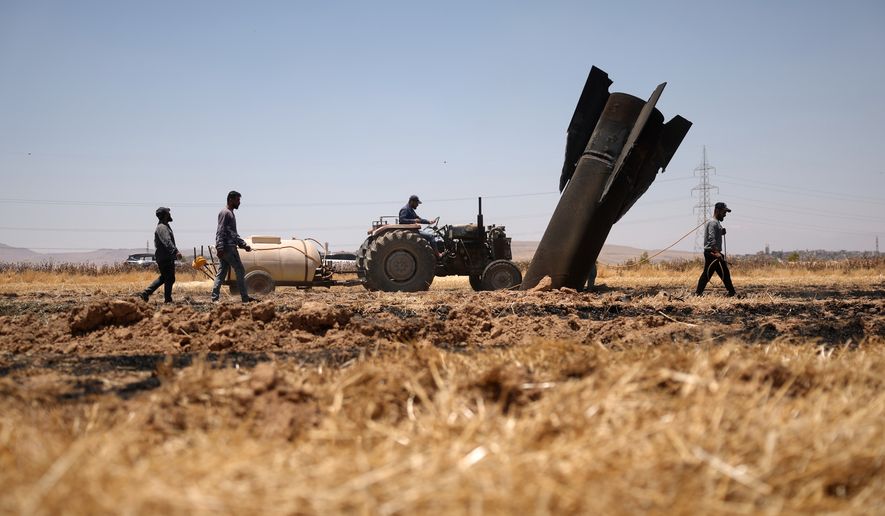

Israel and Iran announced separately Monday that their militaries would halt offensive operations against each other after an explosive exchange of fire overnight that threatened to restart hostilities in the region and upend U.S.-led peace efforts.
Maj. Gen. Ali Abdollahi, who commands Iran’s Khatam al-Anbiya Central Headquarters, announced a halt to Tehran’s ballistic missile attacks on Israel early in the day but promised that the attacks would resume if Israel kept up its attacks on Hezbollah fighters in Lebanon.
“The cessation of armed forces operations is announced. However, it is emphasized that if the aggression and acts of malice continue, including in southern Lebanon, much more severe and crushing measures than before will be forthcoming,” Gen. Abdollahi said in a statement.
People were interested in these podcasts
Iran launched three waves of ballistic missiles at Israeli territory overnight in retaliation for Israel’s continued bombing raids on Lebanon, which in recent days have included neighborhoods near Beirut.
The strikes were the first major Iranian attacks on Israeli territory since the U.S.-brokered ceasefire went into effect in April. A full account of casualties was not known Monday evening.
Israeli Education Minister Yoav Kisch said schools would remain closed Tuesday.
SEE ALSO: Trump says pilots are fine after U.S. helicopter crashes near Strait of Hormuz
“Across the country, schools and educational frameworks are closed in accordance with the directive of the Home Front Command,” he wrote on X.
The Israeli military responded with its own attacks on sites in western and southern Iran, including strikes on Mahshahr, Iran’s largest petrochemical complex. Iranian authorities reported at least 15 injuries as a result of the strikes.
Israeli Prime Minister Benjamin Netanyahu announced a few hours later that his country would pause further strikes. He vowed, however, that Israel would not hesitate to retaliate if Tehran launched more missiles.
“If they make a mistake and resume attacks, we will respond powerfully. Israel has the right to defend itself, and we implement it when needed,” Mr. Netanyahu said.
Mr. Netanyahu made the comments after a phone conversation with President Trump, in which the U.S. leader told his Israeli counterpart not to retaliate against the Iranian attacks. Mr. Trump reportedly told Mr. Netanyahu that he was close to finalizing a deal with Iran and that further strikes could jeopardize peace.
Mr. Trump told Israel’s Channel 12 News on Monday that he warned his Israeli counterpart that he “might soon be left alone” to deal with Iran if he was not careful.
SEE ALSO: Iran war pushes Trump-Netanyahu friendship to limit
In his remarks Monday, Mr. Netanyahu said he had argued for Israel’s full right to self-defense with Mr. Trump during the phone call and did not confirm whether the president had told him to halt further strikes on Iran.
The exchange of fire underscores the importance of the Israel-Hezbollah war in solving the Middle East crisis.
Hezbollah, which receives material and strategic aid from Iran, launched missiles at Israel in early March in response to the killing of Ayatollah Ali Khamenei in a joint U.S.-Israeli airstrike on Feb. 28. Since then, Israeli forces have invaded southern Lebanon and occupied large swaths of the country’s south.
Although Israel and Lebanon have agreed to a ceasefire, the government in Beirut does not control Hezbollah, and the group’s leadership has refused to accept the terms of the agreement.
Iran has objected strongly to Israel’s continued operations in Lebanon, arguing that they are a clear violation of the Pakistani-mediated ceasefire agreed to in April. Israel and the United States have disputed that characterization, saying the ceasefire does not cover Lebanon. Iranian authorities threatened last week to halt negotiations with the U.S. unless Israel stopped its attacks on Hezbollah.
Continued fighting between Iran and Israel could derail the Trump administration’s efforts to finalize a peace deal with Tehran, an ongoing process mediated by Pakistan.
Pakistani Prime Minister Shehbaz Sharif, a key mediator between the U.S. and Iran, said the surge in violence is a reminder that the ceasefire is “tenuous” and that breaking it can have “unbearable consequences.”
“As we work earnestly and painstakingly, together with our brothers and partners, to find a peaceful diplomatic solution to the conflict, and especially when the final objective is just about to be achieved, we sincerely urge all sides to exercise restraint and give peace a little more chance,” he said on social media.
In recent days, the two sides have been circling a “memorandum of understanding” that would reportedly create a durable ceasefire and lift the blockade of the Strait of Hormuz while opening the door for further negotiations over Iran’s nuclear program.
Preventing Iran from developing a nuclear weapon is a central goal of the U.S.-Israeli military campaign, which began Feb. 28.
Meanwhile, the U.S. continues to operate an extensive naval blockade of Iran’s ports in an attempt to pressure the country’s economy.
U.S. Central Command, which oversees military operations in the Middle East, said Monday it disabled an oil tanker that attempted to get around the blockade by sailing toward an Iranian port. A fighter jet fired into the engineering and steering space of the Palau-flagged M/T Marivex after it failed to comply with instructions from U.S. forces in the Gulf of Oman, CENTCOM wrote in a statement.
CENTCOM said it has disabled seven noncompliant vessels, redirected 134 ships that complied with the blockade and allowed 42 vessels supporting humanitarian aid to pass since the blockade began April 13.
Contact the author


Please read our comment policy before commenting.