


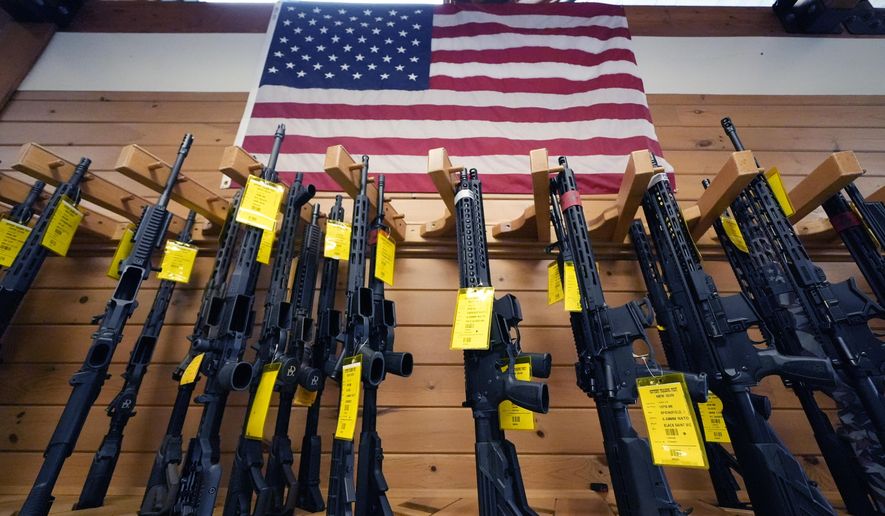

The Supreme Court on Tuesday said it will hear cases challenging states’ bans on semiautomatic “assault weapons” such as the popular AR-15 rifle, putting the issue of gun restrictions firmly before the justices.
They agreed to take cases challenging bans in Illinois and Connecticut, though the eventual ruling would likely affect laws in other Democrat-led states as well.
AR-15s and similar guns are the most popular style of rifle sold in America, making it a prominent target for gun control advocates — and a key test of the Second Amendment’s guarantee of a right to bear arms for self-defense.
People were interested in these podcasts
The justices announced they would hear the cases the same day they released their final opinions for cases argued in their 2025-26 term. The gun cases will be heard in their next term, which starts in October.
A year ago, the justices rejected a similar case challenging Maryland’s ban on the AR-15.
At that time, Justice Brett M. Kavanaugh, a Trump appointee, said the court would have to reckon with the issue soon.
“Although the court today denies certiorari, a denial of certiorari does not mean that the court agrees with a lower-court decision or that the issue is not worthy of review,” he said in a statement. “Additional petitions for certiorari will likely be before this court shortly and, in my view, this court should and presumably will address the AR–15 issue soon, in the next term or two.”
Certiorari is a legal term for an appeal at the Supreme Court level.
Tens of millions of AR-15s are in circulation, and they’re legal in most states, which makes the states that do purport to ban them outliers.
AR-15s are semiautomatic rifles, which means each trigger pull fires a round. They are distinct from automatic rifles or machine guns, where the weapon fires for as long as the trigger is pulled and there is ammunition to feed it.
Restrictions on automatic weapons have long been recognized, but semiautomatic weapons are a trickier matter.
Gun-rights advocates said they’re eager for the justices to rule.
“The Second Amendment protects arms in common use for lawful purposes, and it’s hard to argue that a type of rifle that potentially outnumbers Ford F-150 trucks in America doesn’t meet that standard,” said Adam Kraut, executive director of the Second Amendment Foundation.
Gun-rights supporters say assault weapons bans are based more on the look and feel of a gun than on any material difference in performance.
Gun control groups, though, argue the AR-15 and similar semiautomatic weapons can deal death at an elevated pace, putting them beyond the protection of the Constitution.
There’s reason to think the justices will disagree.
Under the Supreme Court’s latest rulings, for gun restrictions to survive constitutional scrutiny, they must be the sort of laws that would have been countenanced by the founders.
Justice Clarence Thomas, who wrote the 2022 opinion laying out that test, said last year that it’s tough to square AR-15 bans with that standard.
He said AR-15s are quintessential “arms” as envisioned by the Second Amendment, and there’s no sense that the founders would have believed a ban on the most popular rifle in America was constitutional.
The 2022 case, known as the Bruen decision, has upended firearms jurisprudence, spurring challenges to laws that restrict who can possess a gun, where they can be carried, and what types of weapons can be limited.
Earlier this month, the Supreme Court struck down a Hawaii law that sought to bar permitted gun owners from carrying weapons on private property open to the public, such as stores or gas stations, unless they first got explicit permission.
The justices also ruled against the federal ban on habitual drug users, finding that it can’t apply to occasional marijuana users.
But the court put off cases concerning specific weapons bans.
The justices on Tuesday also declined to hear a case that had struck down Pennsylvania’s restriction on gun purchases by adults ages 18-20.
A lower court had invalidated the state ban, and Tuesday’s action leaves that ruling in place.
Gun-rights groups had hoped the justices would hear the case and issue a decision settling the issue nationwide.
Contact the author


Please read our comment policy before commenting.