


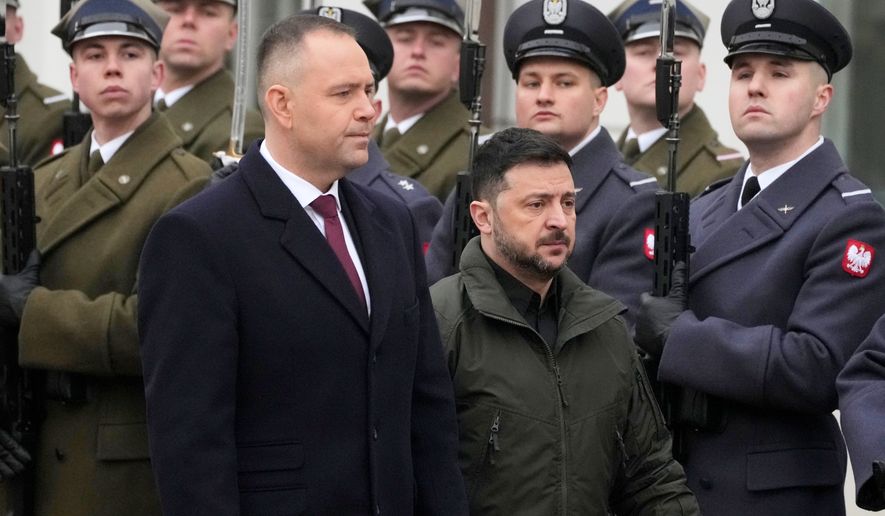

A recent decision by Ukrainian President Volodymyr Zelenskyy to name a military unit after an organization accused of killing upwards of 100,000 ethnic Poles during World War II threatens to spark a diplomatic row between Kyiv and Warsaw.
Last month, Mr. Zelenskyy signed a decree that named one of the military’s special operations units in honor of the Heroes of the Ukrainian Insurgent Army, known as the UPA. The UPA’s World War II legacy is held in great esteem in Ukraine as a symbol of the country’s struggle against Nazi Germany and the Soviet Union, but the unit is viewed much more critically in neighboring Poland.
During World War II, historians say UPA fighters carried out waves of ethnic cleansing against civilians in regions like Eastern Galicia that today spans parts of western Ukraine and southeastern Poland.
People were interested in these podcasts
The legacy of the Ukrainian Insurgent Army is a deeply rooted historical dispute between the two countries. It centers on a fundamentally different interpretation of the organization’s actions during World War II.
On Friday, Polish President Karol Nawrocki stripped Mr. Zelenskyy of Poland’s highest state honor, the Order of the White Eagle, over his decision to name the current unit in honor of the UPA. Ukraine’s president said he wouldn’t argue with Poland’s decision to withdraw the honor.
“The facts are that at least 100,000 Polish citizens were murdered by the UPA in Volhynia, Eastern Galicia, the Lublin region, and the Subcarpathian region, solely because they were Poles, Jews, or members of other minorities,” Mr. Nawrocki said in a statement. “It is a fact that the victims were residents of villages and small towns — entire families, women, children, and the elderly. They were not soldiers on the battlefield. They were defenseless civilians.”
Taras Kuzio, a British political scientist and professor at the National University of Kyiv, said the data indicates the death toll is closer to 39,000 or 40,000 Poles.
He also criticized the notion that only Ukraine’s UPA were criminals and that Polish underground groups like the Armia Krajowa, known as the AK, or the so-called Peasant Battalions, were blameless during the war.
“There is abundant archival evidence that the AK and the Peasant Battalions … committed crimes against Ukrainians. Sometimes this was in alliance with Soviet partisans,” Mr. Kuzio wrote in a 2017 essay for New Eastern Europe magazine.
Poland has been a steadfast supporter of Ukraine in its battles against Russian invaders. Still, Mr. Nawrocki said that naming a Ukrainian unit in honor of the UPA could have “consequences” for the relationship between Warsaw and Kyiv going forward.
“History should not be an obstacle to the future. However, a good future can be built only on the truth,” he said.
Ukraine’s president said he wouldn’t argue with Poland’s decision to withdraw the honor.
“We believed that the Order of the White Eagle, awarded in 2023, was meant for the Ukrainian people and our army. That is what was said at the time,” Mr. Zelenskyy said Saturday on X. “Today, I sent the Order back to the President of Poland.”
He noted that Poland didn’t strip the Order of the White Eagle from Italian dictator Benito Mussolini or Gerhard Schroeder, the pro-Russia former chancellor of Germany.
“Ukraine will remain open to all meaningful formats of engagement with Poland in order to try to avoid conflicting interpretations of the difficult and painful chapters of our shared past and to ensure proper respect for all victims of the 20th century,” Mr. Zelenskyy said. “Ukrainians are doing everything in our power to ensure Europe does not suffer defeat in this century.”
Polish Prime Minister Donald Tusk, a political rival of Mr. Nawrocki, criticized Mr. Zelenskyy’s initial decision to revive the UPA name but warned that a public feud between Ukraine and Poland serves the interests of Russian President Vladimir Putin.
“Getting entangled in the political conflict between politicians in Poland and Ukraine is a strategic mistake that will cost both sides: in business, geopolitically, and reputationally. And in politics, as is well known, a mistake is worse than a crime,” Mr. Tusk said Sunday on X.
Contact the author

Please read our comment policy before commenting.