


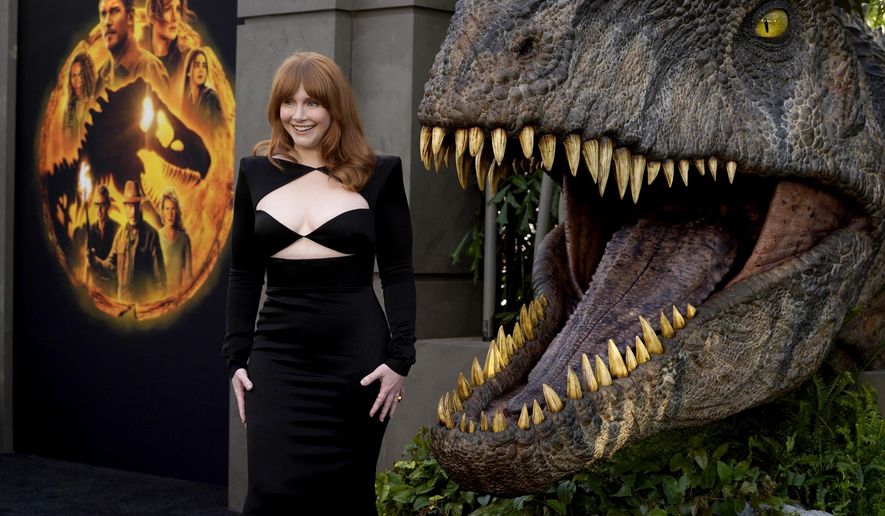

Universal Pictures’ “Jurassic World: Dominion” has dethroned Disney’s “Star Wars: The Force Awakens” as the most expensive film in Hollywood history, with a production cost of $658.8 million, according to financial filings analyzed by Fortune.
The 2022 action-adventure sequel eclipsed the previous record held by Disney’s 2015 “Star Wars” reboot, which cost $638.9 million. Universal and Disney were contacted for comment.
The staggering price tag was driven largely by the COVID-19 pandemic. “Dominion” was filmed at the height of the outbreak in 2020, forcing Universal to implement costly safety protocols and absorb months of delays that pushed the film’s premiere back a full year to June 2022. Throughout the downtime, the studio had to continue paying for soundstages and leased equipment, as well as retaining security personnel, producers and department heads to ensure they remained available once production could resume.
People were interested in these podcasts
The film’s A-list cast spent five months quarantined at the opulent Langley Hotel, an 18th-century manor near Pinewood Studios in the U.K., where rooms ran more than $600 a night. The hotel became something of a cultural curiosity during lockdown, after actor Jeff Goldblum was filmed playing jazz piano in the wood-panelled lounge while co-star Sam Neill sang along.
“Dominion” was the third installment in Universal’s “Jurassic World” trilogy and reunited franchise leads Bryce Dallas Howard and Chris Pratt with original “Jurassic Park” stars Laura Dern, Mr. Goldblum and Mr. Neill.
The production’s full costs came to light through the U.K.’s financial disclosure requirements. Unlike in the United States, where production budgets are closely guarded and folded into broader SEC filings, British law requires studios to set up a dedicated Film Production Company for each picture in order to claim government tax rebates — and those companies must file detailed financial statements. Universal operated the production through a subsidiary called Arcadia Pictures, named after a rescue ship from the previous film, “Jurassic World: Fallen Kingdom.”
The U.K.’s Audio-Visual Expenditure Credit reimburses studios up to 25.5% of qualifying British production spend, provided films meet a cultural points test tied to factors such as U.K. cast members, on-location filming and domestic content. British actress Isabella Sermon, who plays a cloned girl central to the plot, helped bolster Universal’s qualifying tally, as did scenes shot in the woods of southeast England and at Wolfson College, Oxford, which doubled for the headquarters of the film’s fictional Biosyn Corporation.
The reimbursement totaled $127.8 million, bringing Universal’s net outlay on the film to $531 million. Despite “Dominion” grossing just over $1 billion at the global box office, the studio’s roughly $500 million share of ticket revenue — reflecting the industry’s standard 50-50 theatrical split — left Universal at a modest loss on its theatrical run alone.
Across the full “Jurassic World” trilogy, however, Universal turned a profit. “Dominion” was the costliest of the three films, followed by “Fallen Kingdom” at $606.3 million and last year’s “Jurassic World Rebirth” at $254.2 million. Combined U.K. reimbursements of $262.1 million reduced the net outlay on all three to $1.3 billion, against $1.6 billion in combined box office receipts, yielding a roughly $300 million profit — a margin that would have effectively vanished without the British subsidy. A sequel to “Rebirth” is in development.
The record comes against a backdrop of uncertainty for the U.K. film industry’s relationship with Hollywood. President Trump twice threatened in 2025 — first in a May Truth Social post and again in September — to impose a 100% tariff on films produced outside the United States, saying the American movie industry was dying a “very fast death” as foreign governments offered incentives to lure production abroad. Mr. Trump did not specify when or how either levy would be implemented, and no such policy has been enacted. If it were, analysts say the loss of U.K. financing could leave “Dominion” atop the all-time budget rankings for years to come.
U.K. feature film production spending rose 31% to a record $3.8 billion last year, according to the British Film Institute. Disney holds a long-term deal with Pinewood Studios, while Amazon and Netflix have taken up residence at nearby Shepperton Studios.
This article was constructed with the assistance of artificial intelligence and published by a member of The Washington Times' AI News Desk team. The contents of this report are based solely on The Washington Times' original reporting, wire services, and/or other sources cited within the report. For more information, please read our AI policy or contact Steve Fink, Director of Artificial Intelligence, at sfink@washingtontimes.com
The Washington Times AI Ethics Newsroom Committee can be reached at aispotlight@washingtontimes.com.
Please read our comment policy before commenting.