



Twenty-six state and local governments will raise their minimum wage on July 1 — a flurry of legislative action that supporters say is long overdue and critics insist will worsen the nation’s affordability crisis.
The conservative Employment Policies Institute reported that the increases include seven California cities hiking hospitality industry compensation.
Amusement and hotel workers in San Diego will start at $17.25 an hour, while Long Beach hotel and concession workers will earn $26.50 an hour.
People were interested in these podcasts
California will raise pay for healthcare facility workers statewide to $25 an hour.
Alaska will increase the wage floor to $14 for all hourly workers.
In the District of Columbia, the minimum for tipped restaurant workers will jump 30 cents to $10.30 following a law that doubled it from $5.35 in 2022 to $10 in 2023.
“While many areas say they are raising wages to keep up with inflation, these annual hikes are contributing to the affordability crisis,” Rebekah Paxton, the institute’s research director, said Thursday in an email. “A vast majority of economists have warned that high wage mandates worsen the cost of living, decrease job opportunities, and increase automation.”
She cited research showing that minimum wage hikes increase inflation by up to 5.5% for every $1 increase, due to employers raising prices to offset higher labor costs.
A January 2021 analysis published by the National Bureau of Economic Research found 79.3% of studies linked higher minimum wages to fewer jobs, as employers cut shifts and pull back on staffing.
Advocates have countered that local and state pay hikes are necessary to compensate for the stagnant federal minimum wage, which has been stuck at $7.25 an hour since 2009.
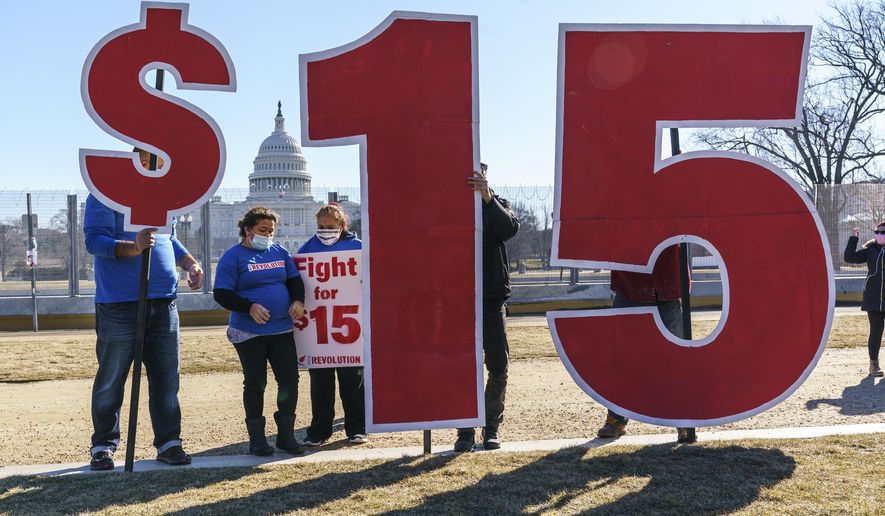
“They signal that communities are no longer waiting for Washington to close a gap that has widened for nearly two decades,” said Angelica Gianchandani, a New York University marketing instructor. “In those same years, inflation eroded 30% of that wage’s purchasing power.”
The Bureau of Labor Statistics estimates that only 1% of workers earn the federal minimum wage or less.
In December 2024, the bureau estimated that California fast-food restaurants lost 6,166 jobs after Democratic Gov. Gavin Newsom signed a $20 minimum wage law the previous September.
That’s 1.1% of positions lost in the industry, reversing a 3.1% gain of 17,528 jobs during the previous comparable period.
Labor economist Michael Reich, chairman of the University of California at Berkeley’s Center on Wage and Employment Dynamics, insists that the state’s latest wage hikes for hospitality workers are unlikely to have any negative effect on employment.
“A majority of the affected workers are covered by union contracts with wage levels that already equal or exceed the upcoming policy increases,” said Mr. Reich, a leading minimum wage advocate.
More harm than good
In Virginia, the Employment Policies Institute noted that the minimum for nontipped workers will increase from $12.41 to $12.77 an hour next month.
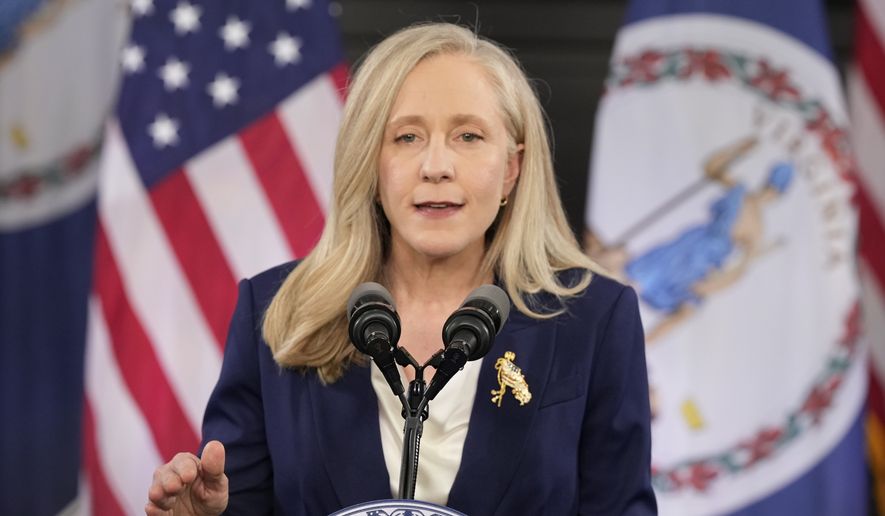
The institute estimates that a $15 minimum wage law that Democratic Gov. Abigail Spanberger signed in April could cost the commonwealth 12,000 jobs.
Ms. Spanberger’s plan will boost the minimum from $12.77 to $13.75 next year and to $15 in 2028. It will then adjust upward for inflation in future years.
Economists have predicted that many Virginia retail, sales, hospitality and administrative employers will either raise prices or downsize staff and services to cope.
“Political leaders argued that anyone earning the state minimum wage should be able to afford to live in Virginia,” said Bruce Yandle, a former executive director of the Federal Trade Commission during the Reagan administration. “But the conventional reaction by economists to minimum wage increases generally sees more harm being done than good.”
Mr. Yandle, an adjunct scholar at George Mason University’s free-market Mercatus Center, said boosting wages above the market value of unskilled labor benefits “leads to larger layoffs” as more employers automate tasks.
Over a dozen states have implemented a $15 minimum wage, bolstering a decadeslong “fight for $15” campaign promoted by liberal activists.
The left-leaning Economic Policy Institute projects that 17 states pay at least $15 an hour this year, including $15.15 in Arizona and $17.13 in Washington.
Other states have faced intense pushback from businesses to measures that could push wage floors to more than $20 an hour.
In Maryland, a bill to bump the state’s minimum from $15 to $25 an hour died in committee this year and missed a legislative deadline.
But Howard County will hike its hourly minimum to $16 on July 1. Montgomery County will bump it to $18 for companies with at least 51 employees, $16.50 for companies with 11-50 employees and $15.95 for companies with 10 or fewer workers.
Political theater
Economists say minimum wage hikes make it harder for the unemployed, recent immigrants, inexperienced younger workers and unskilled laborers to enter the job market.
Economist Peter Earle, senior director of research at the free-market American Institute for Economic Research, said wage floor hikes add “local cost shocks on top of an already uncomfortable price environment.”
“Overall, the new raft of minimum wage hikes are more likely to hurt than help in the current economic climate,” Mr. Earle said. “Having said that, though, the damage will be uneven.”
Since Congress last raised the federal minimum wage, dozens of states and cities have periodically raised their rates above it.
At the same time, 20 states still pay only the $7.25 federal rate. They include Georgia, Indiana, Iowa, Kansas, Kentucky, Pennsylvania, Texas, Utah and Wisconsin.
Hourly workers in 19 states enjoyed a salary bump on Jan. 1, including Arizona’s minimum going up to $15.15 and Washington state’s reaching $17.13.
The Economic Policy Institute estimated that the increases enacted on Jan. 1 would boost pay by $5 billion for 8.3 million workers in those states.
Many states and cities now tie their increases to changes in the U.S. inflation rate or local cost-of-living formulas. Others are phasing in wage mandates that voters approved years ago through ballot initiatives or ordinances.
“The effect will be minimal,” said Barbara O’Dell, a senior legal analyst at the accounting firm Wolters Kluwer, which tracks minimum wage policies.
“At the margins, it may help service industries with recruitment and retention,” she added. “But it may also drive greater adoption of self-service kiosks and other automations that lead to eventual labor reductions.”
Sean Higgins, an analyst at the libertarian Competitive Enterprise Institute, described minimum wage laws as political theater for politicians seeking an “easy win” in liberal areas.
He said the increases set an artificial rate that provides only a short-term boost for some workers, while pushing others out the door.
“Raising the minimum doesn’t mean that employers can magically pay more,” Mr. Higgins said. “Look at how almost all grocery and pharmacy checkout lines are self-service now. That’s a reaction against rising labor costs.”
Contact the author

Please read our comment policy before commenting.