


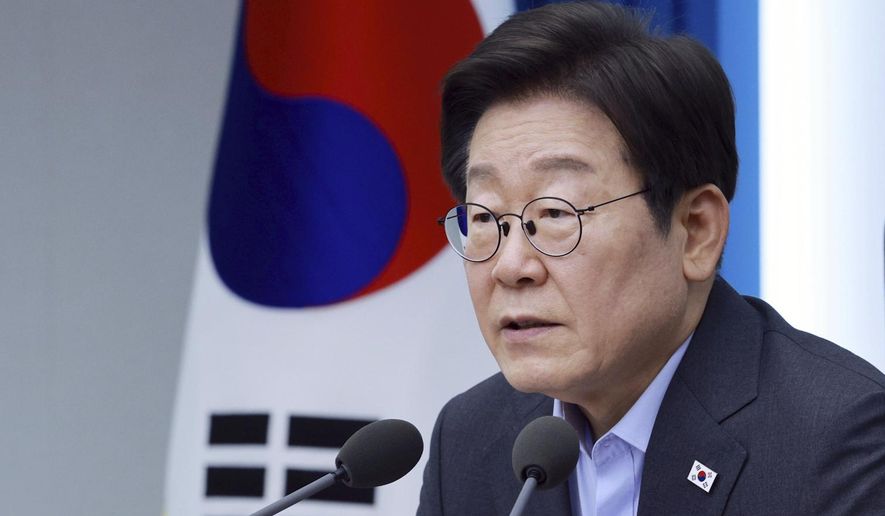

SEOUL, South Korea — His opponents brand him a populist, a hardcore leftist and even a North Korean sympathizer, but South Korean President Lee Jae-myung, a liberal, has launched his country’s stock market into the stratosphere.
Given that the nation’s key stock index was undervalued for decades under the “Korea discount,” the change is staggering.
On June 5, 2025, the day after Mr. Lee entered office, the Kospi, the nation’s benchmark stock index, stood at 2,831 points. On Friday, it closed at 8,124.
That marks a slight fall amid the market’s current volatility. Earlier this month, the Kospi tested record highs in the 8,800-point range.
For a market that had never breached 3,300 points before 2025 and simmered around 2,000 points for two decades, the Kospi’s increase is incredible.
The index is also outpacing overseas competitors in dollar value. Since Mr. Lee entered office a year ago, the Kospi has overtaken the main stock indexes of Britain, Canada and India.
“Korea’s stock markets are seeing an unprecedented rise,” said Kim Sei-wan, president of the Korean Capital Market Institute think tank.
With the Kospi registering the largest increase among developed markets in 2025 and so far in 2026, he said the achievement was worthy of a Guinness World Records entry.
Changes empower shareholders
Although experts say the global artificial intelligence boom and cyclical factors are lifting the stock prices of companies that manufacture semiconductors — Korea’s leading export item — they say the real propellant has been South Korea’s economic democratization policies.
Three tranches of regulatory change have empowered shareholders vis-a-vis the previously untouchable “chaebol.” The giant, family-run conglomerates have dominated the economy since the country industrialized in the 1960s and 1970s.
“The Lee government has made three amendments to the Commercial Act,” Mr. Kim told foreign reporters in a recent briefing. “Revising the act in Korea has been extremely difficult. For the last 25 years, there were just two [changes], but the Lee administration has revised it three times.”
Mr. Lee is in an unusually strong political position. He occupies the presidential Blue House, and his Democratic Party of Korea controls the National Assembly.
Chaebol-controlling family members are not necessarily the majority shareholders, but they have consistently defeated proxy challenges launched by activist shareholders and foreign funds.
That is thanks to a compliant judiciary and bureaucracy and to a regulatory playing field tilted in the conglomerates’ favor.
That field has now been leveled.
The first revision to the Commercial Act strengthened fiduciary duty, legally requiring corporate officers to operate in the best interests of shareholders.
In the past, corporations often prioritized the interests of members of their founding families or invested their profits in other companies or sectors.
The second revision introduced cumulative voting for minority shareholders, strengthening their ability to elect corporate officers who serve their interests. In the past, corporations could fill boards with yes-men.
The third was the mandatory cancellation of “treasury stock.” In most countries, when a corporation buys back its own stock to raise its market value, that stock is eliminated. In Korea, however, the conglomerates could hold those stocks in reserve to wield them in proxy battles if necessary.
Mr. Kim said the revisions were key to reversing the long-held “Korean discount” — the devaluation of Korean stocks compared with their American rivals. Samsung Electronics was valued at a fraction of Apple for years, he noted.
Some pro-corporate voices say the discount was rooted in the North Korean threat.
However, foreign investors and local shareholder activists argued that it was a result of self-serving corporate behavior, enabled by pro-chaebol regulation.
Under Mr. Lee, Seoul’s relations with North Korea have not improved, but corporate regulation has.
The timing of the three revisions — the last was in April — saw the Kospi surge past the 6,000-point level, said Mr. Kim, whose think tank is linked to the government.
Since then, he acknowledged, strong corporate fundamentals and global developments — notably the upward-trending “semiconductor super-cycle” and booming demand for AI-related chips — have been buoying valuations.
Independent market analysts agree with him on the importance of policy in the Kospi’s ascent.
“During the election, Lee Jae-myung promised voters that he would do whatever it takes to make the stock market fair and equitable for minority shareholders,” said Chan H. Lee, managing partner at Seoul-based Petra Capital Management. “He and his party had majority control of the National Assembly, so the first thing he did was change the commercial codes.”
Calling the regulatory changes “fantastic,” the fund manager slammed critics.
“A lot of rules still favor the chaebol, and a lot of newspapers and media view [pro-shareholder policies] as anti-business, but that is not true,” Mr. Chan Lee said. “These allegations, I think, are not fair.”
The downsides
Still, surging equities are not entirely positive. For one thing, wealth disparity has risen.
With early investors realizing massive returns, many nonbuyers are envious and angry. Some young people are reportedly taking on debt to join the investing herd.
Foreign institutions led the charge into the Kospi in 2025, but they have taken profits this year, turning into net sellers. The foreign sell-offs have been so large that they have dragged down the won, the local currency.
Mr. Kim said he thinks the foreign exit is temporary.
“Foreign institutional investors are rebalancing their portfolios,” he said. “Their fraction of Korean stocks is too big right now.”
The sudden, massive shift into stocks could rebalance Korea’s economic landscape.
For decades, Koreans were minimal stock buyers and preferred the traditional investment in real estate.
That means there is also potential to change the physical landscape.
Real estate mania created massive inequalities between those lucky enough to own properties in central Seoul and those who did not — now a major political issue.
It also led to the bulldozing of entire blocks of historical architecture to clear the way for high-rises.
Still, there is upside potential, Mr. Kim said. He cited the anticipated lengthening of trading hours to expand market access.
Although he said Seoul deserves kudos for the Kospi’s soaring fortunes, one market watcher who requested anonymity acknowledged that even government officials who laid out the regulatory changes are gobsmacked.
“I don’t think they predicted this much success,” he said.
Contact the author

Please read our comment policy before commenting.