



A version of this story appeared in the daily Threat Status newsletter from The Washington Times. Click here to receive Threat Status delivered directly to your inbox each weekday.
ODESA, Ukraine — In a train yard near Odesa, Ukraine’s dead return home, their remains stored in body bags stacked in refrigerated cars. Some bodies are whole. Some are badly decomposed. Some bags contain mangled fragments of several men mixed together by blast, time or expediency.
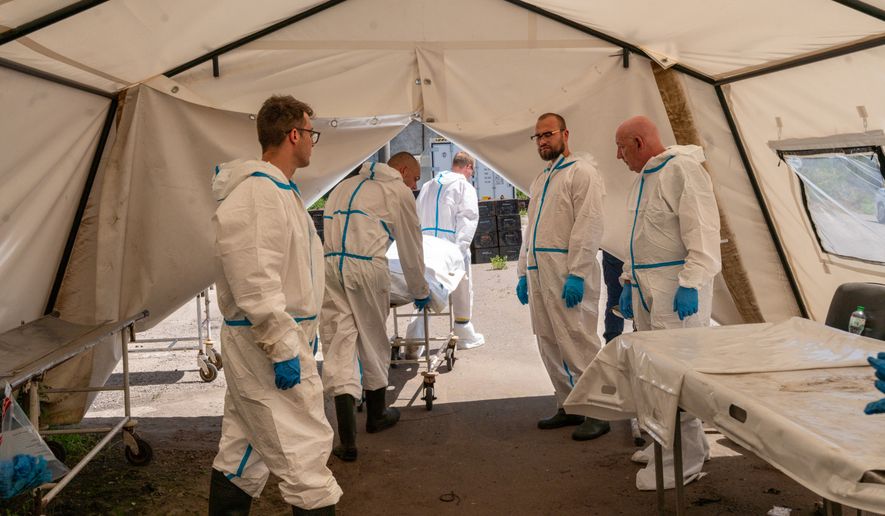
Early on May 27, in Ukraine’s southern port city, a dozen men in protective suits, surgical masks and latex gloves moved between disaster relief tents set up alongside the rail cars.
In the air hung the faint, sickly sweet smell of decomposition.
People were interested in these podcasts
Under one of the tents, Dr. Ruslan Fedoniuk and his colleagues gathered around a body stretched out on a metal table. The soldier was stripped to the waist. His left foot had been torn off, and his weathered skin had turned purple and leathery from exposure to the elements.
As Dr. Fedoniuk began his examination, one of his young trainees took notes.
“The condition in which they arrive is terrible,” the 60-year-old physician said. “But we try to preserve at least what can still be preserved.”
Dr. Fedoniuk and his team examine the clothing, the wounds and what is left of each body.
Every observation is recorded.
More than four years into Russia’s brutal invasion of Ukraine, more than 90,000 people — civilians and military personnel — are listed in the Ukrainian registry of missing persons under special circumstances.
Other estimates cited by officials and international reporting put the number of missing soldiers alone in the tens of thousands.
The war’s hidden front
Dr. Fedoniuk is a forensics expert from Bakhmut, an eastern Ukrainian city destroyed by Russian forces after one of the war’s bloodiest battles. He tells The Washington Times that his team’s work is grim but critically important.
Identifying the bodies of fallen servicemen returned by Russia, often months or years after their deaths, is the only way of bringing closure to their families and to ensuring that they finally get to bury a son, husband, brother or father.
The first large exchange of human remains began after talks between Ukraine and Russia in Istanbul in June 2025. The agreement did not hasten peace. It did, however, open a channel for the return of thousands of dead soldiers.
The International Committee of the Red Cross has supported parts of that process as a neutral intermediary.
The scale is overwhelming. Ukraine received more than 6,000 bodies in one large wave last year. Further repatriations have followed, including transfers of 1,000 bodies at a time this year and another of more than 500 in May. Odesa has become one of the main hubs of this nationwide forensic undertaking.
“The identification of the dead is our ordinary, daily work,” said Dr. Tetyana Papizh, head of the Odesa Regional Bureau of Forensic Medical Examination. “But not in such volumes. No one was used to working like this.”
Her office says it has handled more than 3,000 bodies so far. During one major wave, Odesa received 1,600. Around the tents and refrigerated wagons, as many as 100 people can be mobilized: forensic doctors, investigators, police, emergency workers, genetic experts, orderlies and even explosives specialists.
Danger inside the bags
The explosives specialists are not there for show. With each body bag comes a risk that grenades, ammunition and other unexploded ordnance are mixed in with the dead and their belongings.
Dr. Papizh recalled a case when a member of the forensics team emptied a boot and a grenade fell out. Even after checks, she said, “It can happen.”
Until the soldier is eventually identified, he is assigned a unique 17-digit identifier. That number follows the remains through the entire process until investigators and scientists can find the serviceman’s name.
Each step of the process is scrupulously followed. There can be no room for errors or approximation.
Everything is meticulously photographed and recorded: clothing, boots, wounds, personal belongings, tattoos, scars, dental features, surgical implants and any other trace that might help narrow the search.
Dr. Papizh said even when a body is almost completely destroyed, some poignant reminders of the life that has been lost survive. A wedding ring. A metal plate from an old fracture. A child’s drawing, carefully folded and tucked into a pocket.
“The body is almost destroyed, but the drawings are there: ‘Papa, we are waiting for you,’” she said.
Every fragment becomes evidence
The team looks for every possible clue that could help with the identification: If the condition of the body allows, they take fingerprints. They measure the body or the bones. They search for old injuries or surgical implants that may have been recorded in a hospital file.
“Each body is studied,” Dr. Fedoniuk said. “Everything is described.”
The grinding, endless work takes a toll on mental and physical stamina.
Dr. Fedoniuk remembered opening one bag to find six severed human feet. “Three right feet and three left feet,” he said. “At first, we could assume that it came from a maximum of six people, a minimum of three.”
Each fragment had to be sampled separately to determine how many people the feet belonged to.
The soldier on the table that morning offered few obvious clues: No visible tattoos. No distinctive scars. No personal item that could point investigators toward a family.
“In this specific case, there is nothing like that,” Dr. Fedoniuk said. “Here, everything will depend on genetic material.”
The body showed a traumatic amputation of the left leg. The doctor, however, refrained from making any assumption. “We cannot always say how the person died,” he said. “We can only draw conjectures.”
Morgue to lab
Later that morning, the work moved from the railway site to the laboratory.
In the Odesa bureau’s molecular genetics department, Ruslan Kryvda, who heads the unit, walked through the second half of the process.
Biological samples collected under the tents are documented, prepared, stored and analyzed. Relatives of the missing provide cheek swabs for DNA comparison.
For servicemen, biological material can be stored for years to enable later identification.
“From the moment we receive the body in a bag, the genetic specialists are present alongside the forensic doctor,” Mr. Kryvda explained.
If tissue is still preserved, specialists may take muscle or rib cartilage. If the body is decomposed, burned, mummified or skeletonized, they turn to bones and teeth: jaw fragments, clavicles, femurs, vertebrae or feet that survived because they remained inside boots.
“This is material from which we can establish a DNA profile,” Mr. Kryvda said. “But that is not yet identification.”
A DNA profile must be matched with relatives. The result must then be confirmed, and the family found. Sometimes, however, the family does not accept the evidence.
“Not all relatives accept DNA results,” Dr. Fedoniuk said. “They say that their son, husband or brother is still alive.”
For families of the missing, the hope that a loved one may be in captivity rather than dead can last for months or years. The identification process provides certainty but not comfort.
A tooth, a bone, a name
In the laboratory, Mr. Kryvda picked up a skull and pointed to its upper teeth. Dental work can help identify a tooth, but it can also render a tooth useless for DNA analysis.
“These teeth have also undergone dental intervention,” he said. “If the pulp of the teeth is destroyed, this biological material cannot be used for analysis. That is why we selected teeth that are well preserved.”
The attention to detail is the essence of the process. A usable tooth, a piece of cartilage, a clavicle, a foot preserved inside a boot can turn an anonymous number into a name.
Several of the men working under the tents are young interns training to become legal and forensic specialists.
Dr. Fedoniuk’s own path began in Bakhmut, where he worked as a forensic doctor from 1994 until 2022. After Russia’s full-scale invasion, he was ordered to leave. He returned after two days because, he said, it was hard to abandon the life he had built there.
He kept working under shelling until a shell landed near him.
“That is when I understood I had to leave,” he said.
The danger has followed him to Odesa. On the road from the railway site to the laboratory, a shopping center ripped open by a missile and apartment buildings damaged by Russian drones stand as grim reminders that even those who work with the dead remain under threat.
A duty to the families
For Dr. Papizh, this work is a duty to the living as much as to the fallen.
When identified bodies leave the bureau, she said, the staff feel a strange form of relief. There are fewer dead waiting in the wagons. Somewhere, a family will finally know.
“For us, it is joy,” she said, “because someone will know where their loved one is.”
Dr. Fedoniuk put it more bluntly.
“These are our citizens,” he said. “They died during this Russian aggression. They must be buried properly. And their relatives must know where they died, when, and be able to bury them.”
Please read our comment policy before commenting.