


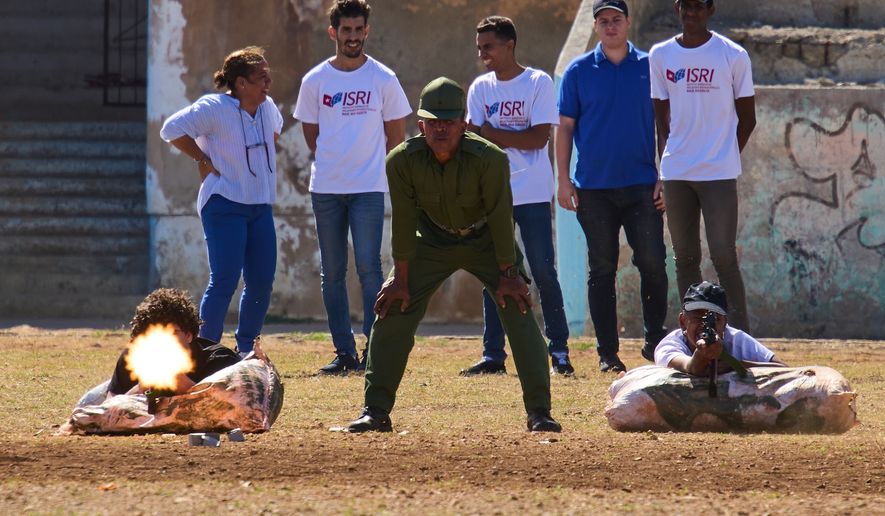

A U.S. military operation against Cuba — whose armed forces are badly outmatched and reliant on outdated defense equipment — could be simpler and more straightforward than the high-stakes raid in January to capture Venezuelan President Nicolas Maduro in Caracas.
Yet success is not guaranteed, beyond whatever short-term military objectives President Trump outlines. Also, U.S. action could spark unintended geopolitical consequences, leading to a major humanitarian emergency and migration crisis in America’s backyard while fueling anti-U.S. sentiment across the hemisphere and driving some regional governments closer to China.
Defense Secretary Pete Hegseth visited a key American military post in Cuba on Wednesday and signaled that the Pentagon is ready for potential action.
People were interested in these podcasts
“What happens with the future of Cuba is in the hands of the president of the United States and the leadership of Cuba,” Mr. Hegseth told U.S. troops stationed at Naval Station Guantanamo Bay. “No matter what, the Department of War is going to be prepared and postured for any possible contingency.”
Military analysts and Pentagon insiders say that if the Trump administration’s intense economic pressure campaign on Cuba ultimately leads to military intervention, decision-makers must not assume the mission will play out as quickly and smoothly as the Maduro raid.
The campaign is championed by Secretary of State Marco Rubio, a Cuban American and widely considered one of Washington’s leading foreign policy hawks on the island nation.
If the U.S. undertakes a decapitation strike targeting Raul Castro or other key political figures, Cuba’s cohesive, top-down Communist Party political structure means the Trump administration would struggle to find an alternative leader in Havana willing to negotiate.
A figure such as Venezuelan Vice President Delcy Rodriguez, who quickly stepped in to replace Mr. Maduro and implement policies demanded by Washington, does not seem to exist in Havana.
Furthermore, some specialists say there does not appear to be a clear opposition figure ready to take over a new government in Havana.
That makes any long-term U.S. objectives murkier and raises questions about whether a quick, limited military operation would achieve the lasting change Mr. Rubio and others have long sought in Cuba.
“Say what you will about Cuba, but the truth is it really was a revolutionary government. Cuba truly is socialist,” said Christopher Sabatini, senior fellow for Latin America at Chatham House, a leading think tank based in London.
“You have a government in Cuba that is much more cohesive, a much tighter ruling circle and much more vertical — and a military that’s much more loyal to that model,” Mr. Sabatini said in an interview. “Those [political and military] fractures and the corruption that made Venezuela so relatively easy, they do not exist in Cuba.
“Any military action would have to confront a much more coherent, vertical and tightly integrated ruling class, a clique, in Cuba,” he said. “It’s very difficult to imagine where those fissures are” for the U.S. to exploit.
Weighing the risks
The U.S. has maintained a comprehensive economic embargo on Cuba since the 1960s. The Trump administration tightened sanctions on Cuba as part of its pressure campaign against Cuban President Miguel Diaz-Canel and his government.
That tightening has deployed threats of retaliatory tariffs and aggressive sanctions designed to choke off energy shipments to Cuba.
As a result, Havana is in the midst of its worst energy crisis in decades and has experienced multiple nationwide blackouts this year. Just a single Russian tanker is believed to have delivered oil to the island since January.
In March, Mr. Trump said he believes he will have “the honor of taking Cuba,” a clear indication that he believes the U.S. under his watch will finally bring about the end of the communist regime in Havana.
Cuba’s close ties with U.S. adversaries Russia and China are a key factor driving the Trump administration’s calculus. Both countries are believed to have multiple signals intelligence operations based on the island.
Yet if the U.S. economic pressure campaign fails, the administration might decide that a limited military operation is the only viable option.
That option has many pros and cons.
On the negative side, any U.S. military action could further destabilize a country already unable to provide some basic goods and services for its citizens. In a worst-case scenario, American troops on the ground might be needed to prevent a total societal collapse.
The U.S. military outpost at Guantanamo Bay could face the threat of guerrilla-style attacks from Cuban security forces looking to exact whatever toll they can on the U.S.
Symbolically, analysts say there is no single Cuban leader whose capture and extradition would carry the same gravitas as the images of Mr. Maduro in handcuffs earlier this year. That includes the 94-year-old Raul Castro, the younger brother of the late Fidel Castro and recent target of a Justice Department indictment for his alleged role in the 1996 shoot-down of two civilian American aircraft.
In addition, some specialists believe that U.S. military action would have the opposite of its intended effect.
“Cubans want and deserve change, but a Maduro-style extraction mission, limited strikes against military targets, or a full-scale invasion of the island are all likely to further delay and obstruct that change from occurring, and thus should be avoided on humanitarian, legal and strategic grounds,” Lee Schlenker, a research associate with the Global South program at the Quincy Institute for Responsible Statecraft, said in recent comments circulated to reporters.
No match for the U.S.
From a strictly military planning perspective, a Cuba mission could be appealing.
Military insiders say Cuba’s military equipment and national infrastructure are in far worse condition than Venezuela’s. There is no evidence that its security forces would fare any better than Venezuela’s against an overwhelming onslaught of American military power. The proximity means the Pentagon could launch a Cuba operation from bases on American shores or in the waters immediately off the coast.
Venezuela boasted more modern air defense systems than Cuba, but even those were no match for the U.S. military. Cuba’s Soviet-era S-125 surface-to-air missile system would likely be destroyed easily. Cuba reportedly has few, if any, operational fixed-wing fighter jets, with its inventory of Soviet-era planes desperately in need of maintenance.
A major U.S. ground operation looks unlikely, but if such a scenario materialized, Cuba’s Soviet-era tanks and armored vehicles would be neutralized quickly.
Specialists generally agree that Cuba poses less of a threat to American troops than the forces of either Venezuela or Iran, both of which have clashed with the U.S. military in recent months.
“Cuba is unable to impose costs upon the United States militarily and economically in the same way as Iran. The Cuban armed forces are weak, their equipment is woefully out of date, and their long-range strike capabilities are severely limited,” researchers with the Center for Strategic and International Studies wrote in a recent in-depth analysis of American military options on Cuba.
“While reports that the country has acquired hundreds of Russian military drones suggest that Cuba may be seeking to acquire an asymmetric capability against the United States, the 300 units allegedly received are orders of magnitude less than what would be needed to credibly close the Straits of Florida or threaten U.S. critical infrastructure on the mainland,” reads part of the analysis, written by acting Director of the CSIS Americas Program Christopher Hernandez-Roy, CSIS senior adviser Mark F. Cancian and Americas Program fellow Henry Ziemer. Other reports indicate Cuba has also received drones from Iran.
Yet their analysis also questioned whether any military options — including airstrikes or decapitation missions targeting Mr. Diaz-Canel or Mr. Castro — would achieve the level of change desired.
“As occurred in Iran, the most likely immediate outcome would not be quick regime collapse but instead a hard-line response led by the Communist Party,” and other government institutions, they wrote.
Contact the author

Please read our comment policy before commenting.