


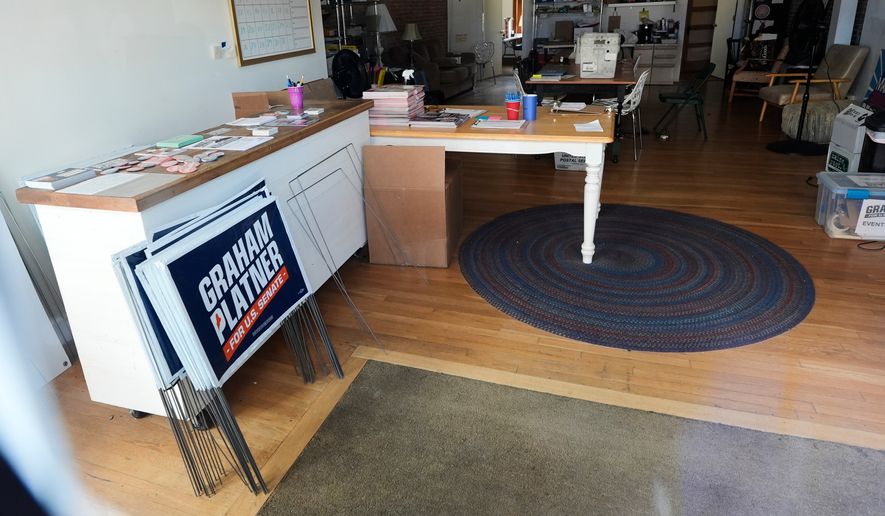

Graham Platner’s exit from the U.S. Senate race in Maine after a woman accused him of rape had Democrats scrambling Thursday to find a replacement candidate and repair the damage to the party.
The recriminations came fast. Party strategists and activists faulted Mr. Platner’s inner circle for brushing aside years of warning signs, including a Nazi symbol tattoo and sexist and racially charged social media posts, only for the campaign to implode at the worst possible moment.
The collapse has jeopardized Democrats’ hopes of unseating Sen. Susan M. Collins and winning control of the Senate.
People were interested in these podcasts
The Maine Democratic Party is scrambling to pick up the pieces and plans to convene a nomination convention before July 27. The details were still being hammered out Thursday as contenders jumped in.
Nirav Shah, who finished second in the gubernatorial primary last month, became the latest Democrat to announce, promising to fight for “Medicare for All,” higher taxes on billionaires, limits on Immigration and Customs Enforcement and an end to President Trump’s “reckless foreign wars.”
“This race is not about one person or one seat. It is about everyday Mainers,” he said in a video announcement. “I’ve shown up and fought for you before, and I am ready to do it again.”
SEE ALSO: Platner ends whirlwind Senate bid after rape allegation
Mr. Platner’s campaign crumbled barely a month after he dominated the Democratic primary with more than 154,000 votes, roughly 72% of the total. Gov. Janet Mills, the presumptive runner‑up, abandoned her campaign in April after concluding she could not defeat Mr. Platner.
Everything unraveled for Mr. Platner this week after Jenny Racicot, a 41‑year‑old Maine resident and a former girlfriend, told Politico that he forced her to have sex in 2021 after showing up drunk at her home.
Mr. Platner denied the allegation, but his left‑wing coalition, including Sen. Bernard Sanders, quickly disintegrated. He bowed out in a defiant video blaming the shadowy Washington establishment for cutting off his campaign’s access to fundraising and voter data.
“They would rather see Susan Collins win,” he said.

Under Maine law, Democrats can remove Mr. Platner from the November ballot only if he formally withdraws by Monday, which would give the party a two‑week window to name a replacement.
Republicans said Mr. Platner was already losing.
Dave Carney, a strategist advising Ms. Collins, said the five-term senator had been quietly building a working‑class coalition.
“Quite honestly, I think that is why so many people were willing to throw him over the boat because he was stinking like a dead fish,” Mr. Carney said.
Inside Democratic circles, frustration is now aimed at Dan Moraff and Leanne Fan, left‑wing activists who helped elevate the former Marine and oyster farmer from obscurity. Others fault Morris Katz, the 27-year-old New York strategist celebrated for helping Zohran Mamdani win the 2025 New York mayoral race.
Mr. Moraff told The Wall Street Journal this year that he knew about some of Mr. Platner’s personal baggage, including inflammatory Reddit posts about drunk women and the tipping habits of Black people. Still, he said he believed voters wanted “real human beings” rather than “candidates grown in vats.”
That theory held until the rape allegation surfaced.
Indeed, Mr. Platner had weathered scrutiny over the tattoo he felt obliged to cover up, sexual text messages to women while married, and accounts from former girlfriends describing unsettling behavior.
Mr. Carney attributed Democrats’ willingness to ignore the red flags to their “blind hatred” of President Trump.
“Most candidates, one of these controversies, would have ended it; he had 12,” said Mr. Carney, adding that Republicans were sitting on other controversies from Mr. Platner’s past. “There is a lot more, and this guy, I am not sure if his mother will even buy his oysters anymore.”
Nicholas Jacobs, a political scientist at Colby College, said Mr. Platner’s movement treated his scandals as proof of establishment persecution — a hallmark of populist politics.
“Every scandal, it didn’t seem to be Platner’s fault; it was evidence of everyone being against the movement,” Mr. Jacobs said.
National Democrats are now weighing whether they can win the Senate majority without flipping Maine, or whether a brutal national environment for Republicans, driven by war with Iran, inflation and high gas prices, could still topple Ms. Collins.
For Maine Democrats, the mess is immediate. They are rushing to assemble a convention for a divided party, evoking memories of the hurried process that elevated Kamala Harris to the top of the 2024 Democratic ticket.
The candidate scramble began immediately after Mr. Platner announced his withdrawal from the race.
In addition to Mr. Shah, former state Senate President Troy Jackson, a fifth‑generation logger and past gubernatorial candidate, jumped in, saying Democrats must honor the movement behind Platner.
“Defeating Susan Collins in November is nonnegotiable — and I’m all in,” Mr. Jackson said in a fundraising email.
He has long been a favorite of the far left and quickly secured the backing of Rep. Ro Khanna of California, who previously endorsed Mr. Platner.
Jordan Wood, who recently lost the 2nd Congressional District primary, is also running. Dan Kleban, co‑founder of Maine Beer Co., who briefly ran for U.S. Senate this year before endorsing Ms. Mills, joined the race as well.
“It’s time for a new generation of leadership in Washington, one that’s not beholden to the establishment that has failed us time and again,” Mr. Kleban said in a statement.
Maine Secretary of State Shenna Bellows, who also announced that she was running, said she would fight for working people and stand up against a “broken system that’s working against us.”
Mr. Carney mocked the emerging field, pointing out their recent struggles in primaries.
“Apparently, for Maine Democrats, if you are not a loser, you are not on the list,” he said.
Please read our comment policy before commenting.