


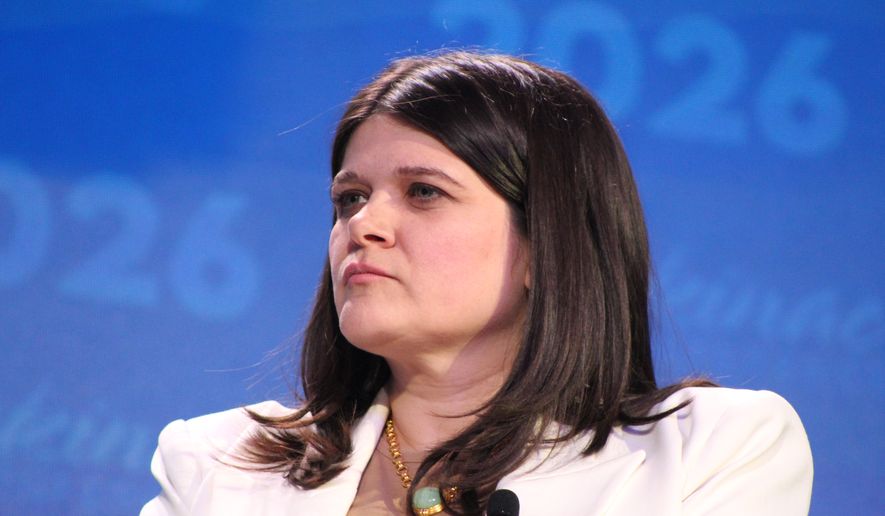

U.S. Senate candidate Haley Stevens is out to prove that a Democrat can stand with Israel in defiance of liberal activists and still win the party’s nomination.
In Michigan’s closely watched primary, the Rochester Hills native and four-term congresswoman is betting that the traditional pro‑Israel posture that has defined Democratic foreign policy for decades remains viable — even as the party’s left wing moves sharply in the opposite direction in the wake of the Israel-Hamas war in the Gaza Strip.
Ms. Stevens’ opponent, Abdul El‑Sayed, said the pro-Israel era is over. The Detroit-area native and son of Egyptian immigrants has made the American Israel Public Affairs Committee’s multimillion‑dollar spending in the race the centerpiece of his argument. He casts Ms. Stevens as part of a Washington culture in which corporate influence and foreign‑aligned interests receive more attention than voters worried about groceries, rent or medical bills.
People were interested in these podcasts
“For too long our foreign policy has been handed to us by the likes of the State of Israel and AIPAC, which has made sure that Democrats and Republicans are doing their bidding,” he said. “So long as our politicians continue to be bought off by AIPAC, do not be surprised when we fight wars that are in their best interest — to annex Lebanon or to do genocide in Gaza.”
Their clash reflects a deeper question confronting Democrats nationwide: whether the party’s long‑standing support for Israel can survive a base increasingly skeptical of the U.S.-Israel relationship.
Polls show Democratic support for Israel has slipped nearly three years after Hamas’ Oct. 7, 2023, terrorist attack that left 1,200 people dead in Israel and 251 hostages taken back to Gaza. The Israeli response has led to the deaths of more than 73,000 Palestinians in Gaza, according to the Hamas‑run Gaza Health Ministry.
An AP‑NORC survey conducted from June 11-17 and released July 7 found nearly 6 in 10 Democrats and more than half of Jewish Democrats say the U.S. is “too supportive of Israel.”
Ms. Stevens and Mr. El‑Sayed are navigating those tensions in sharply different ways as they seek to replace retiring Sen. Gary Peters, a Democrat.
After at first staying neutral in the primary race, Mr. Peters endorsed Ms. Stevens.
“Michigan — and the country — can’t afford to lose this seat,” Mr. Peters said on social media, describing Ms. Stevens as “the fighter we need” with “the record to back it up.”
The endorsement further cemented Ms. Stevens’ place in the party’s establishment wing — Democrats who contend that backing Israel and a two‑state solution remains a broadly electable position with moderates, Jewish voters and independents in a state such as Michigan.
“The difference between my opponent and myself on this issue is that I believe in a two-state solution,” she said. “I can say that Israel has a right to peacefully exist alongside the people of Palestine and in Gaza.”
She has hammered home the idea that supporting Israel does not mean supporting the current government. She said she supports humanitarian aid and that Israeli Prime Minister Benjamin Netanyahu “has not made us safer, has not brought us closer to peace, and he’s endangered Jews here in America and around the world.”
Mr. El‑Sayed dismissed Ms. Stevens’ criticism of Mr. Netanyahu as political posturing. He said it was meant to blunt backlash from the party’s left. Mr. Netanyahu criticized her on July 7 on CNN, saying her remarks were “probably trying to excuse antisemitism.”
“I don’t think Benjamin Netanyahu is attacking her to actually attack her; I think he’s attacking her to try and steer away the stink of how staunchly she stands for their policy,” Mr. El‑Sayed said.
He tied Israeli policy to broader themes of corruption and inequality, saying AIPAC’s spending reflects a political culture in which “corporations are buying politicians” and “foreign‑aligned interests” get more attention than people struggling to pay their bills. He has gone further than most mainstream Democrats, saying the United States “cannot continue to sell weapons to a country that is doing human rights abuses, genocide and apartheid.”
“The problem with a two-state solution,” he said, “is that our policy has been to subsidize the Israeli military to the tune of billions of your tax dollars every single year, and their goal is to foreclose on the possibility of a Palestinian state.”
That message has helped liberal candidates win deep‑blue House districts this year, but Michigan is a battleground where Democrats have lost two of the past three presidential contests and where party leaders believe a more traditional foreign policy posture is essential to winning statewide.
The Stevens-El‑Sayed clash is the latest example of how the expanding split over Israel has reshaped Democratic politics and is expected to be a dividing line in the party’s 2028 presidential nomination race.
That was on display last week when Rahm Emanuel, a potential contender for the Democratic nomination, told a crowd at Tel Aviv University that the alliance between the two nations was at a “crossroads.”
“You cannot fight indefinitely against a world that has stopped believing you have the right to fight,” said Mr. Emanuel, who is Jewish. “You must instead find a new sustainable path to peace, security and economic prosperity.”
In Michigan, Republicans say the Israel debate will follow Democrats into the general election, no matter who emerges from the primary.
If Ms. Stevens wins, she could struggle to energize the left wing of the party, including members of the state’s large Arab American and Muslim communities that protested the Biden administration’s support for Israel during the war in Gaza.
“The risk for Stevens is that using support for Israel against El-Sayed could very easily be seen as an anti-Arab or anti-Muslim play to win the primary,” said former Michigan Republican Party Chair Saul Anuzis. “Those same voters who supported El-Sayed could pull a ‘Biden strategy’ and not vote, or a percentage could come over and vote for a Republican they are comfortable with.”
Analysts blamed Kamala Harris’ 2024 loss to Donald Trump in Michigan partly on Arab American, Muslim and young liberal voters — concentrated in Dearborn and Detroit — who refused to back her because she did not break with President Biden on Israel. Republicans expect those tensions to resurface in November if Ms. Stevens is the nominee.
Conversely, an El‑Sayed victory would give Republicans a different opening. They believe his criticism of Israel would play directly into the hands of Mike Rogers, the former congressman and chairman of the House Permanent Select Committee on Intelligence, who is the leading Republican candidate, allowing him to frame the race as a choice between stability and unpredictability at a moment when global conflicts abound.
Please read our comment policy before commenting.