



OPINION:
It was not picked up by major U.S. news outlets, but it should have been.
Speaking last week at an annual Israeli security summit in Herzliya, a city just a few miles north of Tel Aviv, Maj. Gen. Amir Baram, director general of Israel’s defense ministry, laid out the geopolitical way forward — not just for Israel but also for Washington.
“The state of Israel must prepare through tailored force buildup and advance a new regional architecture, first and foremost with our strategic ally, the United States, and with others,” Gen. Baram told attendees at the Herzliya Conference at Reichman University.
People were interested in these podcasts
Gen. Baram made the remarks at a critical time in the Middle East and beyond.
As Turkey hosts the NATO summit this week after weeks of crackdowns on free speech and the arrests of hundreds of people, President Recep Tayyip Erdogan and his government seem intent on reviving the Ottoman Empire.
Israel and Lebanon have signed yet another ceasefire agreement. Beirut, which has failed by any measure to stop Hezbollah, is evidently relying on its Jewish neighbor to take care of the terrorist group.
Meanwhile, Iran has insisted that there can be no long-term peace in Lebanon without Tehran’s participation. So enmeshed are the mullahs and the Islamic Revolutionary Guard Corps with the terrorist organization they back that Hezbollah even reportedly pushed the regime to make the ending of Israel’s strikes on the group a condition of the U.S.-Iran peace deal.
Washington seems increasingly at a loss for what to do next with Iran.
Last month, President Trump praised the Iranian leaders, calling them “smart” and “very rational people.” Yet just weeks later, after Iran violated the agreement by attacking ships trying to transit the Strait of Hormuz, Mr. Trump threatened to “finish the job” of eliminating Iran if the country did not start adhering to the deal. For now, the shaky memorandum stands.
Who will make the next move? Gen. Baram said it ought to be Israel.
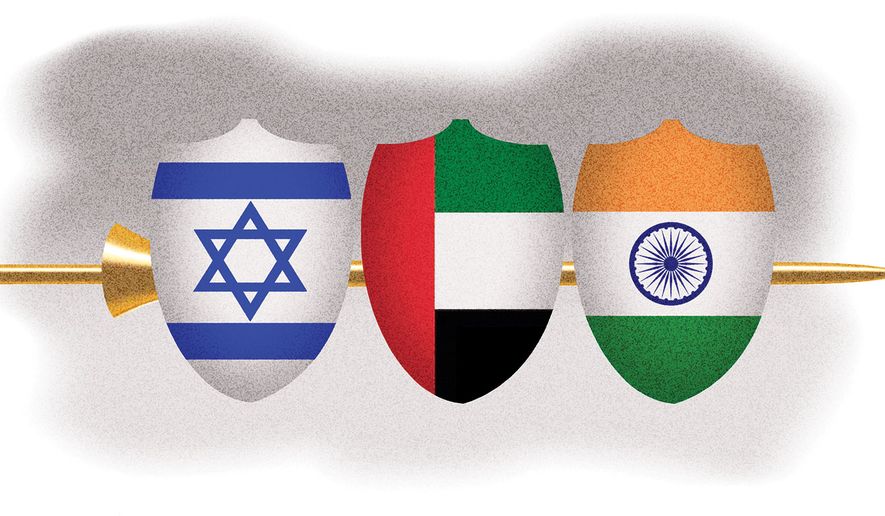
Israel’s new alliance should extend “from India through the UAE to Greece and Cyprus,” Gen. Baram said. “Israel’s strengths in technology, proven operational experience and defense innovation, combined with the Gulf’s financial power, could enable a new security-economic front.”
He is right. The 12-day war with Iran left Israel in a better reputational position with its neighbors. It now wields more influence in the Arab world, according to some top Israeli defense officials. It should consider using that improved position to create a new partnership.
As for India, it is a natural ally of Israel. Speaking to Fox News on Sunday, Israeli Prime Minister Benjamin Netanyahu said India, which relies heavily on Israeli arms, gives the Jewish state “tremendous support.”
In 2017, Narendra Modi became the first Indian prime minister to visit Israel. Mr. Modi visited again this year.
The reason for much of this backing is relatively recent. Israel was the only country to assist India directly in the 1999 Kargil War with Pakistan. By delivering much-needed munitions and missiles for fighter jets, Israel was instrumental in India’s victory in the conflict.
More recently, India and Israel have increased their technological, agricultural, trade and cybersecurity ties. In the coming years, those ties are likely to grow.
The 12-day war also reinforced the Greece-Cyprus-Israel bond. Earlier this year, the three countries made a pact to expand defense cooperation, as they share a common enemy: the Iranian regime.
Though the Iran quagmire continues, the U.S. may soon be forced to turn its attention more fully to China, which it has tried to place on the back burner.
Chinese naval activity in the Western Pacific is growing, making Taiwan nervous. South Korea’s left-wing government, with reported ties to the Chinese Communist Party, is tightening its chokehold on religious liberty and ramping up discrimination against U.S.-owned businesses.
As Gen. Baram said at Reichman, “The difference between [the U.S. and Israel] is not in how we understand the threat, but in our priorities. For us, Iran is an existential threat; for the United States, it is a chronic regional challenge, while China and the Indo-Pacific theater remain the core concern. We think Tehran, they think Taiwan. … A strong, independent, and proactive Israel that stabilizes the Middle East is the very asset that allows the United States to redirect resources toward Asia.”
Maybe the Trump administration should focus some of its energy on helping its strongest Middle East ally forge and deepen these new networks. Doing so will help it too.
• Anath Hartmann is deputy commentary editor for The Washington Times.
Follow the author

Please read our comment policy before commenting.