


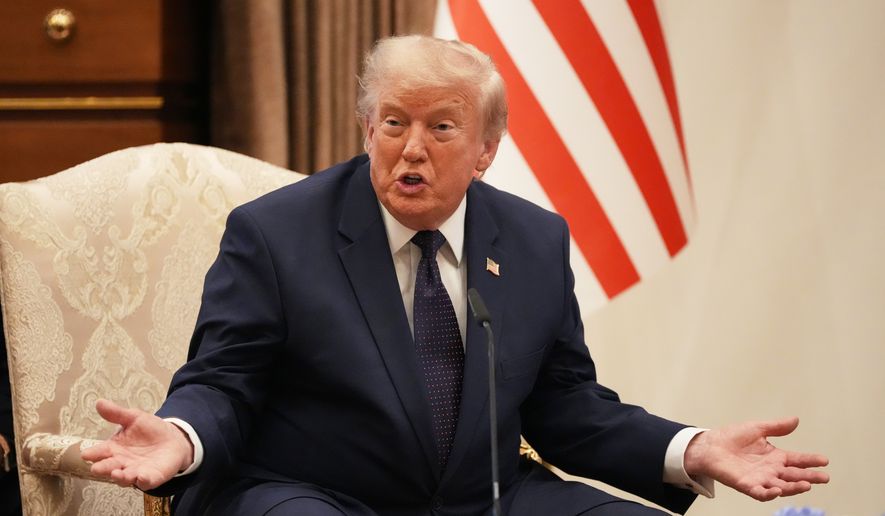

President Trump is backing the House Republican leadership’s plan to use the filibuster-proof budget reconciliation process to pass portions of the SAVE America Act after an initially cool reception to the idea.
In a Truth Social post Tuesday, Mr. Trump urged Republican leaders to make the budget package — dubbed “reconciliation 3.0” because it would be the third such effort this Congress — their No. 1 priority.
“The SAVE AMERICA ACT, which everyone is asking for, paired with the full funding of our Great Department of War, can be passed very quickly, ensuring that the United States of America stays FREE for Generations to come,” he said on social media.
People were interested in these podcasts
The president’s push to use the reconciliation process to pass the SAVE America Act is a slight reversal. Mr. Trump has been urging Senate Republicans to scrap the chamber’s 60-vote threshold to clear a filibuster or to use the talking filibuster rules to circumvent it.
Asked last month whether he would consider using reconciliation to pass some pieces of the bill, Mr. Trump said, “No, not really.”
House Speaker Mike Johnson, Louisiana Republican, who has been pitching the reconciliation strategy for weeks, appears to have persuaded the president to get on board.
Because policies enacted through reconciliation must have a budgetary impact, Mr. Johnson has floated creating a grant program that would give states a financial incentive to adopt requirements that Americans must show proof of citizenship to register to vote and a photo ID to cast a ballot.
Some Republicans have argued that this would take the teeth out of the legislation, as states could simply decline to participate.
Mr. Trump’s post did not address the grant program idea or otherwise specify which pieces of the SAVE America Act must be included in the reconciliation package.
The House-passed version of the bill that has stalled in the Senate amid a Democratic filibuster and opposition from a few Republican senators did not include a ban on universal mail-in ballots or certain transgender policies that Mr. Trump has sought.
Mr. Johnson said he believes the president is willing to forgo those priorities if Republicans can pass proof of citizenship and voter ID requirements.
“He would like to add the prohibition of mail-in balloting, except for exceptions like if somebody is deployed overseas or they’re ill or can’t get to the polling place, but he understands that one is a bigger reach,” the speaker said on “Fox News Sunday.”
“If we can get proof of citizenship and photo ID to vote, that eliminates so much of the problem, all the fraud and everything that everybody’s concerned about in our elections, particularly, frankly, in these blue states,” Mr. Johnson said.
The president also wants the reconciliation package to include $350 billion for defense needs.
The fiscal 2027 budget request he sent to Congress earlier this year asked for lawmakers to provide a total of $1.5 trillion for defense, roughly $1.1 trillion from annual discretionary appropriations and the remainder in mandatory appropriations passed through the budget reconciliation process.
His social media post Tuesday reiterated the latter but did not factor in the $67 billion in supplemental appropriations for the Defense Department that the administration requested last month to address operational costs of the Iran war.
“Our Military’s unmatched POWER was on full display during our Celebration of 250 Years of American Independence and, like our Country, the WAR DEPARTMENT has never been ’HOTTER.’ We need to keep it that way,” Mr. Trump said.
He said he wants Congress to kick off the reconciliation 3.0 process once Congress returns next week from the extended July Fourth recess.
The first step is for the House and Senate to adopt identical budget resolutions with reconciliation instructions for the committees that craft the package.
House Budget Committee Chairman Jodey Arrington, Texas Republican, told reporters that the Republican conference was “at least 80% there” in terms of being ready to adopt a budget for the reconciliation 3.0 bill.
“I think the preponderance of hang-up and discussion time is around pay-fors,” he said.
Senate Majority Leader John Thune, South Dakota Republican, and others in his conference have been skeptical about the chances of passing a third reconciliation bill this close to the November midterm elections because it requires party unity.
Although the notion of boosting defense funding unites Republicans, how to pay for it does not.
Mr. Johnson said he thinks the Senate skepticism stems from speculation about what the House may include in the bill. He said that speculation is unfounded and that his chamber plans to pass a reconciliation package “that will be irresistible for any Republican.”
“We will continue to increase affordability, we’ll reduce fraud, waste and abuse in government, and we’ll secure elections,” the speaker said. “Every Republican would vote for that if packaged correctly, and that’s what we’re planning to do right now.”
Contact the author

Please read our comment policy before commenting.