


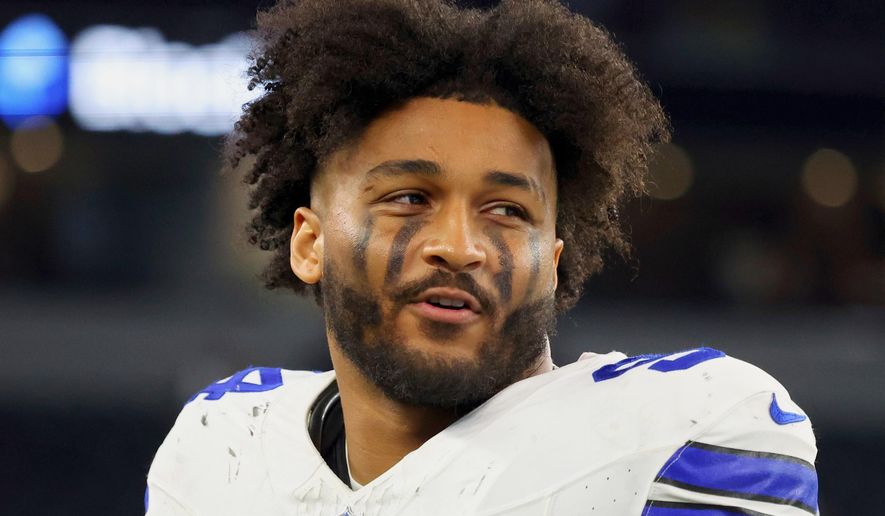

Former Dallas Cowboys defensive end Marshawn Kneeland had stage 1 chronic traumatic encephalopathy when he died by suicide in November, researchers from the Concussion & CTE Foundation announced Tuesday.
Kneeland, who was in the middle of his second season with the Cowboys, died of an apparent self-inflicted gunshot wound following a police chase in Texas. Authorities reported that the 24-year-old expressed “suicidal ideations” prior to his death.
“Unfortunately, I was not surprised to find CTE in the brain of Mr. Kneeland, because we have found this progressive brain disease in nearly half of the athletes we’ve studied who have died before the age of 30,” Dr. Ann McKee, director of the Boston University CTE Center, said in a statement.
People were interested in these podcasts
CTE which features four worsening stages in living patients. It has widely been linked to the repeated head injuries commonplace on football fields across the country. A 2017 study diagnosed CTE in 110 of 111 deceased NFL players who had donated their brains for study.
Symptoms of the degenerative disease include memory loss, aggression, depression and impaired judgment or impulse control. It has not been officially listed as a risk factor for suicide.
Since the NFL first acknowledged the link between football and CTE in 2009, the league has issued stricter guidelines for concussion protocols and helmet requirements. Researchers worry they aren’t enough.
“We have no reason to believe the current generation is at a lower risk of CTE than previous generations. Concussion protocols do not prevent CTE, because CTE is caused by repeated head impacts, not just concussions,” Concussion & CTE Foundation CEO Chris Nowinski said. “If we want to reduce CTE risk, we must implement CTE prevention protocols and aggressively reduce the number and strength of head impacts at every level of the game.”
Kneeland’s family has requested privacy throughout the process. His girlfriend, Catalina Mancera, gave birth to the couple’s child last month.
“While this diagnosis does not change the tragedy of his passing, it provides important context about some of the struggles he may have been facing,” Mancera and the Kneeland family said in a statement. “We share this information to help people understand what NFL and other high contact sport athletes might be struggling with. Raising awareness is important to us.”
Kneeland was fondly remembered by his NFL and college teammates following his death. The Cowboys wore his No. 94 on a helmet decal throughout the season, warmed up in Kneeland shirts after his death and hung his jersey in the locker room.
“We’re playing for him. … Our brother is on the sideline with us, whether it’s physical or spiritually. He’s there,” Cowboys defensive tackle Osa Odighizuwa said in Dallas’ first game after Kneeland’s death. “Having his jersey there, that’s the least we could do. We already know Marshawn is out there on the field with us.”
Contact the author

Please read our comment policy before commenting.