



A version of this story appeared in the daily Threat Status newsletter from The Washington Times. Click here to receive Threat Status delivered directly to your inbox each weekday.
SEOUL, South Korea — A spirited South Korean bid to supply 12 Arctic-capable diesel-electric submarines for the Royal Canadian Navy lost out to a German pitch Monday, as Canadian Prime Minister Mark Carney prioritizes links with NATO over ties to Indo-Pacific partners.
The loss did not stop South Korean President Lee Jae Myung from proposing, one day later at the NATO summit in Ankara, Turkey, a “South Korea-NATO defense industry partnership 2.0,” involving not only arms exchanges but joint research, production and operation of weapons systems.
South Korea’s arms industry has benefited from global instability and conflict, selling weapons to NATO nations fearful of both the Russian threat and concerned about a U.S. drawback from the alliance.
People were interested in these podcasts
South Korea has also seen its air-defense systems, exported to the United Arab Emirates, earn combat credentials in the recent Middle East war.
Even so, NATO is a double-edged sword for Seoul: Alliance members are not just customers, they are also competitors.
French, Spanish and Swedish bidders failed to make the final, two-player shortlist.
But on Monday, after a monthslong marketing campaign by both prospective sellers, Germany’s ThyssenKrupp Marine Systems was named preferred bidder over a South Korean consortium comprising Hanwha Ocean and HD Hyundai Heavy Industries.
TKMS will now enter detailed negotiations with Ottawa on matters including costing, delivery timelines and after-sales services.
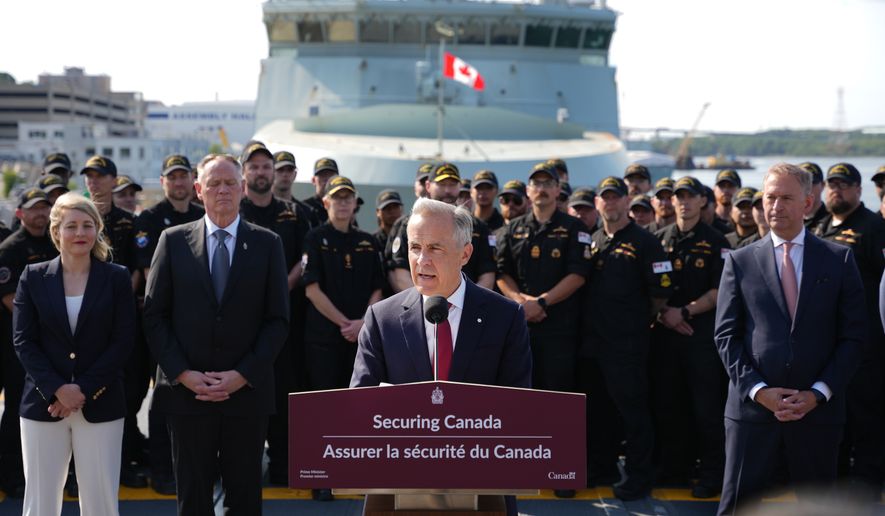
Mr. Carney said in a news announcement that the deal is “the largest defense procurement in Canadian history.”
Canada operates four aging, British-built subs. Only one is operational.
The price for 12 new subs had been estimated by defense pundits at as much as $24 billion. Maintenance and upkeep over the next 50 years adds additional costs, variously estimated at $28 billion to $56 billion.
Canada has both Atlantic and Pacific coastlines, but it was the NATO country that won the bid.
“The procurement will bolster Canadian security through a platform shared by Germany and Norway, two of Canada’s closest allies,” the communique read.
Facing determined South Korean salesmanship, TKMS muscled up its offer in May, partnering with Norway.
The TKMS Type 212CD submarine — the first boat in the class is expected to launch in 2013 — is being acquired by both the German and Norwegian navies.
That cuts costs for Canada. The more boats built, the more economical maintenance, repair and spare-part costs become for all user nations.
Berlin is engaged in an ambitious rearmament program, while Oslo shares Ottawa’s interest in Arctic security.
If talks with TKMS falter, the South Korean consortium remains a “reserve bidder,” Mr. Carney said.
Nobody could accuse South Korea — a rising force in global arms sales — of a weak bid.
The Korean consortium offered massive “offset” — technology transfer and localized manufacturing, used to incentivize arms sales — to Canada. Seoul even sailed one of its own submarines across the Pacific to Canada to give local sailors an up-close look at the offered vessel, up close.
The German win is a blow to South Korean ambitions.
After the Korean War ended, due to close military ties — a mutual defense treaty and the ongoing stationing of U.S. troops in the country — and the need for interoperability, virtually all South Korean arms imports came from U.S. armorers.
Even today, some of Seoul’s best military tech — helicopters, Patriot missiles, F15, F16 and Fe5 jet fighters — is American.
However, as the country climbed the industrial value ladder in the 1990s and early 2000s, it demanded increasing offset to build the foundation of its domestic defense industrial base. Today, that base churns out tanks, self-propelled guns, missiles, jet aircraft, destroyers and warships.
The executive of a global arms manufacturer told The Washington Times at an arms fair held outside Seoul last year, “It is rare to sell a full platform to South Korea. Now, it is mainly components.”
The nearby threat from nuclear-armed North Korea — Seoul lies just 30 miles from the Demilitarized Zone — demands massive quantities of troops and weaponry.
Unlike NATO countries, South Korea never benefited from the peace dividend granted by the implosion of the Moscow-led Warsaw Pact.
Due to its decades-long alliance with Washington, most local weapons classes — bar a handful of tanks, missiles and air-defense systems imported from Russia to pay off debts in the 1990s — are based on U.S. standards. That has allowed South Korea to create an armory of NATO-standard weaponry.
One ironic exception to U.S. influence is in submarines. Korea’s first home-grown boat, commissioned in 1993, was built to a German design.
Looking ahead, the Korean student may overcome the German master. Last year, Seoul won U.S. approval to build nuclear submarines. However, there is still no clear timeline for the process.
Regardless, South Korea’s arms industry — noted for its efficient and speedy manufacturing processes and its generous offset terms — sells massively to NATO and other nations.
According to the Stockholm Peace Research Institute, South Korea was the world’s 10th largest arms exporter in 2026. Ten years earlier, in 2016, it had been in 16th place.
Key exports include the K9 155 mm Thunder self-propelled howitzer, purchased by nations such as Australia, Egypt, Estonia, Finland, Norway, Poland and Romania. Tanks and air-defense systems are also being actively marketed overseas.
Contact the author

Please read our comment policy before commenting.