



OPINION:
Zohran Mamdani, Aber Kawas, Rashida Tlaib, Darializa Avila Chevalier. These are just some of the Democratic politicians who self-identify as both socialists and Muslims. This gives me an opportunity to acquaint you with a bit of little-known history.
We will begin in Baku, Azerbaijan, in 1904, when a Muslim social democratic party known as Hummet was organized to draw the city’s Muslim oil workers into Russia’s socialist movement. In 1920, Hummet merged with other leftist groups to form the Azerbaijan Communist Party.
By 1917, Mirsaid Sultan-Galiev, a Volga Tatar, had joined the Bolsheviks and was soon arguing that Muslim peoples, colonized by the Russian Empire, were a kind of proletariat. His ideology became known as Muslim national communism.
People were interested in these podcasts
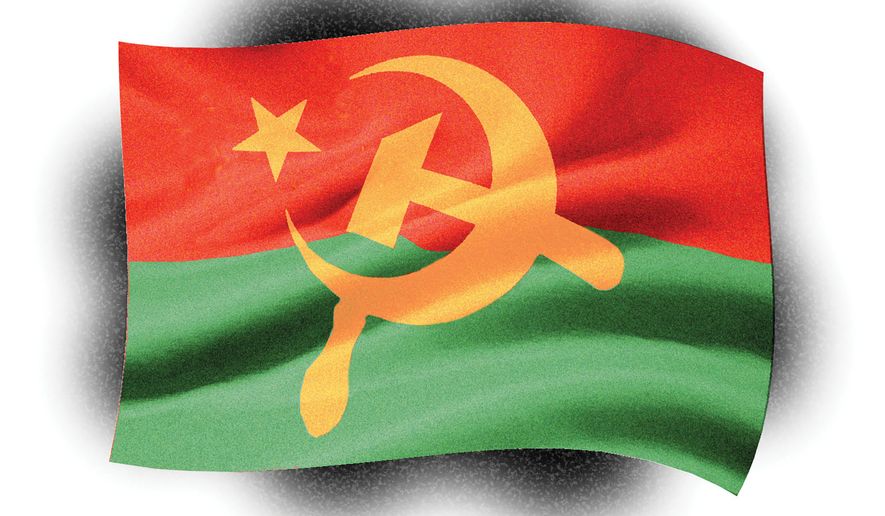
The Bolsheviks took the idea further. Portraying themselves as the world’s foremost anti-imperialists while absorbing the Muslim territories of the deposed Russian empire, they papered Central Asia with agitprop posters aimed at recruiting Muslims for the Red Cavalry.
My favorite appeared in 1919. Artist Dmitrii Moor swapped the hammer and sickle for a crescent and star and declared: “Comrade Mussulman! Under the Green Banner of the Prophet, you fought for your land and villages. But then the enemies of your people took your land. Now, under the banner of the workers’ and peasants’ revolution … join up from the east and west, north and south. Saddle up, comrades!”
This alliance did not last long. In 1923, Sultan-Galiev became one of the first senior Bolsheviks purged from the Communist Party for the crime of “bourgeois nationalism.” Josef Stalin had him shot in 1940.
For decades afterward, Soviet Central Asia was oppressed and immiserated under a regime openly hostile to all religions — even the one it had assiduously courted.
However, the idea planted by Sultan-Galiev — that Muslims and socialists were natural allies against a common enemy, Western imperialists — resurfaced a generation later after the collapse of European colonialism. It split into two camps.
In 1954, Egyptian Prime Minister Gamal Abdel Nasser, an Arab nationalist socialist who invoked Islam when it suited him, jailed and executed leaders of the Muslim Brotherhood, whose mission was then — and remains today — the reestablishment of a powerful Islamic caliphate.
After Algeria won independence in 1962, its leaders were also Arab nationalists and state socialists. Although they treated Islam as part of the national identity they were building, they had no tolerance for Islamists as independent political actors.
The fusion Sultan-Galiev had imagined found its fullest expression in Pakistan and Libya, whose leaders saw socialism and Islam as reinforcing, not rivaling, claims to legitimacy.
Zulfikar Ali Bhutto founded the Pakistan People’s Party in 1967 under the slogan “Islam is our faith, democracy is our polity, socialism is our economy.” After taking power in 1971, he nationalized banks and heavy industry, arguing that socialism reflected Islam’s commitment to social justice.
Libyan dictator Moammar Gadhafi’s 1975 Green Book proposed a “Third Universal Theory,” which rejected both capitalism and communism in favor of what he called an authentically Arab alternative: a state that was socialist in its economics and Islamic in its legitimacy.
Baathism, though it landed closer to Nasser’s camp than Gadhafi’s, may be the strangest hybrid of all. It was built by Michel Aflaq, a Greek Orthodox Christian from Damascus who studied Marxism at the Sorbonne.
He argued that Islam was the great achievement of the Arabs: a shared cultural inheritance rather than a binding theology, available to Christian and Muslim Arabs alike.
Layer onto that a Leninist vanguard party, a socialist economic program and organizational habits influenced by the European fascist movements Aflaq encountered in 1930s Paris, and you get the peculiar result that ruled Syria and Iraq for decades: a socialist one-party state, legitimized by selective borrowings from Islam and eventually ruled by strongmen.
Finally, we come to Iran. The Tudeh Party, Iran’s communist party since 1941, backed the 1979 revolution, calculating that the ruling mullahs were a useful vehicle against American power and influence.
It was a bad bet. In 1983, Ayatollah Ruhollah Khomeini’s government arrested the Tudeh’s leadership en masse, paraded General Secretary Nur al-Din Kianuri on TV to read a forced confession of treason and “espionage,” and banned the party outright.
By the mid-1980s, the socialist/communist allies of Iran’s Islamic revolutionaries were all executed, imprisoned or driven into exile.
I cannot resist mentioning Ilich Ramirez Sanchez, named after Vladimir Ilich Lenin by his Venezuelan Marxist father. Trained in Moscow, he joined the Marxist-Leninist Popular Front for the Liberation of Palestine. In the 1970s, he became known as “Carlos the Jackal,” one of the deadliest terrorists in history.
Captured in 1994, Sanchez was sentenced to life in a French prison where, in 2003, he wrote “Revolutionary Islam,” calling on “all revolutionaries, including those of the left, even atheists” to accept Islamist leadership, arguing that it was the only force capable of confronting the West after the Soviet collapse. He praised Osama bin Laden and called 9/11 a “lofty feat.” He also converted to Islam.
The Islamic socialist experiments produced dead-end economies, one-party repression and, in most of these states, Islamist movements turning against the socialist regimes that had once claimed to speak for them.
Given this history, how is it possible that Muslim socialists have now suddenly become the cool kids in the Democratic Party?
Their brand of socialism is based not on Quranic injunctions, but on whatever strikes them as “social justice” (e.g., rent control, confiscatory taxes on “the rich,” “Medicare for All,” public housing and open borders).
Their Islamic supremacism comes into play in their justification of terrorism as “resistance” and their hostility toward Israelis and Jews who don’t toe the anti-Zionist line.
History, they say, rhymes rather than repeats. If so, expect Mr. Mamdani and friends to produce one more bad verse in a bloody, century-long poem.
• Clifford D. May is founder and president of the Foundation for Defense of Democracies, a columnist for The Washington Times and host of the “Foreign Podicy” podcast.
Follow the author
Please read our comment policy before commenting.