



OPINION:
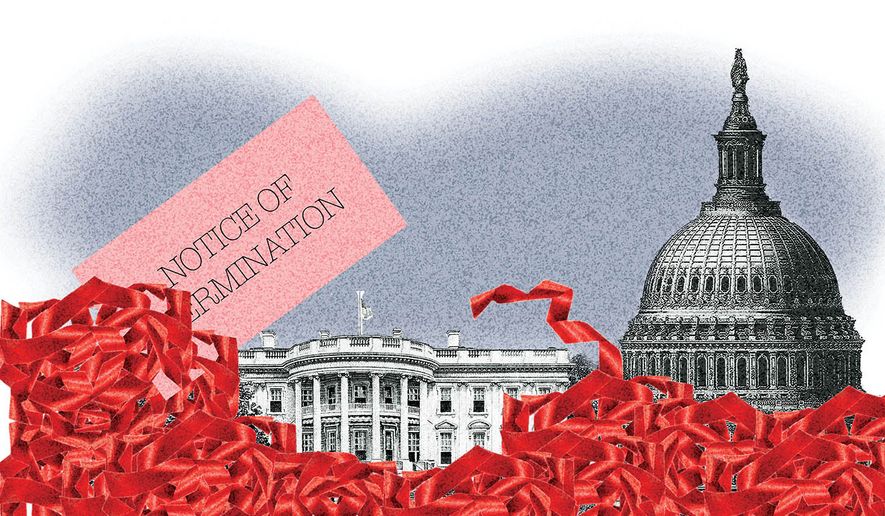
The unitary executive team had a pretty big win at the Supreme Court last week. Six justices toed the Federalist Society line and concluded that the president had the authority to fire commissioners at independent regulatory agencies (think the Securities and Exchange Commission or the Commodity Futures Trading Commission).
In Trump v. Slaughter, the court voted 6-3 that the current arrangements are unconstitutional and violate the president’s executive authority as set forth in Article II of the Constitution.
As a practical matter, this means that the president can fire all the commissioners of regulatory agencies that have provisions in their authorizing statutes requiring minimum partisan representation among their leadership.
People were interested in these podcasts
If the president exercises that authority — and that certainly seems much more likely than not — it will make those agencies more partisan and, probably, less competent.
The simple reality is that the legislatively required bipartisan nature of the independent regulatory agencies tends to ensure that alterations to their regulatory regimes are moderated and happen more slowly than many partisans might prefer.
It is probably not an accident that these agencies are uniformly considered to have the most competent workforces in the federal government.
That said, there is no doubt that the Supreme Court’s decision in Trump v. Slaughter was absolutely correct. Article II begins with the easily understood and concise charge: “The executive power shall be vested in a President of the United States of America.”
This makes it clear as can be that the president has all the executive power and that proscriptions on the composition of the leadership of executive branch agencies, which are what independent regulatory agencies are, intrude on that power.
These agencies were, for the most part, created during the Progressive era by President Wilson or his adherents. In their rush to limit presidential authority (because they did not trust the voters), the “reformers” decided against seeking the constitutional amendment that would have ensured the agencies’ structure could survive the inevitable legal challenges. So here we are.
These independent agencies will likely be folded eventually into the Cabinet departments nearest them with respect to authority and issue area. That will require changes to underlying statutes such as the Securities Exchange Act of 1934 or the Federal Power Act of 1920.
Members of Congress and the next administration will no doubt want to revisit elements of those laws beyond the architecture of the federal government and the organization charts of the agencies.
Keeping in mind that we will have a narrowly divided Congress in the foreseeable future, it is difficult to imagine that the legislative processes associated with addressing the remnants of the independent regulatory agencies and amending the statutes they oversee will be seamless and quick.
In short, there are no easy or happy endings on this particular horizon. The reformers in the early part of the 20th century left us with a mess.
Everyone who uses electricity, eats food or has a bank account is likely to suffer until we can clean it up. We may never be able to devise and implement regulatory regimes — currently under the jurisdiction of these agencies — that are both constitutional and capable of providing the stability and competency those agencies have delivered.
The court definitely did the right thing, but fixing the residual problems will likely take a long time and be very challenging.
• Michael McKenna is a contributing editor at The Washington Times.
Follow the author

Please read our comment policy before commenting.