


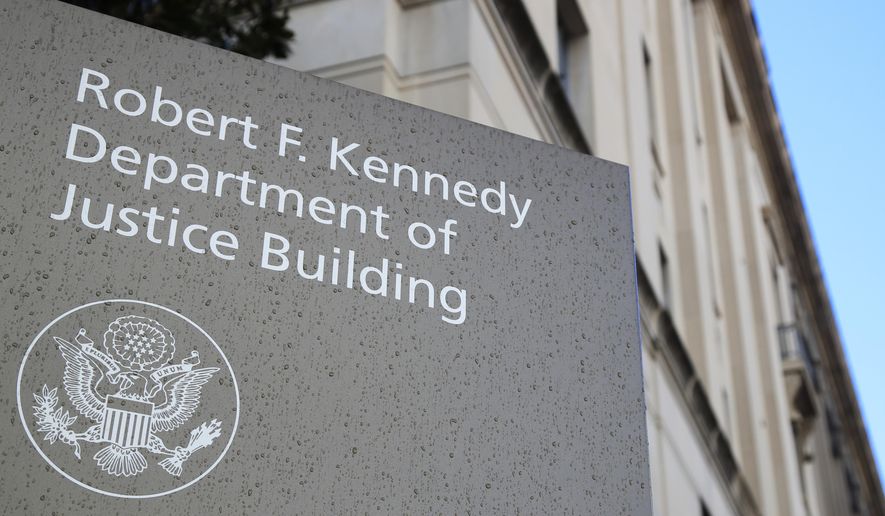

The Trump administration has brought the first case in the U.S. Alien Terrorist Removal Court, seeking to oust an Afghan woman who prosecutors say supported her son’s ISIS-inspired plot to kill people on Election Day in 2024.
The case opens a new front in President Trump’s mass deportation effort, harnessing the resources of a terrorist court created 30 years ago but never used until now.
Named in the deportation application was Nazira Haji Zada, 47, the mother of Abdullah Haji Zada and mother-in-law of Nasir Ahmad Tawhedi, two men who planned to use AK-47-style rifles for mass shootings on Election Day 2024.
People were interested in these podcasts
The Justice Department said Ms. Zada pledged her loyalty to the Islamic State group and helped radicalize other members of her family. The family sold off property to help finance the plot, the department said.
“The allegations in this case show the matriarch of an ISIS-sympathizing family aiding in a plot to launch a mass casualty attack on American voters on Election Day,” acting Attorney General Todd Blanche said.
He said alien terrorists “never should have been here in the first place.”
The case is a test run for the court, known in Washington as the ATRC.
Although it was established by law in 1996, it had never been triggered before now.
Congress wanted to create an avenue outside the usual deportation process for cases in which the government believed it needed to use classified information that would be dangerous if it were made public or revealed to the deportation target.
In court filings, the Justice Department said information being used against Ms. Zada could tip off terrorists to FBI and U.S. intelligence sources and methods.
In an order Monday, Senior U.S. District Judge Joan Ericksen, who serves as chief judge of the ATRC, said there is probable cause to allow the case into the terrorism court.
She ruled that using the regular deportation process “would pose a risk to the United States’ national security.”
Ms. Zada came to the U.S. in 2018 as the spouse of an Afghan ally — someone who had assisted in the U.S. war effort there. Her husband worked at Bagram Air Base from 2009 to 2016, according to an affidavit filed with the ATRC.
She was admitted with legal permanent residency status, which prevents the government from using classified information against her in standard deportation proceedings — prompting the move to the terrorism court.
Tawhedi had come to the U.S. as part of President Biden’s chaotic Afghan evacuation during the U.S. troop withdrawal in 2021. He was one of tens of thousands of Afghans allowed to circumvent the usual immigration system through a humanitarian “parole” program.
The other man in the plot, Ms. Zada’s son, was 17 at the time of the plot, though he pleaded guilty as an adult.
He was a legal permanent resident but, as part of his guilty plea, consented to a judicial order of removal that would terminate that status.
The two were accused of working with ISIS-K, the Afghanistan branch of ISIS.
They were arrested Oct. 7, 2024, about four weeks before the election.
Authorities said they found mountains of evidence tying Tawhedi to ISIS, including communications with an ISIS recruiter wondering whether 500 rounds of ammunition were enough; donations to a charity that funneled money to the group; and a video of Tawhedi reading martyrdom literature to his 1-year-old daughter and a nephew.
The FBI conducted a sting operation, arranging to sell weapons to Tawhedi to prove he was serious about carrying out the attack.
Authorities said their broader family had been planning to return to Afghanistan ahead of the attacks.
The case is likely to test the legality of the terrorism court.
Under ATRC rules, deportation targets cannot review the classified intelligence against them, though they are provided an unclassified summary.
Andrew “Art” Arthur, a former immigration judge who also handled terrorism cases for the old Immigration and Naturalization Service, said the court has not been used before because of the legal questions surrounding it.
In a write-up for the Center for Immigration Studies, he said that when he handled terrorism cases, they were usually able to raise the matter in regular deportation proceedings.
He also said immigration law is complex, and since the ATRC uses regular district judges, they will “be forced to learn it on the fly” under tight deadlines set in the law.
Contact the author

Please read our comment policy before commenting.