



ISTANBUL —
Iraq’s national security council on Wednesday condemned the predawn American and Saudi airstrikes that killed at least 20 members of government security forces whom the U.S. said were actually taking orders from Tehran. The council called the strikes an act of aggression.
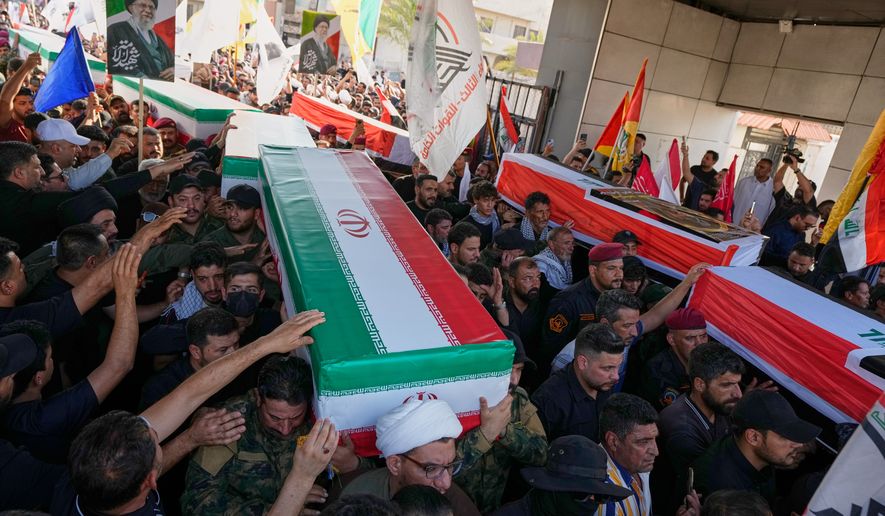
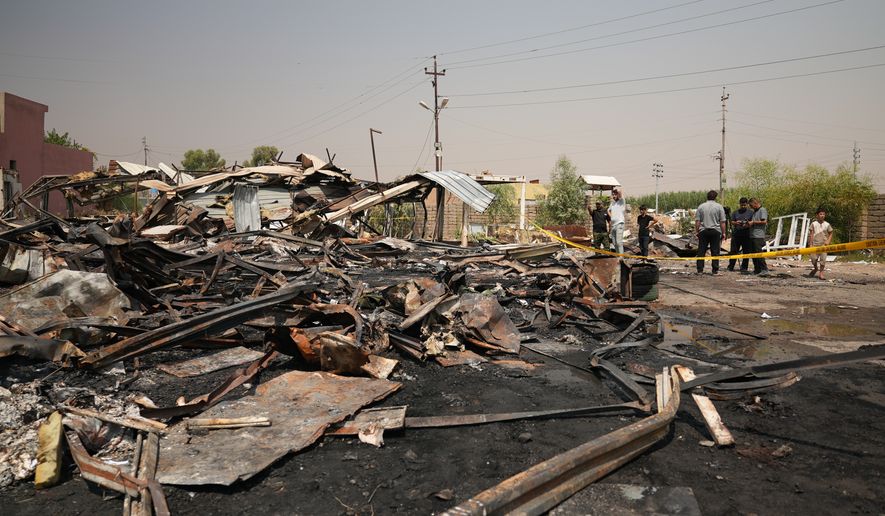
The Popular Mobilization Forces, a coalition of mostly Shiite armed groups written into Iraqi law as part of the state’s security apparatus, said in a statement carried by the Iraqi News Agency that the strikes hit the group’s official headquarters in Baghdad, Wasit, Nineveh, Basra, Kirkuk, Karbala and Diyala, killing 20 people and wounding 32.
People were interested in these podcasts
Iranian state media reported that four Islamic Revolutionary Guard Corps military advisers were killed in the strikes.
President Trump said earlier in the day that Baghdad had signed off on the joint U.S.-Saudi action.
It is the first time Saudi Arabia has claimed responsibility for striking inside Iraq since the war with Iran began in February — a pivotal development, according to Hesham Alghannam, who directs the Security Research Center at Naif Arab University for Security Sciences in Riyadh.
“Riyadh has concluded that deterrence requires visibility,” he told The Washington Times. “Covert responses were not changing the behavior of PMF formations.”
The Saudis had reportedly run earlier operations inside Iraq without acknowledging them, Mr. Alghannam said. Announcing the Wednesday airstrikes alongside U.S. Central Command, he said, “serves notice that Baghdad will be held accountable for what leaves its territory regardless of which formation launches it.”
Iraq’s Ministerial Council for National Security met under Prime Minister Ali Faleh al-Zaidi and issued a statement through spokesman Sabah al-Numan denouncing and condemning the U.S. and Saudi aggression.
According to the statement, the strikes came while the Iraqi government was working to verify and address Saudi and U.S. concerns about attacks originating on Iraqi soil.
Central Command said it struck weapons and logistics sites across eastern Iraq in response to more than 30 drone attacks over the previous 72 hours that the Americans said were directed by Iran’s Islamic Revolutionary Guard Corps. In the same statement, it put the number of attempted attacks on Americans and American facilities in Iraq at more than 600 between February and April.
The PMF’s 30th Brigade said seven strikes hit its positions in Nineveh at about 3:20 a.m., killing 10 people. Its Basra command said its headquarters was struck at 2 a.m.
The Saudi foreign ministry, in a statement carried by the Saudi Press Agency, said the operation was conducted under the right of self-defense recognized in Article 51 of the United Nations charter. The statement cited a Quranic injunction that whoever assaults you be assaulted in like measure, and said the kingdom does not seek escalation but would not hesitate to protect its sovereignty and national assets.
Mr. Alghannam said that citation is not ornamental. It is, he said, “the traditional Saudi formula for a measured but non-negotiable assertion of the right to self-defense, without foreclosing diplomacy.”
The defense ministry spokesman, Maj. Gen. Turki al-Maliki, said air defenses had destroyed drones aimed at petroleum facilities in the Eastern Province and the Riyadh region on Monday and Tuesday, and that investigations traced them to Iraqi territory.
Two days before the strikes, Mr. al-Zaidi — the 41-year-old who took over as Iraq’s prime minister in May — ordered Iraqi security agencies to investigate whether the drones had been launched from Iraqi soil.
A government source told Iraqi media that the prime minister had suspended his official visit to Riyadh as a direct response, halting arrangements for his delegation and the talks set for Thursday.
By Wednesday afternoon, Iraqi leaders began taking a harder line on foreign powers taking action while Baghdad negotiated.
Iraqi cleric Ammar al-Hakim demanded measures to prevent a repetition. The Sunni political bloc Azm called the targeting of security institutions a violation of Iraqi sovereignty and an assault on the state, and pressed the government to answer diplomatically and legally. The Coordination Framework called an emergency meeting of its own. The army chief of staff ordered units to exercise caution.
The PMF called the strikes terrorist attacks.
Harakat Hezbollah al-Nujaba, one of the factions that has consistently rejected Baghdad’s authority, including calls to disarm, said the forces of arrogance and subservience had again shown their ugly face, and that American bases in Iraq were an imminent danger to the country’s security.
The Islamic Resistance in Iraq, the umbrella name under which attacks on American positions have been claimed since February, denied launching the drones at Saudi Arabia and called the Saudi account fabricated.
Muqtada al-Sadr, whose movement sits outside the ruling Shiite alliance, took the opposite position from the factions. Unrestrained militias, he said, should not hand anyone a pretext to bomb Iraq.
All of the armed groups in Iraq are supposed to surrender weapons to the state by Sept. 30, the same day the last American forces are scheduled to leave under the transition agreement with Washington. Government spokesman Haider al-Aboudi has said any weapon outside state control after that date will be handled as unlawful.
Health Minister Abdul Hassan al-Mousawi, a figure in the ruling alliance, said in a television interview this month that four of seven factions were handing over gradually and three were refusing outright: Nujaba, Kataib Hezbollah and Kataib Sayyid al-Shuhada.
The three refusing are among those struck Wednesday.
“Baghdad is no longer assessable as a neutral theater,” Mr. Alghannam said. The relationship with Riyadh is not broken, he said, but the premise it rested on, “Baghdad as a sovereign state capable of managing its own territory, has been visibly challenged.”
What Saudi Arabia wants before the deadline, he said, is not an apology but verifiable action against the specific formations responsible. Past that date, he said, Riyadh would stop treating Iraq as a partner with a fractured state and begin treating it as “a permissive environment for Iranian proxy operations.”
The central government in Baghdad has been tested elsewhere this summer and come up short. Security forces detained 47 politicians and officials in Green Zone raids in late June, among them a deputy oil minister, Iraqi media reported. Not one militia commander was charged. The Supreme Judicial Council has since said it is working with the government on a mechanism to reduce sentences for defendants who return embezzled money, a proposal the Najaf prayer leader Sadr al-Din al-Qubanji rejected publicly as an invitation to steal more.
Kurdish leaders made Riyadh’s argument two days before Riyadh made it with aircraft. Drones that hit Irbil over the previous two or three days had come from inside Iraq, from the direction of Mosul, Kurdistan Region Prime Minister Masrour Barzani told reporters Monday, and he renewed his request that the federal government stop the sources of those threats.
Mosul is in Nineveh, where the heaviest strikes fell Wednesday.
Rudaw, a Kurdish broadcaster based in Irbil, counted 855 drones and missiles fired at the Kurdistan Region as of late May, killing 20 people and wounding 128, with 580 of them aimed at Irbil. “I strongly condemn the heinous attacks by terrorist militias targeting the U.S. Consulate General and civilian areas in Irbil,” Mr. Barzani wrote earlier in the war.
Whether the Americans are in fact leaving is its own question.
Mr. al-Zaidi told Mr. Trump at the White House this month that all remaining U.S. forces would be gone by Sept. 30. The Pentagon’s standing language is that a security cooperation relationship with Iraq continues after the transition. In December, Washington opened a 206,000-square-meter consulate in Irbil that cost about $800 million and is the largest American diplomatic facility in the world.
The money moving the other way was signed on July 17. The U.S. Chamber of Commerce said its summit produced roughly 50 agreements and memoranda of understanding between the Iraqi government and companies including Chevron, ConocoPhillips, BP, Shell, Google, Starlink, PepsiCo and JPMorgan Chase, valued at more than $60 billion. Neither the Chamber nor the Iraqi government has published a breakdown of the figure.
ConocoPhillips is taking 42% of BP’s venture redeveloping four Kirkuk oil fields. Chevron signed three agreements, two on production and one on a pipeline running across Syria to the Mediterranean.
Kirkuk and Basra were among the provinces bombed Wednesday, and Mr. Alghannam said the overlap is what Riyadh is reading. Those provinces, he said, “are also the heartland of the PMF formations that struck Saudi facilities,” which tells the Saudis that Iraq’s economic ambitions and its security apparatus “are running in opposite directions simultaneously.”
He cautioned against treating the $60 billion as committed capital. Most of it is preliminary and nonbinding, he said, “which means the economic architecture is aspirational rather than locked in.”
Iraq signed because the war emptied its treasury. The State Oil Marketing Organization reported exports of about 236 million barrels in the first four months of the year, roughly 58% of the same period a year earlier, after Iran effectively closed the Strait of Hormuz, through which Iraq ships nine barrels in 10. Mazhar Mohammed Saleh, the prime minister’s financial adviser, has put the war’s cost to the economy at $40 billion to $45 billion. Parliament has not passed a budget.
The alternatives narrowed again this week. Iran’s deputy foreign minister, Kazem Gharibabadi, said on state television that Tehran had rejected an Omani plan for shared management of Hormuz and that the strait would not return to toll-free passage. A U.S.-Saudi consortium announced it had shortlisted three sites for a $5 billion refinery and export terminal outside the strait, all in Gulf states with coastline Iran cannot close.
Iraq has none. Its pursuit of pipeline routes to the Mediterranean and into Turkey, Mr. Alghannam said, “confirms that even Iraq now treats the strait as unreliable.” Those routes run overland, through Turkey and Syria, and through the provinces bombed Wednesday.
The two September deadlines fall on the same day, which Mr. Alghannam calls the single most consequential near-term variable in the region and one drawing almost no attention proportionate to it. If the weapons handover is not enforced the day the Americans go, he said, Baghdad will have shown Riyadh, Washington and Tehran at once that it cannot control its own security apparatus.
“And that determination, once made, will restructure how all three engage with Iraq for the decade that follows.”
Please read our comment policy before commenting.