



A version of this story appeared in the daily Threat Status newsletter from The Washington Times. Click here to receive Threat Status delivered directly to your inbox each weekday.
U.S. Army leaders on Wednesday announced the successful demonstration of a more than $3 billion Next Generation Command and Control digital communications prototype, saying the technology’s development is on pace to catapult military planning and operations into the future.
Army Vice Chief of Staff Gen. Christopher LaNeve told reporters on a conference call that the prototype, known in defense circles as the “NGC2” system, will soon move on to larger scale testing, following a slate of exercises carried out during recent weeks at Fort Irwin, California.
The new system amounts to a massive overhaul of the Army’s communications and planning structure, replacing previous — in some cases aged conventional equipment — with a futuristic combination of custom built and off-the-shelf components being provided by a slew of advanced defense technology companies.
People were interested in these podcasts
Gen. LaNeve said that while the system integrates artificial intelligence into the command and control communications process, it should not be viewed as a replacement for military decision making or planning.
Rather, it is a reboot that will give U.S. military leaders expanded capability to operate on what the general described as a “distributed” footing — essentially meaning better digital tools that can be used remotely and move information more quickly through different chains of command.
“It enables us to do these things distributed,” Gen. LaNeve told reporters. “When you look at the modern battlefield conditions that we think we’re gonna have to fight in … the modern battlefield is going to require us to be distributed in order to protect and preserve our most important asset which is our soldiers, our combat power.”
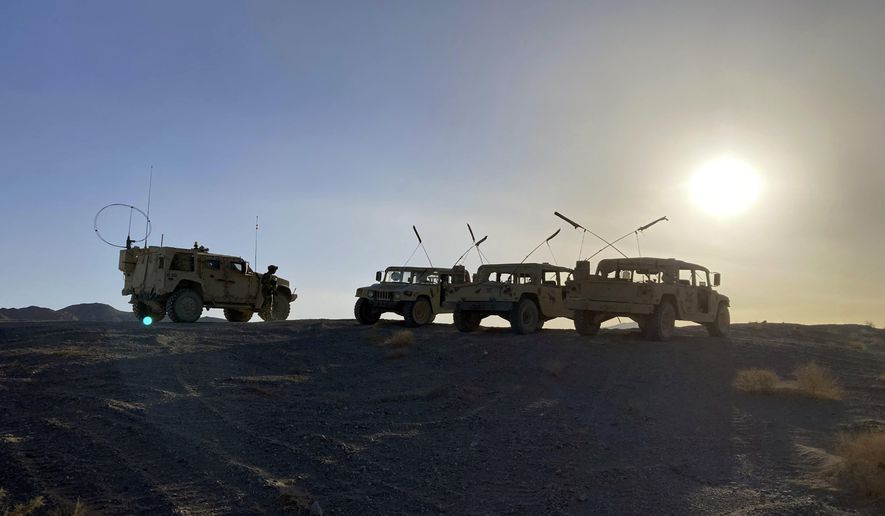
Recent weeks saw the Army test the new NGC2 system at Fort Irwin in a mass training exercise that involved more than 9,000 troops in the Mojave Desert.
The system is being built in four layers and is meant to more closely mimic the consumer electronics industry than prior Army equipment. It is also being conceived with rapidly developing technology in mind.
A Washington Times reporter who was in the Mojave for the recent testing witnessed how the system confronted serious heat challenges presented by the desert.
“We’re gonna have some failures out here in the desert and that’s good,” Gen. LaNeve said Wednesday.
Some critical systems were prone to overheating, and some applications suffered from bugs and errors that still need to be fixed.
“If there is something out here that’s not living up to what has been advertised, we’re going to walk away from that,” the general said.
The different layers of the new NGC2 system are designed to use the latest communications technology to break down barriers between types of information — everything from the location of cannons and helicopters to levels of fuel and water — bringing it into a single pool of data that leverages artificial intelligence.
What’s known as a transport layer contains much of the communications hardware that lets the system use everything from space-based assets from California-based SpaceX’s Starlink system to mesh radios and 5G cellular networks.
A data layer uses cloud-based computing to store the necessary information in real time, while an integration layer translates all of the available points on a given battlefield into useful bits and bytes for applications.
Those applications are designed more similarly to what someone would find on a modern smart phone, taking all of these inputs, reaching back to the cloud, and offering the user a solution.
Unlike what a consumer might find on the micro-computer or smartphone in their pocket, however, the NGC2 “apps” are designed for war.
There are programs such as a target system being provided by Florida-based Palantir Technologies and a machine learning model for geospatial imagery being provided by Texas-based Striveworks. There is even a program being developed internally by the Army to help visualize electromagnetic spectrum planning for electronic warfare.
The testing in California has amounted to “more than just a successful technology demonstration,” according to Brent Ingraham, a deputy assistant secretary of defense, who joined Gen. LaNeve on Wednesday’s conference call.
“For years we’ve talked about acquisition transformation, moving faster, learning faster,” Mr. Ingraham said. “NGC2 is what that looks like in practice.”
The new system relies on a major contract with California-based defense company Anduril and Palantir. The two are on contract with the Army to be the primary data providers for the system, with both providing a common baseline for other companies to build out their products.
That common baseline is what has the Army so excited, combining open source information, classified intelligence, logistics, targeting and nearly every other aspect of warfare available into a single pool. That information can be shared quickly across the battlefield using NGC2, according to the Army, including with allies.
Contact the author

Please read our comment policy before commenting.