



OPINION:
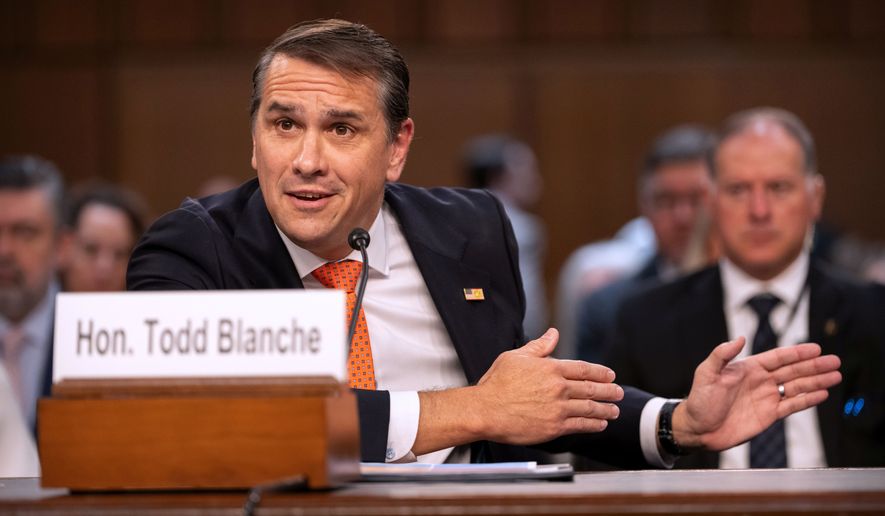
Deputy Attorney General Todd Blanche is not qualified to be the attorney general of the United States because he has demonstrated a hopeless conflict between the rule of law — which he has taken an oath to support — and his sense of personal loyalty to President Trump, whom he represented for several years in a notorious but frivolous criminal case in New York.
What to do about a chief law enforcement officer nominee who has this conflict and will not disavow it? Reject him.
Here is the backstory.
People were interested in these podcasts
For America’s first 100 years, there was no Department of Justice. Federal laws were enforced by state authorities in federal courts. This was part of James Madison’s genius to divide governmental power between the states and the feds.
The modern presidency sits at the intersection of two powerful and often conflicting ideas. One is the unitary executive theory, which argues that because Article II of the Constitution vests “The executive Power” in the president, every official exercising executive authority ultimately answers to him.
The other is the long-standing expectation that the Justice Department, while undeniably part of the executive branch, should administer the law impartially and according to facts, evidence, caselaw, precedent and professional ethics rather than presidential preference.
Today, the tension between these principles has become especially visible in the nomination of Mr. Blanche.
Supporters of the unitary executive theory argue that the president cannot faithfully execute the laws if subordinate officers are free to disregard his lawful directives. In this view, all executive officials exercise authority only because the president has delegated it to them.
If Justice Department lawyers become independent centers of power, democratic accountability suffers because voters elect only one chief executive.
The Justice Department, however, has always occupied a somewhat unusual position. Legally, there is no constitutional independence. The attorney general serves at the pleasure of the president. U.S. attorneys are presidential appointees. Federal prosecutors exercise executive authority. Nothing in the Constitution establishes the Justice Department as a fourth branch of government insulated from presidential supervision.
Yet, over many decades, norms have developed to preserve public confidence in criminal prosecutions. Presidents of both parties have generally avoided directing individual prosecutorial decisions. Attorneys general have frequently emphasized that charging decisions should be based on evidence, applicable law and the likelihood of obtaining a sustainable conviction — not political advantage.
Adding another layer to this tension are the professional obligations of Justice Department lawyers themselves. Federal prosecutors are not simply political appointees. They are attorneys licensed by state authorities and bound by professional rules of ethics. Their paramount duties include candor toward tribunals, honesty in representations to courts, disclosure obligations, fidelity to their client and the prohibition against presenting evidence they know to be false.
Those ethical responsibilities do not disappear because a president expresses a preference. If a presidential directive would require an attorney to violate professional ethics or mislead a court, a prosecutor should resign rather than participate in conduct believed to be unethical.
That is precisely where the theoretical collision occurs. A strong version of the unitary executive theory suggests the president should ultimately control every exercise of executive discretion. We know from history and common sense, however, that certain prosecutorial judgments require legal expertise and professional competence that are inherently independent of political influence. Neither principle entirely eliminates the other. Instead, they coexist in uneasy tension.
Mr. Blanche finds himself squarely within that difficult intersection. Two notorious cases — one involving government murders of innocents and the other involving a swindle of taxpayer dollars — came across his desk recently, and in both cases, he rejected the rule of law and bowed to presidential whim.
Mr. Blanche surely knows the basics of due process (notice, hearing, right to appeal) whenever the feds want life, liberty or property. Yet he permitted and accepted as appropriate the presidential order to enforce U.S. laws against drug trafficking by murdering 221 persons in 67 speedboats on the high seas.
Needless to say, none of these folks received due process, and Mr. Blanche must answer for that.
The better-known of Mr. Blanche’s ethical failures involves Mr. Trump suing the IRS for $10 billion because an IRS employee criminally revealed the contents of Mr. Trump’s tax returns. Two weeks ago, the U.S. District Court in Miami excoriated both Mr. Trump’s present personal attorney and his former attorneys for engaging in a false cause of action — one where there was no adversity between the parties because both sides wanted the identical result.
In response to the lawsuit, Mr. Trump’s Justice Department attorney agreed to give his personal attorneys a fund of $1.776 billion from the federal Treasury to disburse to Mr. Trump’s supporters at Trump’s personal discretion. Mr. Trump’s IRS attorneys agreed that neither the president personally nor his family or closely held corporations could be audited by the IRS.
According to the Justice Department, none of the $1.776 billion has been spent, and the fund is now dormant. However, Mr. Blanche refuses to renounce it or negate his own signature on a document he filed establishing the fund. The federal court ruled the lawyers on both sides of this matter did not act in good faith because all sought to please Mr. Trump at taxpayer expense.
Lawyers in litigation have a duty of zealous advocacy and unimpeachable loyalty to their clients. They cannot secretly or openly aid their client’s adversary. If they are morally, personally or legally conflicted, they must withdraw from the case.
Mr. Blanche remains bound by the same ethical obligations governing every federal prosecutor. He cannot simply substitute presidential preference for legal analysis.
If he cannot do the right thing on cases where the law is obvious and unambiguous, how can he be trusted with complex decisions? Courts, disciplinary authorities and history judge attorneys according to established legal standards rather than partisan loyalty.
In the case of Todd Blanche, the Senate should do the same — and reject his nomination.
• To learn more about Judge Andrew Napolitano, visit https://JudgeNap.com.
Follow the author
Please read our comment policy before commenting.