



A version of this story appeared in the daily Threat Status newsletter from The Washington Times. Click here to receive Threat Status delivered directly to your inbox each weekday.
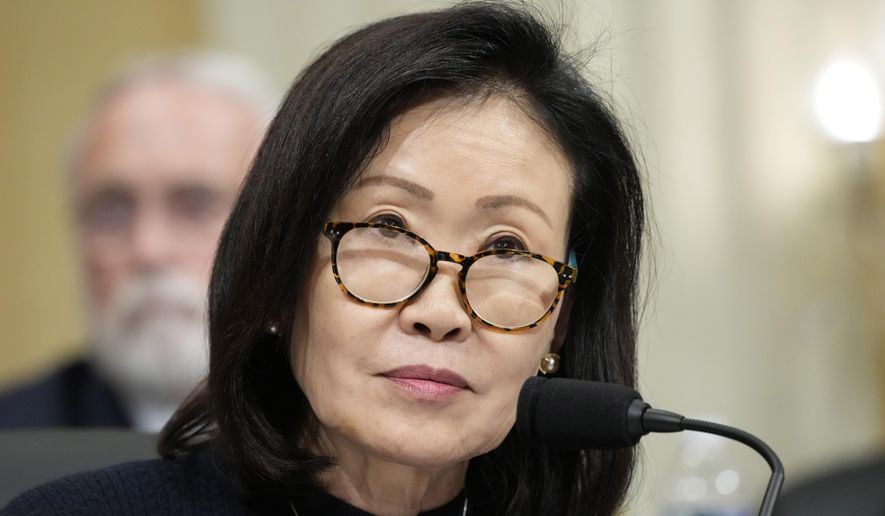
SEOUL, South Korea – Incoming U.S. Ambassador to South Korea Michelle Steel will have a crowded schedule ahead of her as she takes on the role of representing Washington in Seoul, the capital of one of America’s most important allies.
South Korea, the world’s 15th-largest economy and home to some of the world’s biggest brands, such as Samsung and Hyundai, gifts the U.S. military its only boot print on the Asian mainland and inside the strategic First Island Chain — critical for Taiwan’s defense.
A core global player in semiconductors, consumer electronics and autos, South Korea has also birthed in recent years some of the world’s most popular creative industries churning out bands, TV dramas and movies. And it is the ancestral home of some 2 million Korean Americans.
People were interested in these podcasts
One is Ms. Steel, who is expected to arrive in Seoul on Thursday, having been confirmed on July 17.
Born in South Korea, her original name was Park Eun-joo. She lived with her parents in Japan before moving to the U.S. at age 19 and becoming a naturalized citizen.
Now 71, she is a mother of two and a grandmother of four. She takes on a position that has been vacant since Biden-appointee Philip Goldberg stepped down in January 2025 — the same month President Trump started his second term.
A former California congresswoman, Ms. Steel’s fluency in Korean and Japanese could be priceless in navigating the complexities of a country central to a region that lies in the shadow of China, North Korea and Russia.
Bilaterally, there are several contentious diplomatic issues at the high simmer. One is a regulatory brouhaha over Coupang, a U.S.-listed firm that does the bulk of its business in South Korea. Others include slow movements on both a U.S. promise to enable South Korean nuclear submarine construction and a South Korean pledge to invest $350 billion in the U.S.
One issue that could ease her difficulties is the personalities of the two presidents she bestrides.
The Democratic Party of Korea and the U.S. Republican Party are not natural allies, but neither South Korean President Lee Jae-myung nor Mr. Trump is ideologically driven.
With Mr. Lee, a pragmatist, and Mr. Trump, a transactionalist, there is plentiful ground for consensus and cooperation, experts say.
Strategic, economic issues
Built on the foundation of a 1953 mutual defense treaty, the stationing of 28,000 U.S. troops on Korean soil and the extension of America’s “nuclear umbrella,” the bilateral alliance was forged in blood during combat in the Korean and Vietnam wars.
Currently, it is under strain.
Seoul, wary of its geographic closeness and deep trade ties with China, wants U.S. Forces Korea to be focused exclusively on the North Korea threat. Washington demands “strategic flexibility” — the use of Korea-based GIs for regional operations.
Moreover, Mr. Lee has stated that he wants to assume wartime operational control of local troops — which are commanded, under the Combined Forces Command, by a U.S. general — by 2029, when his term ends.
The Pentagon’s position is that “Wartime OPCON Transfer” can take place only when certain conditions are met by South Korean forces. Those conditions are classified.
Some think that if OPCON Transfer goes ahead, the only change will be that a Korean general will take over leadership of CFC. Others fear Washington will not permit GIs to serve under foreign command, will revert to a divided command structure and could drastically reduce the size of U.S. Forces Korea.
However, these issues fall outside Ms. Steel’s State Department remit.
“These issues belong to the Pentagon and the [South Korean] Ministry of National Defense,” said Moon Chung-in, a high-profile academic and expert in North Korea and strategic relations.
For her, one issue will be Coupang. Though headquartered and listed in the U.S., the company is South Korea’s leading online delivery firm.
Following a massive 2025 data breach affecting some 70% of Korea’s population, it was fined $400 million.
Coupang fought back against Seoul regulators with a U.S. lobbying campaign, winning the support of both the U.S. House and White House, which claim discriminatory treatment of an American firm.
“It violated Korean law and is subject to legal consequences in South Korea, but Congress argued that the South Korean government is aiming at Coupang,” fretted Mr. Moon. “In this debacle, what can the new ambassador do?”
Another issue is Seoul’s agreement to invest $350 billion in the U.S. — a massive promise made during a Lee-Trump summit in October 2025. It remains clouded.
“In the U.S., many stakeholders feel like Korea is not moving fast enough,” said James Kim, who heads the American Chamber of Commerce in Korea, or AMCHAM. “None of the commitments have been made, but a new energy deal is going to be announced very soon, as I understand, so that is a good start.”
Shin Kyoung-soo, a retired general who is secretary-general of the Korea-U.S. Alliance Foundation, said he expected more clarity on the deal’s first anniversary, or possibly at the G20 summit, to be held in Miami in December.
A surprise agreement reached in the October 2025 summit was for the U.S. to permit its ally to build nuclear submarines. Though Seoul has moved forward by creating related bureaucratic structures, there are major regulatory hurdles still to be jumped in the U.S.
A similar situation pertains in shipbuilding.
South Korea is, by tonnage, the No. 2 shipbuilder in the world after China and possesses some of the most advanced yards and technologies. Meanwhile, U.S. naval shipbuilding is lagging dangerously behind Beijing’s output.
Korea is an obvious supplier. The problem is American.
Kim Hyun-wook, a director-general at the Korea Diplomatic Academy and a specialist in the bilateral alliance, said the U.S. needs to change the federal law that prohibits the construction of military vessels in foreign shipyards, as well as the Jones Act, which mandates that U.S. commercial vessels must be built in U.S. yards.
South Korea’s Hanwha Ocean acquired Philly Shipyard in 2024, but its capacity does not match Korean facilities.
“I visited the Hanwha shipyard here in Korea roughly five weeks ago, and I have also visited Hyundai: They are pretty immense,” said AMCHAM’s Mr. Kim. “Philly generates two hulls a year — here it is 50, 60 or 70 a year.”
Presidential personalities
The two presidents may be Ms. Steel’s best bet for keeping the alliance on track.
“President Trump and President Lee, I think, are both very pragmatic and realistic,” Mr. Shin said. “If you look at them head to head, president to president, I think the relationship is really great.”
Mr. Kim of the KDA warned that Mr. Lee’s political instincts should not be compared to those of the last president in Seoul who hailed from the Democratic Party of Korea.
“Lee Jae-myung is not Moon Jae-in,” he said, referring to the left-leaning president who governed from 2017 to 2022. While Mr. Moon was a committed leftist, Mr. Lee has ditched his prior ideological baggage and turned out to be a pragmatist, Mr. Kim said — though he admitted that many of those around him are true leftists.
Personal and institutional relationships also keep ties tight.
“The U.S. and South Korea have maintained bilateral relations for 80 years and accumulated dense institutional networks and communications channels, so even without an ambassador in Seoul, they sustained relations,” said Mr. Moon. “But [Ms. Steel] can be a very important facilitator of communications.”
A major factor could be her closeness to her boss.
“If she can call President Trump and persuade him directly, that would be wonderful,” he said.
Contact the author

Please read our comment policy before commenting.