


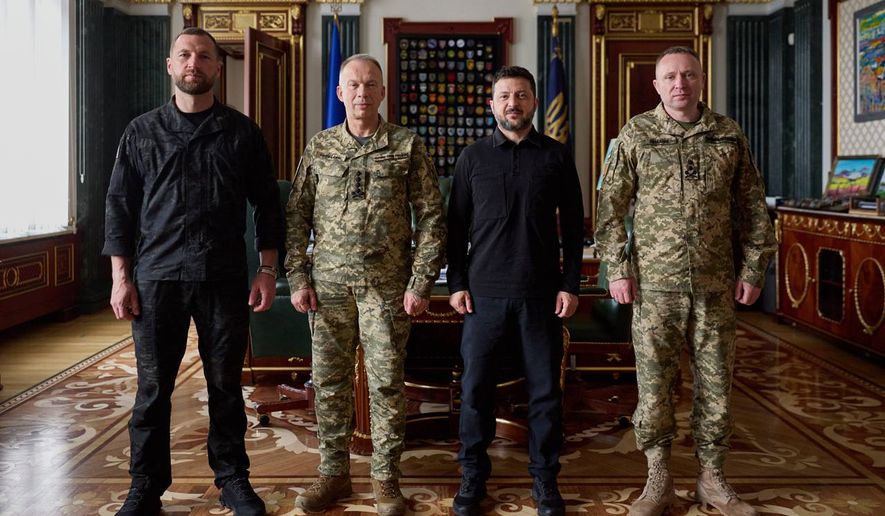

KYIV, UKRAINE — In the span of a single week, the dismissal of a Ukrainian defense minister set in motion a transformation of the country’s armed forces that replaced the old guard with a new generation of leadership.
Ukrainian President Volodymyr Zelenskyy’s decision to fire his popular defense minister, Mykhailo Fedorov, triggered days of public protest that quickly shifted toward the country’s commander-in-chief and highlighted the growing rift over the future of Ukraine’s military.
Demonstrators denounced the commander, Oleksandr Syrskyi, and overwhelmingly rallied behind the departed defense minister, who has emerged as one of the country’s most influential wartime reformers with support from Ukrainians hungry for change. Protesters demanded his reinstatement. Mr. Fedorov’s dismissal followed months of increasingly bitter disagreements between the two men.
People were interested in these podcasts
For Mr. Zelenskyy, it was the second time in a year that a wartime decision triggered a public backlash, after he moved in mid-2025 to curb the powers of anti-corruption agencies. As he did then, the president appeared to move quickly to contain the political fallout. He dismissed Gen. Syrskyi and replaced him with Mykhailo Drapatyi, a disciplined battlefield commander whose reputation was forged in the years following Russia’s first invasion in 2014.
Gen. Drapatyi’s appointment marked a sharp generational and philosophical break from Gen. Syrskyi, who was shaped by Soviet military tradition. But public support continues to coalesce around Mr. Fedorov. The protests have further elevated his political standing.
Much of the public’s anger was directed at Gen. Syrskyi, who became a symbol of deeper frustrations that had accumulated within the military since Russia’s full-scale invasion in 2022.
Gen. Drapatyi’s appointment has helped ease some of those concerns. Widely respected by troops and fellow officers, he represents a younger generation of commanders whose credibility was earned on the battlefield rather than inherited through the Soviet military system.
“He enjoys a high level of trust within the military. I think this appointment could boost what is often called morale, that is, strengthen the fighting spirit,” said Oleksandr Musiienko, a military analyst in Kyiv.
The divide between Mr. Fedorov and Gen. Syrskyi was described by one Western defense official as between “different planets.” The official spoke on the condition of anonymity because they were not authorized to brief journalists.
Mr. Fedorov championed a data-driven, technology-led approach to warfare that clashed with Gen. Syrskyi’s more traditional ground-forces doctrine. Gen. Drapatyi could be a bridge between the two camps, analysts said. Low-profile but highly respected, he has earned the confidence of front-line commanders while embracing many of the reforms championed in Kyiv.
“He has shown an ability to adapt to the realities of modern warfare, to changing battlefield conditions and to shifting and reallocating resources,” Mr. Musiienko said.
For many Ukrainians, Gen. Syrskyi came to embody the rigid command structures and Soviet-era thinking that Mr. Fedorov’s ambitious reforms sought to overhaul. When Mr. Fedorov publicly identified Gen. Syrskyi as the chief obstacle to those reforms, it brought to light those broader public grievances.
They include the military’s entrenched bureaucracy and Gen. Syrskyi’s command style, criticized as overly centralized and prone to micromanagement, alongside constant mobilization challenges.
Gen. Syrskyi also came under intense criticism for his association with the 425th Separate Assault Regiment, known as Skelia, which for many Ukrainians became emblematic of the tactics that expended soldiers’ lives for marginal territorial gains.
In addition, the regiment was the focus of a major public scandal after an investigation by the Ukrainian publication Babel reported allegations of systemic abuse, torture in training camps and dozens of noncombat deaths. The allegations triggered an investigation, resulted in the suspension of the regiment’s commander and intensified scrutiny of the military’s command culture.
The political drama is not over. Mr.. Fedorov announced Thursday that he had rejected Mr. Zelenskyy’s efforts to persuade him to rejoin the government in a different role, saying would not accept any position other than defense minister.
Please read our comment policy before commenting.