



OPINION:
For decades, American policymakers have sought stability with China by managing symptoms rather than addressing causes. The result has been a cycle of engagement, disappointment and growing tension.
Facilitated by years of diplomatic outreach, economic integration, enormous strategic gifts and transfers of technology, the Chinese Communist Party (CCP) has accelerated a massive military buildup, expanded its global influence operations, intensified espionage, threatened Taiwan and America’s allies, and pursued policies increasingly hostile to U.S. interests. Yet Washington still largely approaches China as a difficult competitor rather than what it was all along: an ideological and geopolitical adversary.
However, the problem is not China itself. It is the Chinese Communist Party.
People were interested in these podcasts
This distinction is critical. U.S. policy has too often treated the CCP as the permanent and legitimate embodiment of the Chinese nation. In doing so, it has ignored one of the central lessons of the Cold War: Lasting peace cannot be achieved merely through improved atmospherics or diplomatic engagement with totalitarians. Tensions decline only after reducing concern and eliminating their primary cause.
In the case of China, those concerns stem from the totalitarian nature of the CCP and the aggressive policies that flow from it.
The United States has begun strengthening its defenses. Military modernization, supply-chain diversification, investment restrictions and technology protections are all necessary. But defensive measures alone leave America permanently reacting to Beijing’s initiatives.
What is missing is an offensive strategy — and not simply a military one but a moral, political, informational and ideological strategy to place pressure on the CCP’s greatest vulnerability.
That vulnerability is not the so-called People’s Liberation Army or China’s economy. It is the Party’s monopoly on information and its fear of its own people.
The CCP rules without the consent of the governed. Following the wreckage of World War II, it conquered China through deception, intelligence operations against their rivals and with the indispensable aid of Stalin’s Soviet Union. Its record of atrocities and crimes against humanity over the last century beggars belief.
The CCP’s own narrative of legitimation is built upon an elaborate body of fabrications. It must therefore suppress free discourse in perpetuity, lest the Chinese people awaken to the lies en masse and demand change.
The CCP thus depends on an immense internal security, surveillance, propaganda and censorship apparatus, which suppresses dissent, maintains the Big Lie, demoralizes and numbs the populace into apathy and isolates subjects from one another — a tool of Soviet statecraft known as atomization.
The regime understands that democratic ideas, free communication, religious belief and independent civil society all threaten its monopoly on power.
American strategy should recognize this reality and adopt a two-track approach: firmness toward the regime and friendship toward the Chinese people.
During the Cold War, the United States succeeded not merely because it deterred Soviet military power but because it challenged the legitimacy of communist rule. Through public diplomacy, broadcasting, support for dissidents and an unwavering commitment to truth, America demonstrated that the Soviet system was neither inevitable nor permanent.
The same principle applies today. The United States should consistently distinguish between the CCP and the Chinese people. We should openly support universal human rights, religious freedom, the rule of law and democratic self-government. We should expose corruption, repression, forced labor, religious persecution, forced organ harvesting and other abuses that the regime works tirelessly to conceal.
Truth is a strategic asset that broadly favors the free nations. The United States should rebuild its neglected public diplomacy capabilities to leverage truth and openness. During the Reagan years, Washington invested heavily in international broadcasting through Voice of America and Radio Free Europe. Those institutions helped break communist information monopolies and gave hope to millions trapped behind the Iron Curtain.
Today’s challenge is even larger. China has built the most sophisticated censorship apparatus in history. Meeting that challenge requires substantial investment in broadcasting, internet freedom technologies, satellite communications and new methods of bypassing the Great Firewall. The goal should be simple: help the Chinese people communicate freely with one another and gain access to information their government seeks to suppress.
Washington should likewise strengthen relationships with Chinese dissidents and diaspora communities, as well as Uyghur, Tibetan, Mongolian and Hong Kong activists. These communities possess cultural knowledge, credibility and networks that can help communicate ideas the regime fears most.
At the same time, American leaders should abandon the self-censorship common in official engagement with Beijing. Diplomatic dialogue has its place, but dialogue should not require silence about human rights abuses, political repression or aggressive behavior abroad.
President Reagan understood that moral clarity strengthens deterrence. When he challenged the legitimacy of Soviet communism, he encouraged dissidents behind the Iron Curtain and demonstrated confidence in the superiority of freedom over tyranny…
America should seek a stable, peaceful relationship with China while recognizing that its greatest potential partner is not the CCP leadership but the Chinese people themselves.
A successful China strategy will combine military strength, economic resilience, technological security, robust counterintelligence and an energetic campaign of truth. The United States prevailed in the last great ideological struggle not simply because it was materially stronger but because it offered a more compelling vision of human dignity and freedom: It was a manifestation of moral-political strength, without which all the material assets are mere vanity.
If America seeks genuine peace, we must stop courting the CCP and start championing the Chinese people.
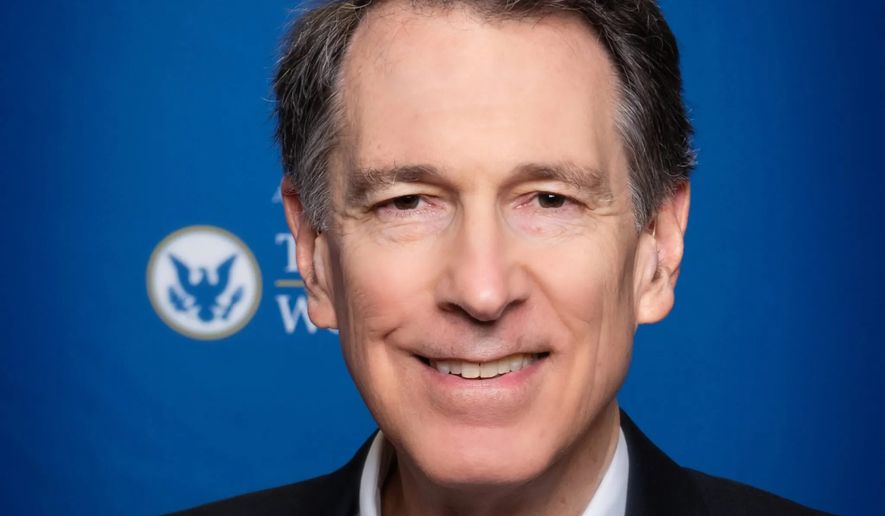
• John Lenczowski, Ph.D., is the Chancellor, President Emeritus and Founder of The Institute of World Politics, and served as NSC Director of European and Soviet Affairs under President Reagan.
Please read our comment policy before commenting.