


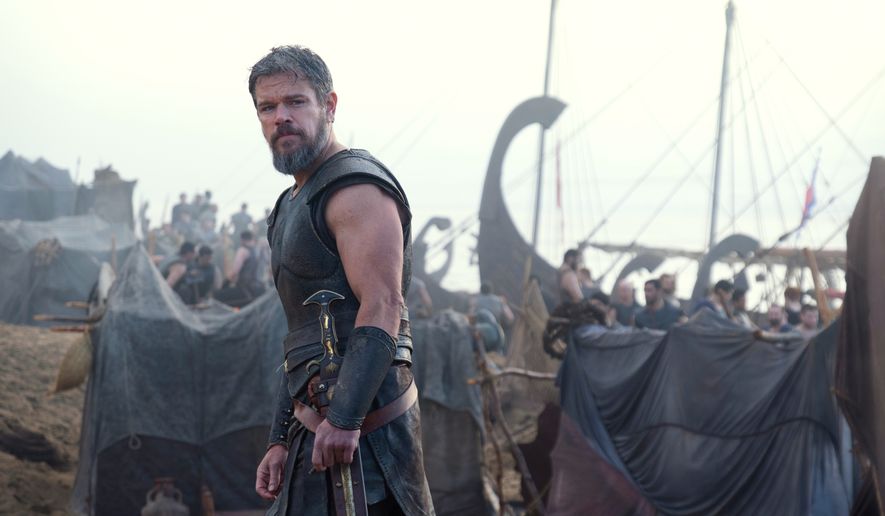

Homer’s “The Odyssey” has long been interpreted for the public by classical studies scholars and now — with director Christopher Nolan’s $250 million film version garnering rave reviews — by a new generation of film critics.
The blockbuster opening on screens across the U.S. this weekend is dominating the cultural conversation, but the voices of fighting men with real experience of combat and its aftereffects often find themselves sidelined in the discussion. Given the content of Homer’s epic, that is odd.
Straight readings of the (supposedly) blind bard’s works deliver accounts of wartime heroism and horror; of archetypal battle leaders; of substance abuse and marital infidelities; and the temptations faced by women back home.
Less literal interpretations of Homeric episodes — confrontations with otherworldly monsters and a descent into Hades — speak to post-war mental traumas.
Homer wrote “The Odyssey” and “The Iliad” centuries after the events the epics supposedly depict and for many more centuries, his masterpieces were considered straight myth.
But they may have been informed by reality. More recent research suggests the Trojan War, or something similar, actually happened.
In the 1870s, German archeologist Heinrich Schliemann discovered the remains of a Bronze Age, walled city, with geographical features — its old coastline, nearby rivers and distant mountains — exactly mirroring Homer’s descriptions of Troy.
The site, in Hisarlik, Turkey, dominates the entry to the Dardanelles, a strategic maritime chokepoint linking the Mediterranean and Black Seas.
Excavations uncovered traces of weapons and ashes indicating the citadel was, indeed, burnt to the ground around 1,200 BC. That syncs with the classic historian Herodotus’ estimate that Troy fell in 1,250 BC.
Mycenaean-era script proves that “Achilles” was an actual name in the late Bronze Age and real figures — including Alexander the Great — visited the supposed site of the uber warrior’s tomb.
While Homer’s 10-year siege seems unlikely, a series of raids, skirmishes and battles is feasible. The war’s legendary casus belli — the elopement (or kidnapping) of Queen Helen of Sparta — also hints at dark history.
Slave raiding — with women of child-bearing age the most prized targets, and ransomable aristocrats doubly so — was a constant in the Mediterranean until the 19th century.
Now, as Hollywood breathes new life into the Greek epics, American veterans of the Global War on Terror say that Homer’s timeless lines echo across millennia, reflecting their experiences of war and its aftermath.
Warriors and war
The Iliad’s heroes are Greece’s Achilles and Troy’s Hector — arguably, two sides of the warrior archetype. The ruthless Achilles is motivated by loot, slaves, glory and vengeance. The honorable Hector fights for his wife, child, father and city.
Joe Labarbera, who served 54 months in five combat tours as an American infantry officer in Iraq and Afghanistan, said he understands the enduring interest in the “Homeric version of honor and glory.”
“I’ve not met many who compare to Achilles, but I knew a lot of Hectors,” he said.
Donald Vandergriff, whose career spanned the U.S. Marines, U.S. Army and contracting work in Afghanistan, met both types.
The modern Achilles, he said, “appears today in aggressive special operations elements and line units that prize individual initiative and recognition.”
“Most career officers and senior NCOs who endure repeated combat deployments ultimately align more closely with Hector’s outlook.”
Homer details his heroes’ specializations.
Achilles is a battle winner described as “swift-footed” — a reference to the criticality of footwork in close combat. Odysseus, “the man of twists and turns,” is known for tactical cunning.
Homer talks of gods descending to earth and single warriors terrifying entire hosts. Dubious? Yes. But his many descriptions of combat read as authentic.
In the climactic duel of “The Iliad,” Achilles experiences his enemy’s charge in slow motion: He has ample time to select his target, aiming his spearhead at the vulnerable point over the rim of Hector’s breastplate: His throat.
“The depiction of time dilation during combat and the deliberate targeting of vulnerable anatomy is consistent with what experienced fighters report,” said Mr. Vandergriff, who today writes books on military doctrine. “Homer’s choice of the throat reflects practical combat knowledge rather than literary invention.”
When Odysseus reaches home, occupied by insolent suitors, he uses an identical kill shot: The suitor’s leader, Antinous, falls to an arrow through his neck, blood jetting from his nostrils.
Homer paints his kill zone with equally gruesome realism. The opening lines of “The Iliad” tell of corpses being scavenged by wild dogs and carrion birds.
That prompted memories of a visit David Park, an infantry major, made to a company outpost in Afghanistan, where defenses included a dry moat full of smoldering dogs.
“Soldiers invited me to watch the next morning: A new group of dogs would come to eat the dead and burning dogs, it smelled like a barbecue,” said Mr. Park, who today is a property executive in Washington, D.C. “The gunner would aim and shoot the biggest and closest ones and the rest would run off.”
GIs burnt the dead dogs with jet fuel and the situation repeated. So grim was the tableau, the Taliban left the outpost alone.
Women, drugs, monsters
“The Iliad” depicts war; “The Odyssey” post-war. For 10 years after the Greeks burned Troy — enabled by Odysseus’ use of a wooden horse to infiltrate its formerly impregnable citadel — he struggles to return home across hostile seas.
En route, he is seduced by the witch Circe, spends seven years with the nymph Calypso, and is sorely tempted by The Sirens — irresistible songstresses.
War may have sharpened Odysseus’ frothy libido.
Physiologists speculate that combat troops unconsciously feel powerful biological urges to reproduce, due to the constant possibility of death.
“Prolonged exposure to combat heightens the biological and psychological drive for physical and emotional release,” Mr. Vandergriff said.
That explains constant discussions of sex among soldiers — and the rear-area brothels of the Korean and Vietnam wars.
“It was an open secret that soldiers were taking their leaves in Germany, where they would simply stay at a brothel for two weeks, then return, ’recharged and ready to fight,’” Mr. Park said.
Substance abuse is encountered in the “Land of the Lotus Eaters.” Some of Odysseus’ men become addicted, forcing him to drag them aboard ship and lash them to the benches for cold turkey.
That danger, too, feels all too real for modern veterans.
“Eleven percent of VA patients have diagnosed substance use disorders compared to 8.5% of civilians,” a May study by RiversideRecovery, an addiction treatment center in Tampa, Florida, found.
On the home front, Odysseus’ wife Penelope remains faithful, but her experience — besieged by aggressive suitors — mirrors expeditionary troops’ anxieties that men back home will court their loved ones.
That anxiety is grounded. “About half of those I knew with girlfriends or young wives lost those relationships on deployments,” Mr. Labarbera said.
One of Homer’s most poignant passages is the recognition of Odysseus by Argos — the pup he raised before leaving for Troy, now an aged hound dying on a compost heap. The faithful pet recognizes his master — then dies.
Mr. Labarbera acknowledged the scene’s veracity.
“When I returned from my last deployment, my ridgeback, Scipio, howled and cried and walked and paced around as I lay on the floor,” he recalled. “He licked and cuddled me for almost an hour.”
Prior to homecoming, Odysseus undergoes fantastical trials that form some of the epic’s most iconic passages.
He outfoxes man-eating monsters: A one-eyed giant, Polyphemus; a squid-like monster, Scylla; and the Laestrygonians, huge cannibals who hurl boulders at his ships.
In a harrowing scene, he descends into Hades, offering fresh blood for spirits to drink in return for information.
Do these macabre episodes part with reality? Perhaps not, given the demonic impact combat can have on soldiers’ psyches.
The scenes “map onto the nightmares, hypervigilance and sudden intrusive memories reported by veterans,” said Mr. Vandergriff. “Several men I have known described recurring visions of mutilated bodies, of ambushes, of inescapable threats that closely parallel the epic’s perils.”
Postwar, Mr. Park was contacted by the wife of a medic who had triaged every casualty at his base.
“He’d wake up screaming every night,” he recalled. “We had to commit him to a psychiatric facility – not the first or last time I visited one.”
Mr. Labarera was struck by a starker realization.
“As far as monsters: I realized I am the monster,” he said. “After over 30 firefights in five deployments and all the judgments and decisions leading to harming people, I’ve become numb to violence.”
The big Italian-American withdraws to his family farm in New Jersey.
“I live deep in the country to avoid the stress of strange people,” he said. “I have to limit my time in public.”
Hollywood’s latest blockbuster may lure an audience of veterans whose experiences sync with Homer, some 3,200 years after a city called Troy may have fallen.
“Homer’s lasting relevance stems from his refusal to either glorify war or reduce it solely to trauma,” said Mr. Vandergriff. “He presents both the powerful drive for honor among fighters and the lasting personal costs … veterans frequently recognize their own experiences in these poems.”
Contact the author

Please read our comment policy before commenting.