


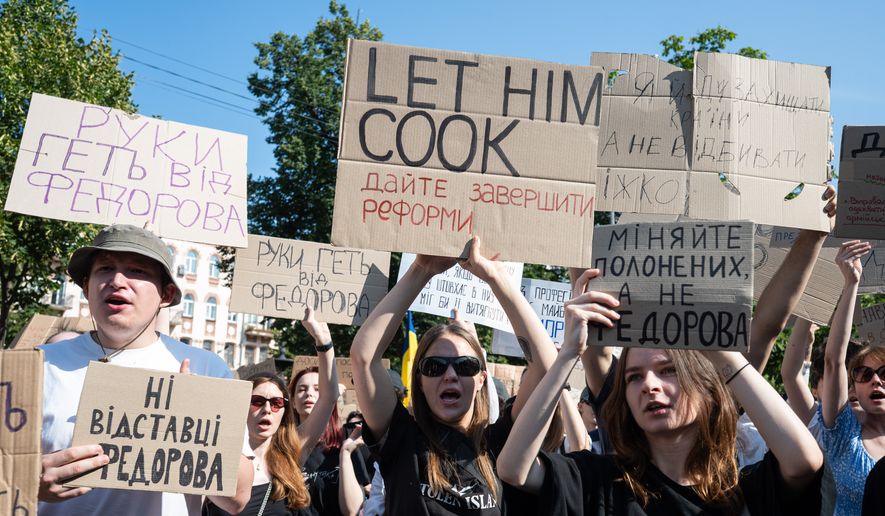

PARIS — Ukrainian President Volodymyr Zelenskyy’s ouster of Defense Minister Mykhailo Fedorov after just six months has triggered an unusual backlash in wartime Ukraine, with soldiers, civil society activists and even members of the president’s party warning that the move risks derailing military reforms at a critical point.
Mr. Fedorov, 35, was brought into the Defense Ministry in January to shake up one of Ukraine’s largest and most oversight-resistant bureaucracies. He was charged with implementing the fast-moving, data-heavy approach he had used as digital transformation minister to expand Ukraine’s drone industry and digitize other government departments.
His tenure ended abruptly this week as part of a broader Cabinet reshuffle that also swept out Prime Minister Yulia Svyrydenko after one year in office.
People were interested in these podcasts
Mr. Zelenskyy had been expected to nominate Interior Minister Ihor Klymenko to succeed Mr. Fedorov, but Mr. Klymenko reportedly declined the post amid public protests over Mr. Fedorov’s ouster, leaving Mr. Zelenskyy without a candidate to submit to parliament. The defense post remains temporarily vacant, leaving Ukraine without a formal defense minister as the political crisis plays out.
Mr. Zelenskyy has offered little public explanation for removing a minister whose political stock appeared to be rising.
That vacuum has fueled questions over whether Mr. Fedorov fell victim to the very reforms he had been brought in to carry out.
“The main problem is that Fedorov started trying to bring order to the arms market and defense procurement,” political analyst Volodymyr Fesenko told The Washington Times shortly before the decision was announced.
“There are very strong conflicts of interest and extremely fierce competition there,” he said. “By trying to clean it up, Fedorov effectively provoked conflicts with people whose interests were affected.”
Mr. Fesenko said a broad “anti-Fedorov coalition” had emerged in recent months, spanning parts of parliament, government institutions and figures close enough to the presidential team to make their views heard by Mr. Zelenskyy. His assessment echoes reporting that Mr. Fedorov repeatedly resisted efforts to direct lucrative weapons contracts toward favored companies, angering powerful interests in Ukraine’s political and defense establishment.
Mr. Fedorov appeared to acknowledge the resistance in a lengthy account of his tenure posted as he prepared to leave office. Among his accomplishments, he wrote that his team had “initiated an unpopular but vital transformation of the military.”
The backlash to Mr. Zelenskyy’s latest shuffle was swift.
Maria Berlinska, one of Ukraine’s best-known advocates for military drone development, called Mr. Fedorov’s removal one of Mr. Zelenskyy’s biggest mistakes and warned that Ukrainians could ultimately pay for the decision with their lives.
Oleksandr Merezhko, chairman of parliament’s foreign affairs committee and a member of Mr. Zelenskyy’s Servant of the People party, said Mr. Fedorov was highly respected by Ukraine’s international partners and had become associated with hopes for genuine reform at the Defense Ministry.
Two prominent advisers also announced their departures. Serhii Sternenko, an activist and a major drone supplier to frontline units, praised Mr. Fedorov as Ukraine’s most effective defense minister and pointed to unfinished reforms. Serhii “Flash” Beskrestnov, a specialist in drones and electronic warfare, said numerous projects would now have to be handed to another team.
Olena Tregub, executive director of the Independent Defense Anti-Corruption Commission, a Kyiv-based watchdog group, said Mr. Fedorov had been making steady progress.
“Given the limited access to information and the realities of an active war, any assessment should be made cautiously. Nevertheless, three clear success stories stand out,” she said in a statement to The Times. She cited the departed minister’s push for data-driven wartime strategies, his anti-corruption efforts and his work with Elon Musk that shut down Russia’s use of Starlink terminals on Ukrainian battlefields.
She said Mr. Fedorov was ousted at a critical moment.
“Change at this stage could delay or disrupt several strategically important initiatives,” she said, including long-term planning for defense budgets, Ukraine’s recent effort to establish international defense partnerships and the announcement this week regarding Ukraine’s participation in developing a European anti-ballistic defense initiative.
The furor stands in sharp contrast with the optimism surrounding Mr. Fedorov’s January appointment.
“The arrival of Fedorov symbolizes first of all a different style of management,” Hanna Shelest, director of security programs at the Ukrainian Prism think tank, told The Times after he took over the ministry.
The expectation was that a politician who had built his reputation on digital government and helped nurture Ukraine’s defense technology ecosystem might force an institution shaped by decades of bureaucracy to move at the speed demanded by modern warfare.
Mr. Fedorov pushed the “mathematics of war,” an analytics-based approach that uses battlefield data to measure the effectiveness of units and weapons, automate drone demand and redirect resources toward systems that deliver results. He expanded technological programs while trying to overhaul procurement and recruitment, although critics said his reforms in recruitment had failed to produce results quickly enough.
Those efforts also put him on a collision course with more traditional elements of the military establishment.
Mr. Fesenko said some of Mr. Fedorov’s proposals on the organization of the armed forces, mobilization and methods of warfare were deeply unpopular among parts of the military leadership. Reports of tensions with the commander in chief, Gen. Oleksandr Syrskyi, had circulated for months, although the military has denied any personal conflict between the two men.
Mr. Fesenko said the friction was initially part of a deliberate system of competing centers of influence created by Mr. Zelenskyy.
“Fedorov was supposed to restrain Syrskyi and propose a new strategy of war, the technologization of war,” he said. “In principle, it worked reasonably well.”
Regardless, the arrangement grew increasingly strained as Mr. Fedorov attempted to change personnel policies, procurement priorities and the way battlefield performance was measured.
The controversy is also feeding a wider debate over how power operates inside Mr. Zelenskyy’s wartime government.
Opposition lawmaker Yaroslav Yurchyshyn argues that successive reshuffles have hollowed out the Cabinet’s independent political role and concentrated strategic decision-making around the presidency. In his assessment, ministers are increasingly expected to execute decisions rather than build their own political authority, creating a system in which successful, proactive officials can eventually become liabilities if they develop an independent public profile.
Mr. Yurchyshyn also points to the growing weakness of parliament in the process. Although the Constitution requires 226 lawmakers to approve a new prime minister, Mr. Zelenskyy’s once-dominant Servant of the People faction can no longer reliably muster such a majority on its own. Opposition parties say they are prepared to discuss candidates and programs but complain that meaningful consultation rarely takes place.
For Mr. Yurchyshyn, the issue goes beyond personalities. Repeated government “reloads,” he argues, have made it harder to attract strong, independent managers who know they may have little autonomy and can be removed with little public explanation.
The latest shake-up coincides with Ukraine’s preparations for another difficult winter after Russian attacks badly damaged its power and heating infrastructure. Mr. Zelenskyy has made winter preparation the central justification for his choice of Naftogaz chief Sergii Koretskyi, who was confirmed Thursday as prime minister. Mr. Zelenskyy cited Mr. Koretskyi’s experience as a crisis manager in the energy sector.
Mr. Fesenko said the logic makes sense for the premiership, but he questioned whether changing defense ministers at the same time was worth the disruption.
“Many people now regard this position as an electric chair,” he said. “The problems and challenges Fedorov faced will also confront another minister.”
Replacing Mr. Fedorov with Mr. Klymenko, a career police official who has run the Interior Ministry since February 2023, could create its own difficulties, Mr. Fesenko said. Mr. Fedorov was a civilian with deep ties to Ukraine’s drone and defense technology communities and had built a degree of credibility with the military. A former national police chief who would be taking over civilian leadership of the armed forces may receive a less welcoming reception.
“It will be extremely difficult for Zelenskyy to find such a strong candidate for defense minister,” Mr. Fesenko said.
The political analyst said Mr. Zelenskyy values unity inside his team and has a history of eventually removing officials who become centers of internal conflict. That may help explain why Mr. Fedorov, despite remaining one of the administration’s most recognizable and popular officials, became expendable.
Still, the speed of the decision carries risks.
“Changing the defense minister every six months is not appropriate during a war,” Mr. Fesenko said. “Fedorov has authority, and he has launched reforms.”
For a country whose battlefield survival increasingly depends on its ability to innovate faster than Russia, the question now is whether those reforms have become strong enough to survive the reformer who pushed them through.
Please read our comment policy before commenting.