


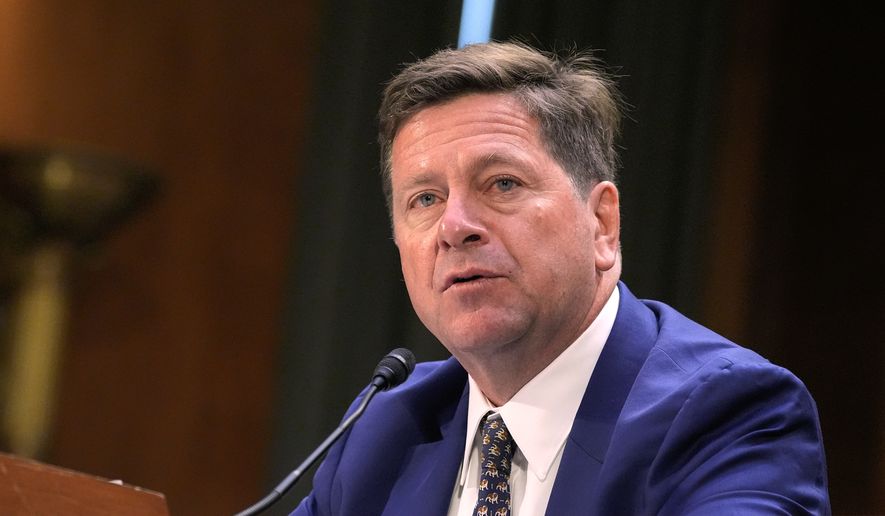

Director of National Intelligence nominee Jay Clayton appears headed for a partisan confirmation vote after refusing to say during his confirmation hearing Wednesday that Joseph R. Biden won the 2020 presidential election.
Democrats are concerned that President Trump has and will continue to use the intelligence community to try to prop up his false claims that the 2020 election was stolen from him.
In response to numerous questions on the topic, Mr. Clayton tried to thread the needle in his answers — a clear attempt to avoid saying something that would anger Mr. Trump.
People were interested in these podcasts
He acknowledged that Mr. Biden was certified as president but would not directly say that he won.
“I am bitterly disappointed,” said Sen. Mark R. Warner, the top Democrat on the Senate Select Committee on Intelligence.
Mr. Warner, who is friendly with Mr. Clayton and worked closely with him when he chaired the Securities and Exchange Commission, went into the hearing defending the nominee as some of his colleagues questioned his qualifications for the DNI role.
By the end, he did not seem prepared to vote to confirm Mr. Clayton.
Other Democrats were more blunt about their opposition after Mr. Clayton dodged their questions on the 2020 election.
“Disqualifying,” said Sen. Jon Ossoff, Georgia Democrat.
Republicans can confirm Mr. Clayton as DNI without Democratic votes but cannot afford any GOP defections in committee or more than three on the floor.
Senate Intelligence Chairman Tom Cotton, Arkansas Republican, said he is planning for the committee to vote on Mr. Clayton’s nomination early next week.
Mr. Clayton holds a top-secret security clearance as he works on numerous high-profile prosecutions in his current role as U.S. attorney for the Southern District of New York.
His office has prosecuted “foreign enemies who put innocent Americans at risk and have American blood on their hands,” Mr. Cotton said. “For example, he’s overseen the indictment of Venezuelan dictator Nicolas Maduro, secured the guilty plea of Venezuelan general Hugo Carvajal and overseen the prosecution of an Iran-backed terrorist connected to multiple attempted terror attacks in the United States.”
Mr. Clayton said his current role has given him “significant national security experience” in matters involving foreign terrorist organizations, counterespionage, money laundering, bribery and the abuse of communications platforms to sow disinformation.
In his previous role as SEC chairman, he said his national security experience included efforts to protect financial services infrastructure from cyberattacks and combat Chinese influence on financial markets.
Mr. Clayton said he would approach the DNI role in the same way he did his previous leadership positions in both the public and private sector: “mission-focused and team-oriented, taking on the challenges and seizing the opportunities.”
Republicans on the panel were generally pleased with his testimony, but Democrats were not.
Their focus on questioning the nominee about the 2020 election came in part because Mr. Trump is scheduled to deliver a primetime address on Thursday that is expected to raise more questions about the results.
The president told reporters on Tuesday that his speech will discuss vulnerabilities in voting machines but otherwise declined to share details in advance.
Bill Pulte, Mr. Trump’s acting DNI, was reportedly involved in pressing the president to deliver the address.
Mr. Clayton said he has had no involvement in the matter, which would be inappropriate before his confirmation.
Republicans spent some of their questioning asking about Mr. Clayton’s views on downsizing the ODNI, which Mr. Trump has made clear is his goal.
Sen. Susan M. Collins, Maine Republican and one of the original authors of the law that created the ODNI, said it has grown far bigger than they envisioned but that it still has a critical mission to oversee the government’s 18 separate intelligence agencies.
“I am deeply disturbed that some administration officials and indeed some senators have called for not just a reduction in the size of ODNI, but that we abolish it altogether,” she said.
Mr. Clayton said he supports the existence of DNI. He likened it to a board of directors of a large corporation that in itself is fairly lean and relies on reporting from subsidiaries about the day-to-day management of the company.
“To the extent that the ODNI has gotten into operations or started to play the roles of some of those other agencies, it probably should pull back, because it’s difficult to be both operations and oversight,” Mr. Clayton said. “But I think an oversight role is important.”
He said Mr. Trump has not asked him to dismantle ODNI or given him any instructions “other than to do a good job.”
Contact the author

Please read our comment policy before commenting.