


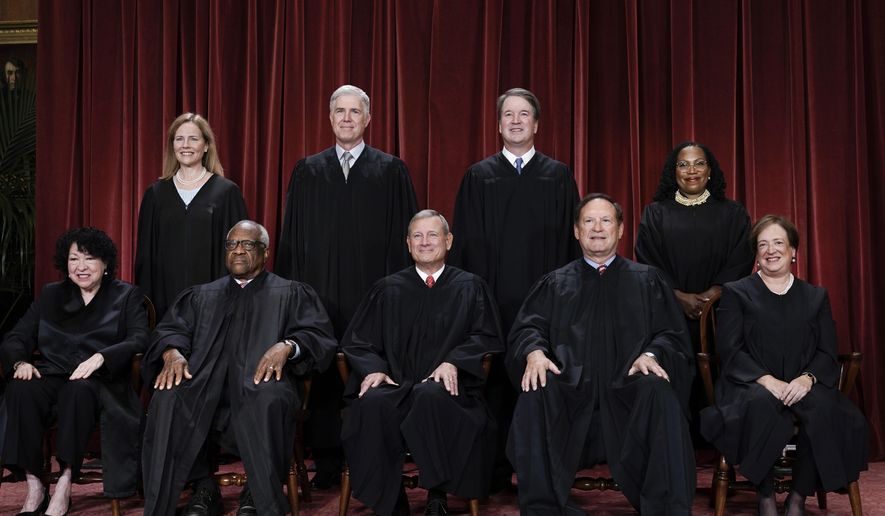

Supreme Court justices detailed growing and disturbing threats to their safety as they asked Congress on Tuesday to increase their security budgets.
Justice Amy Coney Barrett described having to explain to her 12-year-old son why she was bringing home a bulletproof vest.
She also revealed that she has been targeted by a perverse threat. Perpetrators arranged unwanted food deliveries to judges’ homes in the name of Daniel Anderl, the son of a federal judge who had been slain by a disgruntled lawyer in an attack on the judge’s home.
People were interested in these podcasts
Justice Barrett said the threats are meant to punish judges for prior rulings or, in some cases, to intimidate them in future cases.
“It’s hard to see how some of them are not designed to do precisely that,” she said.
On Monday, a man was arrested at a street barrier when police discovered he was armed. The man was asking for directions to the Supreme Court.
Justice Barrett and Justice Elena Kagan were making a rare appearance before Congress to defend the high court’s budget request for fiscal year 2027.
Although security concerns dominated their remarks, they also pulled back the curtain on some of the high court’s inner workings and disputes about its operations.
That included how to impose a code of conduct on the justices. They have a code, but enforcement is left to each justice.
“We continue to talk about the issue amongst ourselves,” Justice Kagan said, though she added they had not been able to reach a consensus.
She said the court has made progress in managing the growing use of the “shadow,” or interim, docket, which is when cases come to the justices in a preliminary posture and do not usually receive full briefing or oral argument.
Major policy decisions are made, albeit temporarily, in interim docket rulings, but the justices had been reticent to release full opinions.
That is now changing. The court is trying to say more about some of the heftier emergency docket rulings, Justice Kagan said.
She said they are still struggling with whether those interim rulings are binding on lower courts. In some rulings, justices have said decisions are binding, but other times have suggested more leeway.
“The court itself has been of a little bit mixed mind,” Justice Kagan said.
Congress is working on the fiscal year 2027 spending bills. The Supreme Court accounts for just 2% of federal judiciary spending and 0.1% of all U.S. government spending.
For 2027, the justices want a $14 million increase in operations, 7% above 2026 levels. Most of that is going to extra police, space to house them and 12 cybersecurity experts to combat growing attempts to penetrate the court’s systems.
Roughly 200 million cyberattacks were attempted against the court in 2025. That figure is expected to nearly double in 2026. Some of those are from foreign actors, the justices said.
Regarding physical and personal security threats, the court had a 25% increase in 2025 and expects a 38% increase this year.
“For some of us, those threats have come very close, and all of us live with the knowledge that they may again materialize,” Justice Kagan said.
Justice Barrett sought to drive home the personal nature of the threats.
This spring, she faced a “swatting” incident in which someone called in a report of a disturbance at her home. Local authorities responded.
She said that, luckily, her Supreme Court police detail intercepted the county officers and defused the situation.
Lawmakers from both sides of the aisle expressed support for more funding.
“It is increasingly dangerous to be a Supreme Court justice these days,” said Sen. Susan M. Collins, Maine Republican.
Ms. Collins said members of Congress themselves have sparked some of the threats.
“It’s appalling to me that some of the rhetoric is coming from public officials on both sides of the aisle, who should know better than to level personal and political attacks against the judiciary,” she said.
She pointed to a March 4, 2020, comment by Senate Minority Leader Charles E. Schumer, New York Democrat, warning that justices would “pay the price” if they attempted to erode the Roe v. Wade decision that established a national right to abortion.
Democratic senators, meanwhile, pointed to President Trump and his team’s harsh criticism of the justices’ rulings in recent months.
The hearing was remarkably respectful on both sides of the dais. Lawmakers and court members were careful not to cross lines in person.
Justice Kagan said criticism of the court “is fair game.”
“But intimidation is a different thing entirely,” she said.
Justice Kagan said it was Congress a decade ago that first prompted the court to improve security after several key members learned that only the chief justice had a permanent detail.
Lawmakers also made a pitch to the justices to return to Capitol Hill more often.
The last time justices testified on their budget was in 2019, in the House. Senators said the last appearance before their spending committee was in 2011.
In the years since, the court’s security needs have exploded.
That was put in stark relief in 2022, after the leak of a draft opinion in the Dobbs case, which went on to overturn Roe v. Wade and return the issue of abortion to the states.
Threats to the court surged. One person now sits in prison after plotting to assassinate Justice Brett M. Kavanaugh. The man showed up at the justice’s suburban Maryland home in the early hours of the morning with tools to break in and weapons to kill.
Justice Kagan said one vulnerability for the court is that the first security screening for visitors is when they are already in the building.
She said they are exploring ways to extend that perimeter beyond the building, including creating a security entrance to screen people before they enter.
Congress adopted that approach for the Capitol with the construction of the subterranean U.S. Capitol Visitor Center. After the Sept. 11, 2001, terrorist attacks, the project’s security scope was heavily expanded, culminating in its opening in 2008 as the mandatory, secure exterior screening point for all visitors.
Contact the author

Please read our comment policy before commenting.