


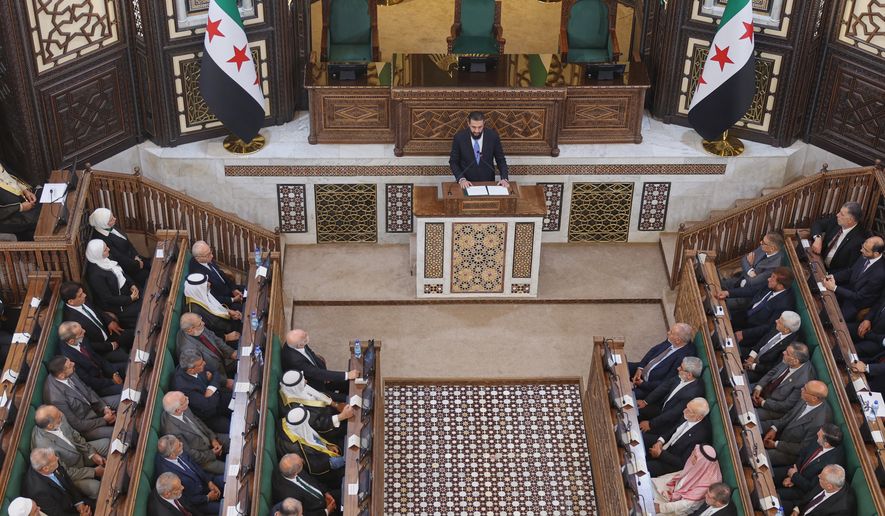

The State Department this month announced formal plans to remove Syria’s designation as a state sponsor of terrorism after nearly 50 years, as the Trump administration deepens ties with the young government in Damascus.
The move carries major economic and security implications for Syria and could give President Ahmad al-Sharaa more room to consolidate power in the central government.
“There’s nothing that was a bigger priority for Syria than the lifting of the State Sponsor of Terror designation,” Mouaz Moustafa, executive director of the U.S.-based nonprofit Syrian Emergency Task Force, told The Washington Times. “The SST designation was a kiss of death … even though the Caesar sanctions, which took way too long, a year to lift, were gone. The fact that the SST remained was really a killer for banking connectivity in Syria, for economic rebuilding.”
People were interested in these podcasts
The formal push began with what appeared to be an impromptu remark by President Trump last week at the NATO summit in Ankara, Turkey — a comment that was quickly followed by the State Department’s announcement of formal action to remove the designation.
The State Department said Mr. Trump had informed Congress of his intent to remove the designation “following a 45-day pre-notification period,” during which lawmakers can hold hearings or introduce legislation to block the move.
Rescinding the designation would eliminate one of the Syrian government’s largest remaining obstacles to rejoining the global economy. The label bans the export and sale of U.S. weapons, blocks most forms of financial assistance, requires Washington to oppose loans from international institutions such as the World Bank and strips a country of sovereign immunity in U.S. courts.
Removing the terror-sponsor designation has drawn widespread bipartisan support in Congress. Lawmakers say the al-Sharaa government has made progress in domestic security since the fall of the Bashar Assad government in 2024 and the designation is holding back economic development rather than pressuring a hostile regime.
Sen. Jeanne Shaheen of New Hampshire, the ranking Democrat on the Senate Foreign Relations Committee; Rep. Joe Wilson, South Carolina Republican; and Sen. Elizabeth Warren, Massachusetts Democrat, sent a letter this month to Secretary of State Marco Rubio urging him to lift the designation.
“U.S. financial institutions have been clear that the SST designation represents a key remaining roadblock to Syria’s financial connectivity, which is needed to facilitate private sector investment and billions of dollars pledged for economic recovery,” the letter reads.
Even as the Chevron Corp. and the ConocoPhillips Co. entered new exploration agreements with Syria in 2025 and 2026, the terror designation added a layer of legal risk on top of Syria’s other sanctions.
Because terror-sponsor status maintains restrictions on U.S. financing and export licensing regardless of Treasury-issued general licenses, companies had to plan for the possibility that financing or licensing terms could tighten so long as Syria remained grouped with fellow SST countries Iran, North Korea and Cuba.
Despite the designation, Damascus joined the U.S.-led, anti-Islamic State task force Operation Inherent Resolve, and has worked consistently with Washington on intelligence sharing and prosecuting Islamic State fighters.
But the current designation complicated efforts to fund that cooperation. The Times reported last month that the designation directly interfered with allocating resources under the Counter-ISIS Train and Equip Fund, which over the past decade has supplied millions of dollars’ worth of equipment to U.S.-backed fighters in Syria.
Under U.S. law, those funds could only go to pre-approved groups such as the Kurdish-led Syrian Democratic Forces. But with the SDF and other U.S.-approved groups now folded into the official Syrian military, the funds would technically have to flow to a government still labeled a state sponsor of terror.
With U.S. forces no longer present in Syria, there is no clear oversight mechanism to ensure funds reach only pre-approved groups within the military.
Advocates who have pushed for the designation’s removal for months argue that clearing Syria’s economic obstacles will speed rebuilding and improve security.
“It made no sense that the designation remained, and it really kind of stopped Syria from being able to rebuild after the horrible years of destruction it had to go through,” Mr. Moustafa said. “An economic failure, a failed state economically, is literally a petri dish for genocidal massacres against everyone, by everyone, and a perfect place for things like ISIS and other extremist groups to find root again.”
Still, skeptics have argued that removing the designation will eliminate one of the remaining pieces of leverage Washington holds over Damascus and say that Mr. al-Sharaa will not always be a reliable partner.
The Washington Institute for Near East Policy, a U.S. think tank that has criticized Mr. al-Sharaa, said in November that Washington must seek clearly defined conditions from Syria before it removes the designation.
In particular, the institute’s analysis calls for cooperation “with the United States on countering Iran and Hezbollah, and maintain a zero tolerance policy regarding terrorist activity by foreign fighters.”
The demand precedes a similar one made by Mr. Trump this year when he implied that Mr. al-Sharaa could take on a more active role in fighting Iran-backed Hezbollah in Lebanon.
But Mr. al-Sharaa insisted that military activity outside Syria’s borders is not in the cards presently, pointing to the country’s disastrous interventions in Lebanon spearheaded by Mr. Assad during his tenure.
While Mr. al-Sharaa said Syria is continuing to disrupt Hezbollah’s smuggling networks in Syria, the refusal to get more deeply involved suggests that while Damascus may be willing to cooperate with Washington to rejoin the global economy, it draws the line at intervening in regional conflict.
Contact the author

Please read our comment policy before commenting.