



OPINION:
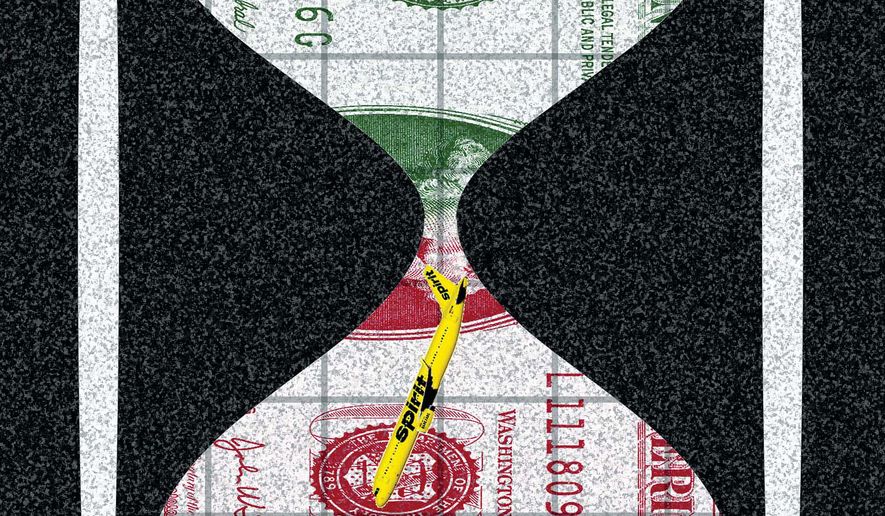
The collapse of Spirit Airlines says a lot about what is right and wrong with the economy, and why whoever sits in the Oval Office has a tough time winning a decent job approval rating.
In 1992, Charter One, a discount charter airline, inaugurated no-frills scheduled service under the Spirit Airlines brand. It was for folks willing to stuff their belongings, lunch and a water bottle into carry-on bags and backpacks — those who could afford a distant vacation or business trip only if travel costs were kept down.
It stole market share from legacy airlines and was profitable until COVID-19. Then the shutdowns starved airlines, and Spirit never really recovered.
People were interested in these podcasts
The Iran war and skyrocketing fuel prices were hardly the only, or even the most important, nails in its coffin.
The big guys fought back by offering basic economy seats, often subsidized by passengers in business and first class.
The hard economics were that since 2019, neither Spirit nor the big legacy carriers could fly passengers for rock-bottom, no-frills fares and still cover their costs.
Spirit was not just for poor folks.
The Wall Street Journal cited Liz Myers, a single mother from Illinois, who flew Spirit to take her children to Walt Disney World and work-training events. Anyone who has paid Disney’s prices knows it is not aimed at people on welfare.
Nowadays, there is less demand for middle-class flying.
Spirit and its competitors could not raise prices enough to break even until someone quit the market.
Now, more people are riding the bus.
Since 1979, the top and bottom thirds of workers have experienced faster wage growth than those in the middle.
In this hourglass economy, more households have incomes above $150,000, and those closer to the bottom are not quite as desperate as they were.
General Mills and Campbell are squeezed by middle-class folks buying store-branded groceries, while the well-off bid up the prices for concerts, theater tickets and sporting events.
From the late 1970s through COVID-19, manufacturing employment fell owing to globalization, supercharged by China’s industrialization and advances in factory automation that boosted productivity.
Now, artificial intelligence is decimating entry-level white-collar jobs.
Affluent parents are doling out more than $50,000 for career coaches to help their college-student offspring land promising first jobs.
It is becoming commonplace for baby boomers to have children who are doing very well in finance, high tech and the professions or who did not make the cut and now struggle to pay off college loans.
Young people are told the country is hungry for tradesmen and technicians. Too often, they cannot land a spot in a community college or union apprenticeship program and turn to private training programs.
A nine-month cosmetology program can cost $17,000, and a 14-month aircraft maintenance program $40,000. Although those lead to decently paying jobs, the tuition begets student loans that can preempt borrowing to purchase a first home.
Either way, the children of folks who once occupied the prosperous middle class face the same squeeze that got Spirit Airlines: insufficient demand.
Most are employed, but they are taking the brunt of the squeeze in real incomes.
Americans are good at coping.
The rise of Walmart, the decline of Macy’s and the success of Spirit until COVID-19 were the products of the middle class still shopping and flying but trading down from coach to no-frills.
Presidents Trump and Biden put the country deeper into debt by doling out pandemic relief that was often banked and then spent gradually through early 2024.
With that cash depleted, Americans are saving less and borrowing more.
That string is running out.
More middle-class folks with decently paying jobs are falling behind on mortgages, credit cards and car payments.
Once-manageable monthly payments become overwhelming with rising homeowners’ association dues, insurance premiums, property taxes and the resumption of student loan payments.
Americans are characteristically confident and optimistic. When things go wrong, they expect it is because the politicians are not offering the right solutions.
Hence, Donald Trump beat President Obama’s secretary of state, Hillary Clinton, in 2016. Then, Mr. Obama’s vice president, Joseph R. Biden, ousted Mr. Trump, who in turn clobbered Mr. Biden.
Politicians increasingly offer quick highs with medicine wagon elixirs.
New York City Mayor Zohran Mamdani was elected on a promise to tax the rich to pay for city-run grocery stores and free bus service, as if that would not drive more wealthy New Yorkers to relocate to Florida.
History teaches that paradigmatic innovations, such as the automobile, create jobs to replace those destroyed. Evidence is emerging that is happening with AI.
The answers do not lie in taxing someone else to pay our bills. We are someone else.
Simply, Americans once again will have to adapt: learn new skills and stop the lemming politicians offering quick cures.
The good news is that we will adapt. Ten years from now, I will be writing about how the middle third has gotten fat again.
• Peter Morici is an economist and emeritus business professor at the University of Maryland, and a national columnist.
Follow the author
Please read our comment policy before commenting.