



OPINION:
Recently, Vice President J.D. Vance granted a series of interviews to The New York Times, USA Today, Fox News and others in which he openly acknowledged that his Christianity influences every aspect of his life: his politics, sense of duty, ambition and moral priorities.
In one interview, he said, “My Christian beliefs encourage me to concentrate on the positive.” He went on to explain how his faith in Christ helps him resist the temptations of “power” and redirect his carnal impulses toward service rather than self.
In another appearance, Mr. Vance stated that he believes he has providentially been placed in office “for a brief period of time to do the most amount of good for God and for the country” that he can.
People were interested in these podcasts
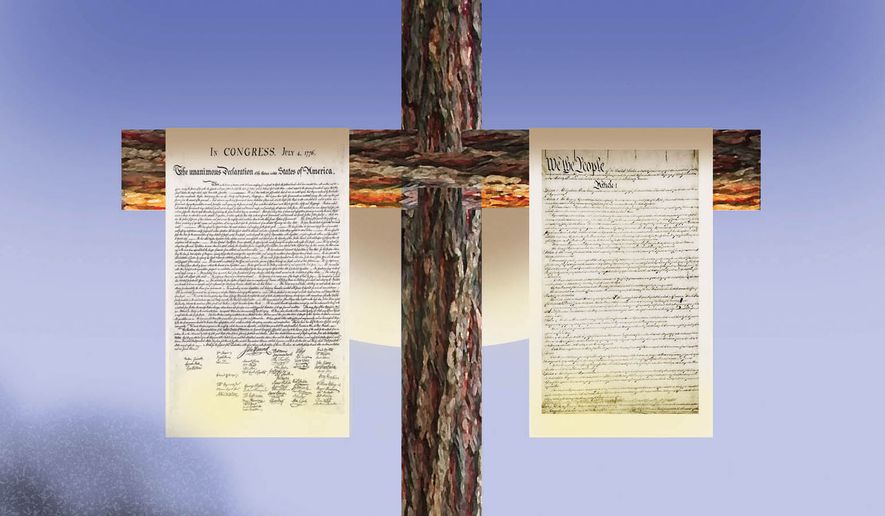
Yet in another, the vice president said history shows clearly that the United States has a Christian foundation and that “Christianity is America’s creed,” one that has provided the “moral language” for America’s public and private life for the past 250 years.
In all these interviews, the vice president was consistent. For him, Christianity is not just a Sunday affair or a “private matter” that he keeps to himself and confines to the four walls of the church. To the contrary, Mr. Vance’s religion is an all-consuming, life-transforming, culture-changing worldview that, if pushed out of the public square, will leave a moral vacuum for both individual citizens and our body politic as a whole.
In summary, Mr. Vance sees the Christian faith as the foundation of America’s moral and social order, diametrically opposed to the radical secularism of the left. He argues that our nation is dramatically weakened by excluding it.
He is right, and he stands in good company.
James Russell Lowell, 19th-century abolitionist, Harvard professor and first editor of the Atlantic Monthly, once said, “The worst kind of religion is no religion at all, and these men living in ease and luxury, indulging themselves in the amusement of going without religion, may be thankful that they live in lands where the gospel they neglect has tamed the beastliness and ferocity of the men who, but for Christianity, might long ago have eaten their carcasses like the South Sea Islanders, or cut off their heads and tanned their hides like the monsters of the French Revolution.”
He went on: “When the microscopic search of skepticism, which had hunted the heavens and sounded the seas to disprove the existence of a Creator, has turned its attention to human society and has found a place on this planet ten miles square where a decent man can live in comfort and security, supporting and educating his children unspoiled and unpolluted; a place where age is reverenced, infancy respected, manhood respected, womanhood honored, and human life held in due regard — when skeptics can find such a place ten miles square on this globe, where the gospel of Christ has not gone and cleared the way and laid the foundation and made decency and security possible, it will then be in order for the skeptical literati to move thither and then ventilate their views. But so long as these men are dependent upon the religion which they discard for every privilege they enjoy, they may well hesitate a little before they seek to rob the Christian of his hope, and humanity of its faith, in that Savior who alone has given to man that hope of life eternal which makes life tolerable and society possible, and robs death of its terrors and the grave of its glooms.”
Hilaire Belloc, the early 20th-century essayist, poet, polemicist and historian, agreed with Mr. Lowell. He said: “The modern world imagines that it has outgrown religion. It has done nothing of the kind. It has merely forgotten it. And because it has forgotten it, it no longer understands itself. Men do not realize that the whole framework of their moral judgments, their political habits, and even their intellectual methods [were] formed within a Christian society and cannot exist long outside it. When that framework breaks, they will not find themselves enlightened, but bewildered; not free, but enslaved; not rational, but confused.”
Belloc, Lowell and Mr. Vance are essentially saying the same thing John Adams said in the earliest days of the birth of our nation: “Our Constitution was made only for a moral and religious people and is wholly inadequate for the government of any other.”
We should all be thankful that our current vice president is willing to suffer ridicule and mockery from our culture’s political intelligentsia and educated elites by reminding us of the obvious: Religion should never be a private matter.
Without Christianity in the public realm, our country — indeed, every country — will inevitably become a hell on earth.
• Everett Piper (dreverettpiper.com, @dreverettpiper), a columnist for The Washington Times, is a former university president and radio host. He is the author of “Not a Day Care: The Devastating Consequences of Abandoning Truth” (Regnery). He can be reached at epiper@dreverettpiper.com.
Follow the author
Please read our comment policy before commenting.