


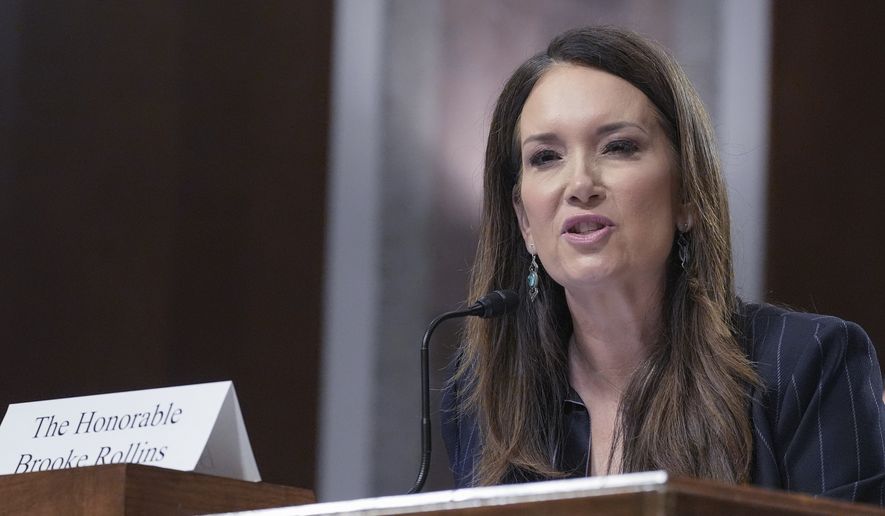

The Department of Agriculture is rolling out a challenge to fast-track fertilizer production in the U.S., complete with half a billion in funding.
Agriculture Secretary Brooke Rollins announced the national initiative Tuesday: the Fertilizer Investment & Expansion for Long-Term Domestic Supply, or the FIELDS Program.
She said it will include a $500 million investment from her department’s rural development team and existing fertilizer facilities.
People were interested in these podcasts
To provide agricultural producers with additional domestic fertilizer options and strengthen the U.S. fertilizer supply chain, the program is intended to begin or expand independent domestic fertilizer production capacity.
Ms. Rollins said the agriculture community is struggling due to the high cost of fertilizer and fuel, jarred by the Iran war’s closure of the Strait of Hormuz.
“Our goal is simple: We want fertilizer plants built in America, and we are willing to prioritize it. We want fertilizer produced in America, and we want fertilizer delivered in America to American farmers, and by doing so, by opening up the market, obviously those prices will come down for our farmers,” she said.
Stephen Alexander Vaden, the deputy agriculture secretary, said, “We know the fertilizer issue didn’t just crop up when there was a conflict in the Middle East; farmers have been dealing with this for at least the past five to six years.”
He added, “We’re going to solve the problem by making strategic investments in projects that are shovel ready and that will produce fertilizers of all types in amounts that will be market significant and that will ensure that we have domestic production here in the United States, so we are not worried about ships on some strait that most people have never heard of, and whether or not they’re going to be able to make it through.”
The Environmental Protection Agency simultaneously kicked off a national challenge with up to $30 million in prize funding to support alternatives to conventional chemical crop desiccation, the common practice of spraying pesticides to dry out crops in the final days before harvest.
It framed its own project as a win on both ends of the dinner table: Farmers receive new tools that lower costs and keep American agriculture competitive in the global market, and families can eat food grown with fewer conventional pesticides.
By supporting cost-effective alternatives to conventional chemical crop desiccation — the common practice of spraying pesticides to dry out crops in the final days before harvest — the project is intended to minimize the use of conventional chemicals.
The $500 million investment is in addition to the Fertilizer Production Expansion Program, a Biden-era initiative providing grants to independent businesses to help them expand the manufacturing and processing of fertilizer and nutrient alternatives in the U.S., with a total allocated funding pool of up to $900 million.
Even as the total dollar amount is smaller than the Biden administration program, “the focus is completely different,” EPA Administrator Lee Zeldin said, adding that the difference is quality over quantity.
“We are looking for a small number of projects that already have the economics behind it, private financing behind it, and that with an injection of federal capital can be accelerated to provide actual fertilizer that farmers can purchase quicker,” he said.
The Trump administration’s newest effort to expand domestic fertilizer production in the U.S. comes on the heels of a landmark court decision and an executive order that protect a popular pesticide: glyphosate.
The Supreme Court ruled in favor of Bayer last Thursday in its fight against failure-to-warn lawsuits regarding cancer claims tied to its popular weedkiller product, Roundup, and its key chemical component, glyphosate.
In February, President Trump signed an executive order to accelerate the domestic production of phosphorus and glyphosate-based herbicides — a directive that establishes these materials as critical for national security and domestic agriculture.
“The importance of our crop protection tools are not just about supporting our farmers; they are truly about supporting a food supply system that moves into national security questions and are absolute,” Ms. Rollins said Tuesday when asked about the high court’s recent decision.
The Make America Healthy Again movement has advocated for the reduction of pesticide and agrochemical use, but the broader Trump administration has been pushing to expand fertilizer production capacity and defend glyphosate specifically. Mr. Trump’s February mandate ignited a rebellion among many MAHA advocates.
The EPA’s challenge, however, is positioned as the MAHA-friendly offset, seemingly keeping fertilizer production and pesticide use as separate conversations.
Contact the author

Please read our comment policy before commenting.