



OPINION:
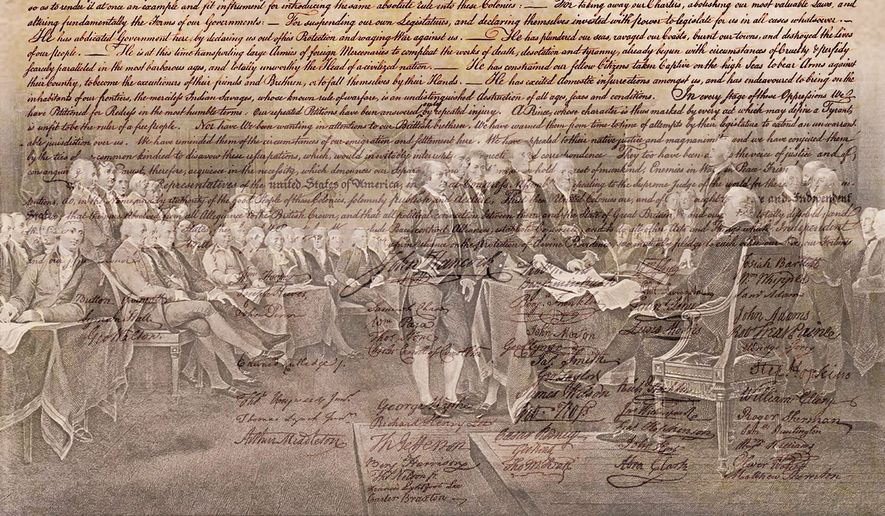
Nearly 250 years ago, 56 men gathered in the Pennsylvania State House. The date: July 4, 1776.
They were young men, untested and unproven. More than a dozen of them were 35 or younger (some guy named Thomas Jefferson was just 33), while only eight were older than 60.
History has a way of flattening its protagonists — turning flesh-and-blood humans into marble statues, their doubts and fears smoothed away by centuries of reverence.
People were interested in these podcasts
But in the days before that pivotal Thursday, the men debating American independence were not statues. They were lawyers, farmers, merchants and scholars. They were husbands and fathers. And they were terrified.
The Second Continental Congress had been wrestling with the question of striking off against the British, who, although 3,500 miles away (by boat, mind you), still controlled the Colonies. King George III was, after all, a bit of a tool.
For the record, it was not, as some romanticized accounts suggest, a unanimous or obvious choice.
John Dickinson of Pennsylvania, one of the most respected legal minds of his generation, refused to sign. He believed reconciliation with Britain was still possible — even desirable. He wasn’t a coward or a loyalist at heart; he was a pragmatist who understood what war truly meant.
And war was already underway. Lexington and Concord had happened more than a year earlier. Men were already dying. The question was no longer whether the Colonies and Britain were in conflict; it was whether that conflict would become something permanent and irreversible.
Jefferson, tasked with drafting the Declaration, had been laboring over the document for weeks. Brilliant, yes, but also acutely aware that he was writing something that could either become the founding text of a new nation or the primary evidence at his treason trial. These were not mutually exclusive possibilities.
This is the detail that modern readers most often gloss over: What these men were doing was treason. Not philosophically. Not metaphorically. Legally, under British law, signing a declaration of independence from the Crown was a hanging offense.
Benjamin Franklin, who at 70 was the elder statesman of the group, reportedly quipped as delegates prepared to sign: “We must all hang together, or most assuredly we shall all hang separately.”
These were men with something to lose. John Hancock, whose signature would become so large and bold that his name became a synonym for the act of signing, was one of the wealthiest merchants in the Colonies. He was risking everything.
So was Robert Morris, who would go on to personally finance significant portions of the Revolutionary War. So was Benjamin Harrison, whose family legacy was deeply tied to Virginia’s social order.
The popular imagination often casts the Founders as idealists, and they were. But they were also acutely rational men who had weighed the costs. The fact that they proceeded anyway is what makes the moment extraordinary.
The ideas were not new, but the movement was. Jefferson drew heavily from John Locke, the 17th-century Enlightenment thinker commonly known as the “father of liberalism,” and his idea of the natural rights tradition that had been building intellectual momentum for decades.
The ideas in the Declaration — that all men are created equal (well, not Blacks, but that’s a whole other kettle of fish that America is still trying to right), that governments derive their just powers from the consent of the governed — were not invented in Philadelphia. They were synthesized, sharpened and then applied in a way that had never been attempted at this scale.
That is no small thing. Philosophy and action are separated by a vast chasm that most ideas never cross. The men in that room in late June and early July of 1776 were attempting to build a bridge across that chasm in real time — while a war raged, their colleagues argued and the summer heat made the Pennsylvania State House nearly unbearable and while British warships sat in New York Harbor.
Leadership, at its most essential, is the willingness to act under conditions of profound uncertainty. The Founders did not know they would win. In fact, they had every reason to think they would lose big. They did not know their republic would survive. They could not have imagined that the document Jefferson was drafting would still be celebrated nearly 250 years later.
What they had, instead of certainty, was conviction — and the discipline to act on it. They had the intellectual honesty to acknowledge what they were risking and the moral seriousness to believe the stakes justified the risk.
On July 2, 1776, the Congress voted for independence. John Adams wrote to his wife, Abigail, that the date would be celebrated by future generations with great festivities. He was off by two days — the Declaration was formally adopted on July 4 — but his instinct was right. Something profound had happened.
In the days just before it did, a group of imperfect, frightened and deeply serious men sat together in a hot room and chose to bet everything on an idea.
That, more than anything else, is worth remembering. We are, without doubt, still imperfect. But tell me the story of the creation of a nation better than the United States of America.
• Joseph Curl covered the White House and politics for a decade for The Washington Times. He can be reached at josephcurl@gmail.com.
Follow the author

Please read our comment policy before commenting.