


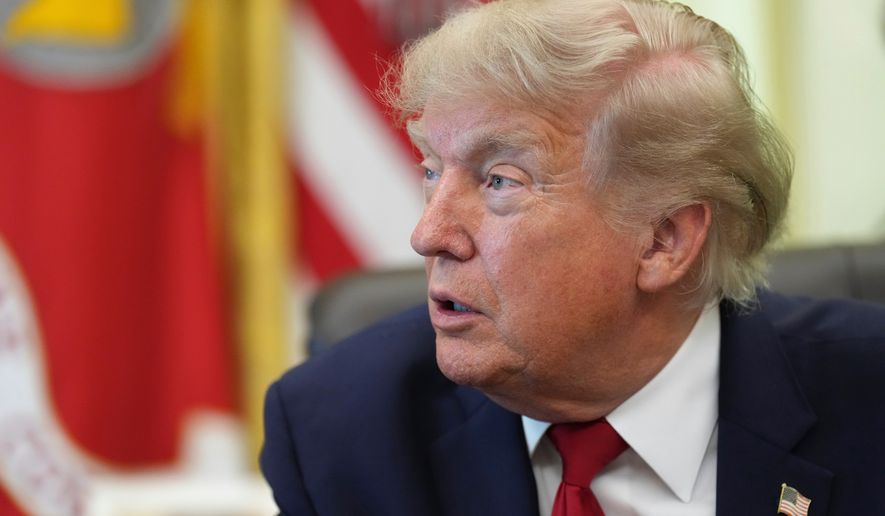

Next week’s NATO summit in Turkey might be the last time President Trump joins alliance heads of state since U.S. officials are considering canceling next year’s event, tentatively planned to take place in Albania, analysts said Tuesday.
“There’s a question of whether there would actually be a summit in 2028 during a U.S. election year,” said Max Bergmann, director of the Europe, Russia and Eurasia Program at the Center for Strategic and International Studies think tank.
Most European leaders are hoping for a “fairly boring and technocratic” July 7-8 NATO gathering without a lot of drama, Mr. Bergmann said Wednesday during a briefing about the upcoming summit hosted by CSIS.
People were interested in these podcasts
“It’s never quite clear with President Trump what will transpire at these summits,” he said.
Ramping up European defense spending and the evolving role of the U.S. in the alliance are likely to top the agenda at the NATO summit.
“We’ll see how that goes, because some European countries have spent more, particularly Nordic countries that have a lot of fiscal space. Other countries have not, such as France and especially the U.K.,” Mr. Bergmann said.
The summit is taking place as the battlefield momentum in the war between Russia and Ukraine is clearly shifting in Kyiv’s favor, said Maria Snegovaya, a senior fellow at CSIS.
“Russia is not winning this war [but] the strategic outlook still remains uncertain,” she said. “I’m sure that the NATO summit will be somewhat a reflection of these trends.”
Seth Jones, president of the Defense and Security Department at CSIS agreed that more than four years after Russian President Vladimir Putin ordered the full-scale invasion, Moscow is not winning.
“We’ve seen actually a decline in Russian control of territory. We’ve seen really significant challenges in Russian casualty rates now surpassing recruitment rates for Russian soldiers,” Mr. Jones said.
Since February 2022, Russian forces have sustained nearly 1.2 million casualties, more losses than any major power in any war since World War II. In addition to the steadily-climbing tally of dead and wounded troops, the Russian people are facing a sputtering economy, high prices at the supermarkets, heavy internet restrictions, and oppressive crackdowns on freedom of speech, analysts said.
“The overall indication is that the Russians, at least at this point — and no war is ever linear — the Russians are actually losing right now,” Mr. Jones said.
Despite the Kremlin’s well-documented setbacks on the ground in Ukraine, Russia could recover over the next four to five years with the help of China and pose additional threats to countries in Eastern Europe, said Seth Jones, president of the Defense and Security Department at CSIS.
“I think the role of the United States [in NATO] is important, both from a conventional standpoint — particularly with the brigade combat teams and some of the long-range strike capabilities — as well as the role of U.S. nuclear forces in Europe that are still important to deter Russian actions,” Mr. Jones said.
Mr. Trump sees NATO as an obsolete alliance designed to benefit 31 other member states at the expense of the U.S taxpayer.
Member states are required to spend a minimum of 2% of their GDP on defense, though some are not. The president was particularly upset when several other NATO members declined to assist the U.S. during Operation Epic Fury, the large-scale U.S.-Israeli military operation against Iran.
Analysts said NATO was designed to keep the U.S. as the central player in Europe. The alliance’s first secretary general famously described its purposes as keeping the Russians out, the Americans in and the Germans down.
“NATO is fundamentally structured around the United States, and has been for the last 77 years. That’s how we have wanted it,” Mr. Bergmann said. “What you have now is 31 countries dependent on docking into the United States.”
This historic fact raises the question of what Europe would do if the U.S. pulls back from the lead role.
“It is a really important fundamental question that Europeans are currently reckoning with,” Mr. Bergmann said. “While Europeans cooperate in basically every other sector, that is not the case for defense.”
NATO Secretary General Mark Rutte is widely referred to as a “Trump whisperer” due to his ability to engage with Mr. Trump and remain on his good side.
“It seems like he’s found the right way to communicate with the U.S. administration in a way that essentially sustains this lack of public, open disagreements,” Ms. Snegovaya said.
Contact the author

Please read our comment policy before commenting.