


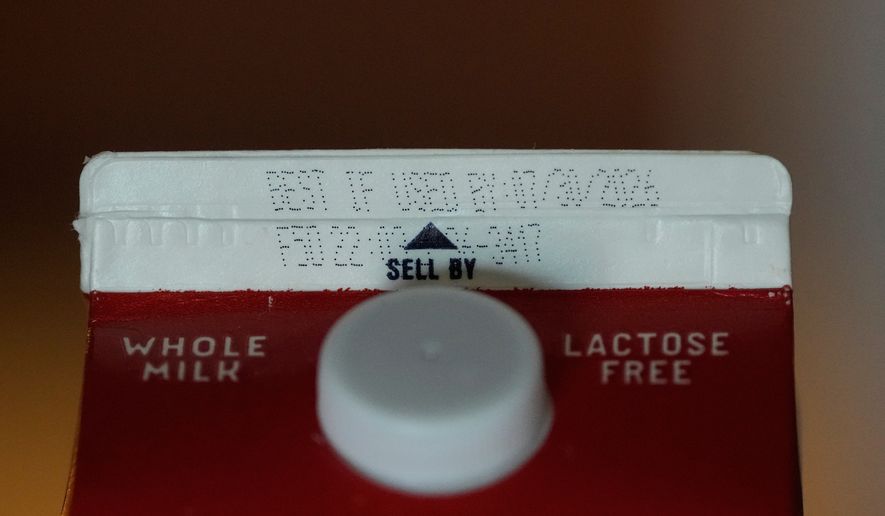

California grocery shelves are getting a makeover this week as a new state law bans the “sell by” date labels that have long left shoppers guessing whether food is spoiled or simply past its prime.
The law, which bans the use of “sell by” labels that experts say act as a guide for retailers on how long to display products on shelves but are not an indicator of whether food is still safe to consume, took effect Wednesday. Under the law, packaged food that carries a date label must use one of two standardized terms — “Best if Used By” for a quality date or “Use By” for a safety date — with the correct designation determined by the nature of the product, not an unrestricted choice by the manufacturer, according to the California Department of Food and Agriculture. Some products may require both a quality and a safety date, while others need neither, since the law generally does not require that a date label be added at all unless another statute already mandates one.
The measure, known as Assembly Bill 660, was authored by Democratic Assemblywoman Jacqui Irwin of Thousand Oaks. California became the first state in the nation to standardize food labels when it approved the law in 2024 as part of a broader push to reduce food waste and greenhouse gas emissions.
People were interested in these podcasts
In a statement cited by Newsweek, Ms. Irwin said, “Having to wonder whether our food is still good is an issue that we all have struggled with,” calling the bill’s signing “a monumental step to keep money in the pockets of consumers while helping the environment and the planet.”
New York state lawmakers have approved a similar law awaiting Gov. Kathy Hochul’s signature, and legislation addressing food labeling has also been proposed in Illinois, Maryland, Massachusetts, New Jersey and South Carolina, though none of those measures has passed.
Nick Lapis, director of advocacy at Californians Against Waste, which co-sponsored the bill, said food labels are the leading cause of household food waste and have also created problems for food banks, since many people mistakenly believe a passed “sell by” date means food has expired. “We don’t need to build some kind of huge infrastructure and invest tons of money to solve this,” Mr. Lapis said. “We just need companies to use the same words across brands.”
There are more than 50 different date labels on packaged food sold in stores nationwide, according to a 2022 report on food waste published by the University of Maryland, and the information on those labels is largely unregulated and often unrelated to food safety. Kumar Chandran, policy director at the nonprofit ReFED, said consumers “get confused and they just default to assuming that whatever date is on the package means ’don’t eat it and throw it away.’”
With no federal regulations requiring what information date labels must include, confusion over date labeling has been estimated by the Food and Drug Administration to account for roughly 20% of consumer food waste nationwide — a distinct figure from overall food waste. Separately, the AP reported that about 6 million tons of unexpired food is tossed in the trash in California each year, a general food-waste estimate cited by state officials and advocacy groups rather than a figure isolating waste caused specifically by label confusion. Currently, infant formula is the only product regulated federally with date labels, though the U.S. Department of Agriculture recommended a decade ago that food sellers switch to “Best if Used By” labeling, and a bipartisan bill establishing a uniform national standard is pending in Congress.
The industry response has been largely favorable. Nate Rose, a spokesman for the California Grocers Association, said some grocers have had to overhaul their labeling systems, but the association has broadly supported the change, calling it “a win-win where we can reduce food waste and consumers will find these decisions a little bit simpler.” He added that shoppers will continue to see old-style labels on shelves for months as retailers sell through existing inventory.
Violations are not subject to a penalty specific to AB 660; rather, they fall under the California Food and Agricultural Code’s general enforcement provisions, which classify most violations of the code as misdemeanors unless a different penalty is expressly provided elsewhere in statute.
This article was constructed with the assistance of artificial intelligence and published by a member of The Washington Times' AI News Desk team. The contents of this report are based solely on The Washington Times' original reporting, wire services, and/or other sources cited within the report. For more information, please read our AI policy or contact Steve Fink, Director of Artificial Intelligence, at sfink@washingtontimes.com
The Washington Times AI Ethics Newsroom Committee can be reached at aispotlight@washingtontimes.com.
Please read our comment policy before commenting.