



A version of this story appeared in the daily Threat Status newsletter from The Washington Times. Click here to receive Threat Status delivered directly to your inbox each weekday.
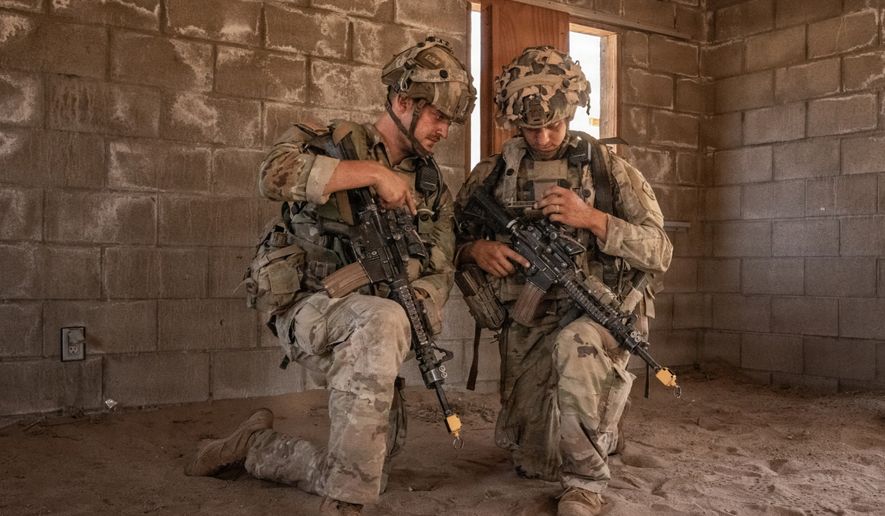
FORT IRWIN, California — An enemy drone flies overhead with its cameras trained on a collection of cinder block, plywood and shipping container structures that the Pentagon has constructed in the desert here to mimic an austere war-zone urban environment.
U.S. Army troops on the ground use billowing smoke to block the drone’s view of their approach to the “mock city,” before moving in through simulated gunfire and seizing a clutch of the makeshift buildings styled after a prison.
Throughout the exercise, Army leaders at various levels are watching the action unfold in real time. Even troop commanders in the middle of the action have cellphone-sized screens — swiveled down from mounts on their chests — showing their location on the map, which building they’re in, where friendly forces are around them and where enemy units are expected to be.
People were interested in these podcasts
This is the futuristic scene that played out during recent weeks in the Mojave Desert, where the Army conducted its largest testing to date of a more than $3 billion Next Generation Command and Control (NGC2) artificial intelligence-integrated digital communications system.
The exercise, known as Project Convergence Capstone 6, saw the Army stress-test the new technology in a vast simulated battle between soldiers, fighting each other across more than 1,000 square miles of desert landscape in blistering 110-degree heat.
The goal, according to Army leadership, was to step into a future where warfare could be reshaped with planning, intelligence, targeting and logistics using advanced new AI-enabled tools and modern communications.
A reporter from The Washington Times’ Threat Status national security team was on the ground for the testing and witnessed soldiers operating in an environment where even the smallest piece of information could feed a commander’s decisions.
U.S. allies directly involved
The main events of the war games focused on the new NGC2 system, a massive overhaul of the Army’s battle communications structure, replacing previous — in some cases aged conventional equipment — with a futuristic mix of custom-built and off-the-shelf components being provided by a slew of defense technology companies.
Maj. Gen. Patrick Ellis, the commander of the 4th Infantry Division, described it as being flexible for a U.S. military embracing a new approach of continually updating to keep pace with rapid technological change, particularly as it relates to AI.
“It’s not perfect. My line would be it’s ready but not done,” Gen. Ellis said during an exclusive interview with Threat Status. “We are ready to deploy this. We are ready to fight with this now, but it’s not totally complete.”
The NGC2 system represents one of the first times the Army has sought to engage in mass-scale leveraging of off-the-shelf components, ready-made for immediate use without long wait times for custom manufacturing.
During the months leading up to the latest testing, the 4th Infantry Division and the U.S. Army’s Futures and Concepts Command at Fort Irwin oversaw a development process that brought defense technology contractors out into the field to take feedback directly from soldiers.
Project Convergence Capstone 6 itself was different. No contractors were around to help, and the goal was to test whether the system is ready for broader use by the Army.
Soldiers from Australia, Britain, Canada and New Zealand participated in the recent war games. Collectively, they brought more troops into the training than many at Fort Irwin had ever seen.
“We have about 9,700 soldiers out there in the box,” said U.S. Army Lt. Gen. Michael McCurry, who heads the Futures and Concepts Command. He added that the drills involved testing more than 90 technologies, including “a whole bunch of drones, some machine learning, artificial intelligence [and] decision tools.”
He and other Army leaders said the result was a successful test that will lead to the NGC2 program continuing and — barring insurmountable engineering challenges — the eventual adoption of the new communications system by the entire U.S. Army.
The ’god-calculator’
The system’s AI-enabled software applications have been dubbed the “god-calculator” by soldiers in the field.
“All the data’s in one location, it’s not existing in a series of stovepipe systems,” Gen. Ellis said. “It broke down all those walls, and all the data is in one place.”
That offers an opportunity to combine intelligence and information from public sources, classified channels and international allies into a single pool that can be used by leadership — and AI — in even some of the most remote locations. All of this operates on a collection of both cloud-based and local computers and is referred to as the “data layer.”
The ability to combine all of the data wasn’t something the Army had the capability to do before the program for the NGC2 prototype started last year. Instead, information was often locked in independent computers specifically designed to accomplish one task: a computer for artillery, missiles and other surface-to-surface munitions, a special program for targeting and intelligence collection, another piece of software for logistics planning.
Now those unique processes sit in what’s known as the “application layer.”
“Instead of connecting bespoke systems to each other, we’re actually connecting systems to the data layer,” Gen. McCurry said. “We can share the information we want to share, protect the information that, as a nation, we’ve decided we want to protect.”
All of that is supported by what the Army calls “transport and integration.”
Integration is where all of the forms of data are coded for use by the overall system. It is, for instance, how GPS information from satellite imagery on an enemy location gets properly displayed on a map viewable on an individual commander’s pocket-sized screen.
Transport consists of tying together the data from all the different types of radios and satellite feeds, as well as things such as the intelligence being soaked up by drones and sending into a secure cloud computing architecture.
The system integrates tools that were previously available only to U.S. Special Forces or for very specific missions. Examples include such technology as the advanced tactical Modular Portable Unit 5, or MPU5, a mesh radio made by New York company Persistent Systems and capable of being completely reprogrammed remotely, or the Starlink-type satellite communications systems made by the California-based company SpaceX.
Under NGC2, information pulsing through those tools is simultaneously connecting to real-time modeling programs anchored around artificial intelligence.
The desert fight
Commanders for the recent drills got nervous as enemy drones suddenly hovered in the sky over the desert. Capt. Alex Bayer, the company commander for a unit carrying out the assault on the mock city at Fort Irwin, said she was concerned the drones would engage lethally to disrupt her mission as she moved her troops forward.
“I was like, man, they’re gonna call for fire,” she said, referring to enemy artillery or other assets that could shoot using the drones as their eyes. “We gotta get in this building quick.”
Capt. Bayer said the NGC2 system helped her plan and engage with the challenge, even though her unit had very little anti-drone technology. She could see where the drone was on the map, planning to move quickly into the compound and use the terrain to avoid it.
The flip-down cellphone-like screen in her possession was her main reference as she called over the radio, directing her soldiers.
“It actually was super helpful because it was populating the PLI [position location information] for my platoon leaders,” she said. “All the buildings are labeled, which is super convenient instead of having a huge map — trying to find it, carry it and run around.”
She could actively see, in real time, where her troops were and when they sent up reports of enemy engagements. Building by building, she was able to coordinate with units next to her on the map as they took hold of the mock city.
She said it also let her higher headquarters know where they could and couldn’t shoot artillery or drop bombs in support of the operation.
“That’s super helpful for them,” Capt. Bayer said. “It helps them to command and control the fight as well, especially when reporting that front line.”
The mock enemy commander took notice.
“What I did see was an increased level of synchronization that I was not expecting,” U.S. Army Capt. Mohamed Elmaola, who acted as an enemy commander during the exercise, said of Capt. Bayer’s assault.
“I’m surprised, based on all the different units, the rapid interoperability,” Capt. Elmaola said. “It was noteworthy in my opinion. In my mind, my goal was to desynchronize a multinational brigade consisting of six battalions.”
That unit, made up of a combination of American, Australian, British, and New Zealander troops, worked together to attack the mock city using the NGC2 system.
“They were definitely more synchronized in their attack on the city than I expected,” Capt. Elmaola said.
That’s exactly the goal, according to Gen. Ellis. Commanders having a real-time map with both friendly and enemy locations that they can look at as it’s happening allows units to coordinate and leverage AI-enabled tools that speed up planning and targeting.
“We had some really in-depth discussions about ‘Hey, I’m concerned about this piece, you’re concerned about that piece, how do we make this all work?’ And everybody is drawing on there and having the conversation,” Gen. Ellis said. “We couldn’t do that two years ago in this division, so from my perspective I think that’s phenomenal.”
As commanders debate tactical decisions in real time on the NGC2 system, icons pop up on their screens showing enemy locations and capabilities, analyzing all of the sensors from across the battlefield to provide data and assess threats.
The system simultaneously feeds a machine-learning model that can be prompted to “predict what the outcomes are going to be” of certain decisions, giving percentages of success or failure and taking into account factors such as ammunition and fuel that friendly troops are holding.
“The models aren’t perfect, but then again neither were the war games in the past where we were using dice and standing around a big map in the dirt, moving wooden blocks around,” Gen. Ellis said. “It’s helping us think through problems, helping us solve those, and we don’t have to all be in the same physical space to do that.”
Major energy consumption
More than 40 private defense companies are involved in NGC2’s development, all of which fall under the purview of Joe Welch, the Pentagon’s portfolio acquisition executive in charge of the system.
He told reporters during the testing at Fort Irwin that collaboration among the sometimes-competing companies, coupled with a focus on allowing private technology contractors to connect directly with the troops during the testing process, has dramatically accelerated development timelines.
“I think that’s really the secret sauce,” Mr. Welch said. “It is a success of our Army transformation and acquisition transformation journey.”
Contractors tend to agree, citing a new era of futuristic defense industry collaboration.
“A huge part of the advancement that NGC2 has made is in creating a new operating model for how the Army thinks about next-generation programs,” said Tara Murphy Dougherty, the CEO of Air, an AI-enabled national security logistics company and software platform.
Air is one of the original participants in the development of NGC2, pushing early for AI-assisted predictive logistics to be integrated into the system in the hope of creating a platform that can deliver food, fuel and ammunition before needs become dire, and without the bureaucratic slowdown of repeated requests being sent up the chain of command.
This is “all about this collaboration of the Army saying, ‘Here are our problems or challenges. Bring us your ideas about how to solve them,’” said Ms. Murphy Dougherty.
The approach is akin to that of the private commercial technology industry, where companies build products to meet a need, but also adapt quickly to new developments or market trends.
But there are still hurdles to overcome in the NGC2 system’s development. Commanders in the recent mock-city fight noted that power consumption and heat created problems.
“The energy demand that comes with NGC2 is something we can’t overlook,” Capt. Elmaola said. “Especially when we start meeting austere terrain such as the desert.”
Capt. Bayer reported issues with some of the MPU5 radios used during the war games. “We put them on a charger and it used to take maybe two hours for a battery,” she said. “Yesterday, six hours. And then some of them just refused to charge. It’s too hot.”
Overheating affected much of the newer technology. Capt. Bayer described some of her soldiers carrying spare batteries only to eventually find that they had become “dead weight” in their packs.
But some creative solutions worked. In one example, soldiers realized that dunking a spare T-shirt into cold water and wrapping it around Starlink antennas quickly brought down the equipment’s temperature.
“The question is, when you’re using commercial technology, do you have to ruggedize it? I don’t know,” Gen. Ellis said. “I’m not sure the entire Army would need a massively ruggedized, and probably fan-cooled and very expensive cooling system to make it work where a brown T-shirt and ice water can solve that problem.”
He added that lessons from the recent testing are being transferred to 1st Corps, the U.S. Army’s higher headquarters that is next in line to broaden out the NGC2 fielding.
“I think a lot of the technology can evolve and be adapted,” the general said. “But I can tell you that we’re very happy with where we have, hopefully, driven the base product to provide this prototype to the Army.”
Contact the author

Please read our comment policy before commenting.