


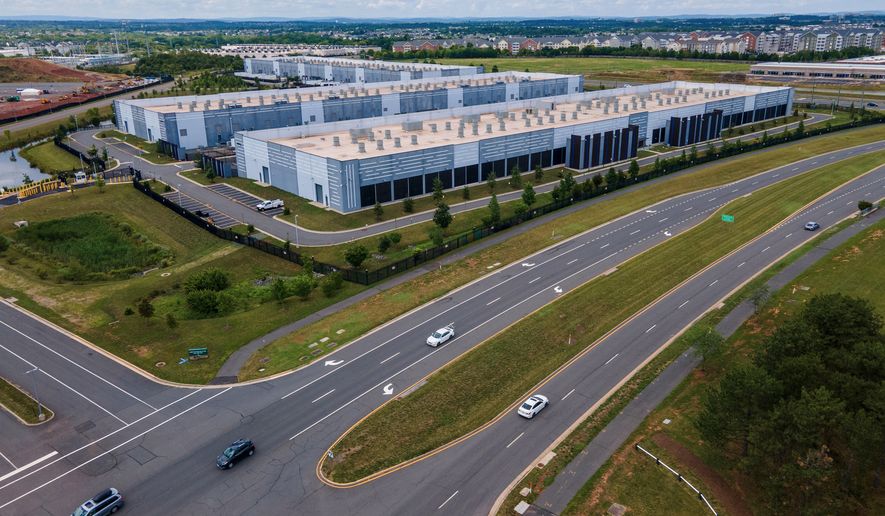

More restrictive legislation could soon curb Virginia’s data center boom, as residents push back on increased noise and utility bills.
In the Virginia General Assembly, Republican state Sen. Glen Sturtevant and Democratic Senate President Pro Tem L. Louise Lucas recently called on Gov. Abigail Spanberger to end the commonwealth’s $1.6 billion annual data center sales tax exemption.
Ms. Spanberger, a Democrat who took office in January, already has signed several laws regulating data centers that impose new energy taxes and shift grid infrastructure costs from residents to operators.
People were interested in these podcasts
Officials at the environmental consulting firm Gasilov Group noted that 46 more data center bills are pending in the Virginia Legislature next year, in addition to a growing number of counties and cities considering pauses on new applications.
“They do have the potential to slow growth down,” said Arif Gasilov, a partner specializing in energy at the Tucson, Arizona-based firm. “If Virginia isn’t suitable to build data centers anymore, you could see opportunities opening up in nearby states that ease regulations.”
Mr. Gasilov noted that the Gallup polling firm reported in May that 71% of adults who responded to a survey did not want a data center built near them.
Lawyers, industry experts and political observers interviewed by The Washington Times predicted that “pay your own way” policies might make Virginia more like Maryland and the District of Columbia, where data centers are less common.
“The public was welcoming at first of data centers as ‘clean’ cash cows that required few public services and were supposed to generate tax revenue,” said Viktor Pregel, a D.C. lawyer specializing in public-private partnership development projects. “But public reception has soured due to issues like visual blight, noise and rising utility bills.”
A January poll from the Global Strategy Group and the Chesapeake Climate Action Network Action Fund found that 73% of 800 likely Virginia voters blamed data centers for rising electricity costs.
Manassas homeowner Patrick Harders says his utility bills jumped by 30% and have continued to increase because of the 63 data centers in his city.
“I think Virginia has to become more like Maryland because people are starting to see the impact on noise levels, water usage and utility bills,” said Mr. Harders, a former Republican candidate for the Prince William Board of County Supervisors. “There was just too much of it approved, too fast and too recklessly.”
He urges Virginia lawmakers to follow the example of Maryland’s Montgomery County Council, which last week voted for an 18-month moratorium on new data center construction.
The industry tracking site DataCenterMap estimates that 68 companies have opened a nationwide high of 651 data centers in Virginia since the state enacted its sales tax exemption in 2008. Most are in the northern part of the state, which handles a large share of the world’s internet traffic.
Maryland operates 58 data centers, mostly around Baltimore and in Frederick County. Strong local restrictions have kept that number from growing.
The District has six data centers, primarily clustered along the K Street and Virginia Avenue downtown corridor. The city’s maze of environmental regulations has prevented more from appearing.
In Virginia, public backlash has slowed development. That includes Prince William County, where a plan to build the world’s largest hub near the Manassas Civil War battlefield died last month after angry homeowners and preservationists won a series of legal fights.
“I would expect that there will be significant new legislative restrictions on data center operators in the state of Virginia in the next couple of legislative sessions as the data center advocates see the impacts on their constituents,” said Mac Haddow, president of the Oak Valley Homeowners’ Association, which successfully sued to block the hub.
Cash cows
Advocates tout the benefits of data centers to local economies and government revenues.
Virginia’s Joint Legislative Audit and Review Commission estimates that data centers contributed 74,000 jobs, $5.5 billion in labor income and $9.1 billion in gross domestic product to Virginia’s economy in 2024. That’s roughly 1% of the commonwealth’s GDP.
More recent estimates show even larger amounts flowing into government coffers and the statewide economy.
“If you combine prudent budgeting with data center investments, they can be a boon for the nearby people,” said Josh T. Smith, a data center researcher at the libertarian Pacific Legal Foundation.
Mr. Smith estimated that data centers use about 5% of electricity nationally. The Department of Energy estimates that data centers’ consumption rate will grow from 4.4% in 2024 to between 6.7% and 12% by 2028.
“Bans don’t solve any of the real problems revealed by the data center boom,” Mr. Smith said.
In Virginia, the Loudoun County government’s website states that data centers have lowered taxes for residents.
“For every $1 in services that Loudoun County provides to data centers, the county receives $26 in tax revenue,” a website page states.
The Data Center Coalition, an industry trade group, estimates that Loudoun County will collect more than $1 billion in tax revenue from the industry this year and Prince William County more than half a billion dollars.
“Northern Virginia became a world-leading data center market thanks to smart, forward-looking policies at the state and local level that led to significant investment and economic benefits for the communities who chose to welcome data center investment,” said Nicole Riley, the Data Center Coalition’s director of Virginia government affairs, in an email.
Future trends
Data center pushback has grown nationally: Last month, New York became the first state to ban data centers, as Democratic Gov. Kathy Hochul ordered a one-year moratorium.
It remains unclear whether increased regulatory burdens will cause data center companies to relocate from Virginia or merely pull back on new applications.
Ms. Riley said the Data Center Coalition encourages state and local policymakers to embrace “market competition” as a response to local concerns.
“Competitiveness is a function of many factors, including available and suitable land, workforce, infrastructure, tax and regulatory environment, and local sentiment,” she said. “Which is why we encourage policymakers to adopt policies that allow for communities to compete for the responsible growth and investment that they want.”
Virginia has more data centers per capita and per square mile than Maryland.
The District leads the region in both metrics due to its small size, and it has not passed laws specific to data centers. But the city’s environmental laws and restrictive zoning have stifled further large-scale data center development.
In Maryland, Democratic Gov. Wes Moore has declared data centers “critical infrastructure” and signed legislation to streamline permitting requirements. His office and the Democrat-controlled General Assembly have requested a report on the likely environmental, energy and economic impacts of data center development by Sept. 1.
The state capital, Annapolis, sits in Anne Arundel County, which has offered tax breaks to data centers.
But the CCAN Action Fund estimates that 3 out of 4 Marylanders live in cities or counties that have paused data center development — including Frederick, Baltimore, Washington and Prince George’s counties.
Virginia’s Loudoun County, home to 250 data centers, is also considering a moratorium on new applications.
Advocates of restrictions insist that energy taxes, special-use permits, sound engineering studies and set-back limits from residential properties will make data centers more acceptable to Virginia residents.
Attorney Chap Peterson, a Democratic former state lawmaker, warned that voters are running out of patience for the centers.
“Local governments are no longer rolling out the welcome mat, and I expect the sales tax exemption to remain under scrutiny,” said Mr. Peterson, who represents preservationists opposed to Prince William data centers.
“Data centers take too much space, use too much energy and soak up a lot of water,” he added. “That’s a problem that must be solved ASAP.”
Contact the author

Please read our comment policy before commenting.