


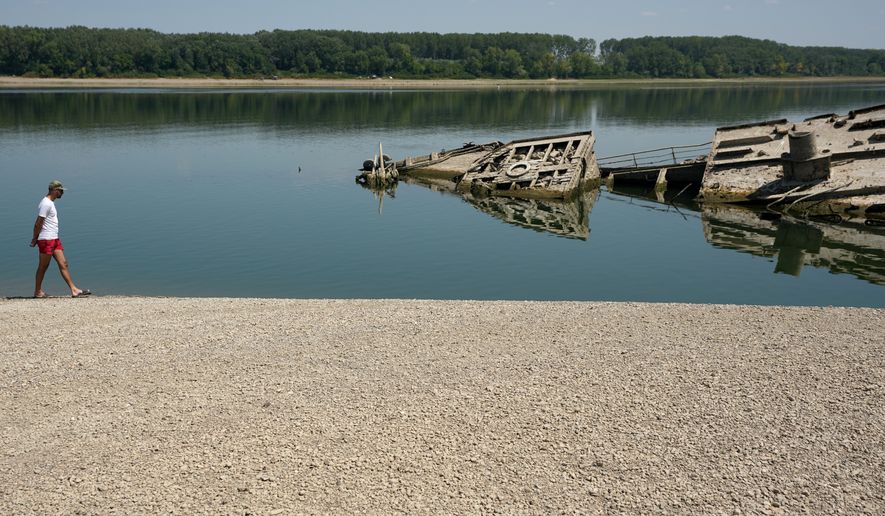

PRAHOVO, Serbia — Water levels on the Danube River, the second longest in Europe, have dropped so low because of drought that the hulks of dozens of World War II German battleships are emerging into view.
They are a curious distraction from the summer heat crisis. The Danube’s record-low water levels also have forced power plants to the brink of shutting down, and governments across Central and Eastern Europe are taking steps to conserve electricity.
In the middle of the river separating Serbia and Romania near the Serbian port of Prahovo, a rusty hull is now visible along with a broken mast where the Nazi flag used to fly.
People were interested in these podcasts
The ships, some still laden with weapons, belonged to Nazi Germany’s Black Sea fleet that the Germans deliberately sank as they retreated from Romania and as Soviet forces advanced deeper into Europe near the end of the war.
Historians say up to 200 German warships were scuttled in September 1944 near Prahovo in the Danube gorge as they came under Soviet fire. The idea behind the deliberate sinking was to slow the Soviet advance in the Balkans. But Nazi Germany surrendered months later, in May 1945.
The sight of the old warships is a reminder that the Serbian government, with European Union financial support, has long been trying to do something about them. Some were removed from the river by Communist Yugoslav authorities, but most have remained because of the explosives they carried.
Now, however, authorities are trying to keep traffic flowing on the Danube, which flows through 10 nations, as the dropping water levels create dangerous conditions.
Krsta Brandic, a Prahovo resident, said the low water levels have almost stopped ship traffic: “As you can see, the [big] ships can’t pass anymore.”
Hundreds of small boats and dozens of cargo ships were marooned on the dried out river bank near the northern Serbian city of Novi Sad.
Elsewhere along the Danube, the low water level has forced popular cruise ships, where passengers usually disembark for sightseeing in Budapest, to dock far upriver, while cargo ships have stopped operating nearly entirely, according to Hungary’s Ministry of Transport and Investment.
In Bulgaria, where the Danube forms a border with Romania, police evacuated 186 tourists from a cruise ship that had run aground near the port city of Vidin.
The ship Viking Ullur, which had been scheduled to take on supplies in Vidin, was unable to reach the port after running into a shallow shoal, according to Bulgaria’s state news agency BTA.
Bulgarian border police said the ship was running low on drinking water when it went aground.
Viking strongly disputed reports that there had been a shortage of food or drinking water on board the Viking Ullur at the time of the incident. A representative of the company said the ship was “well stocked with food and potable water for all guests and crew,” and that there were sufficient provisions to support those on board for up a week after the incident.
One house boat owner, Radovan Segrt, who runs river excursions on his vessel, told The Associated Press that the water in the Danube had withdrawn “some 15 to 20 meters [50 to 65 feet] from its shore.”
“The summer season is over now, as far as boat riding is concerned,” he said.
Please read our comment policy before commenting.