



A version of this story appeared in the daily Threat Status newsletter from The Washington Times. Click here to receive Threat Status delivered directly to your inbox each weekday.
KYIV, Ukraine — A little after 3 p.m. Sunday, the solitary wail of an air raid siren rose above Kyiv’s busy Chokolivskyi Boulevard. Within seconds, others joined it, echoing through Solomianskyi, a sprawling residential and transport district southwest of the city center.
Few passersby appeared to pay much attention. The previous alert had ended less than half an hour earlier.
That nerve-wracking yet increasingly familiar rhythm is part of a new Russian pressure campaign against the Ukrainian capital.
People were interested in these podcasts
For days, Russian forces have been sending small groups of Shahed-type drones toward Kyiv at regular intervals, sometimes only 30 to 60 minutes apart, stretching air raid alerts across much of the day and repeatedly disrupting transportation, businesses and logistics.
On Thursday, Kyiv endured 13 alerts totaling 872 minutes — nearly 15 hours and a single-day record since Russia launched its full-scale invasion in 2022. A prolonged Russian strike series over the next two days lasted more than 28 hours and involved more than 550 drones and loitering munitions.
The effect can be disproportionate to the number of drones involved. Each new incursion can interrupt sections of Kyiv’s metro, delay trains, send employees and customers toward shelters and force air defense crews back into action.
The repeated alerts Thursday disrupted metro lines, and some Ukrainian long-distance trains accumulated delays of more than 17 hours.
On Sunday afternoon, the all-clear came at 3:36 p.m. The respite lasted 18 minutes.
At 3:54 p.m., the sirens started again as authorities warned of more jet-powered drones approaching. By late afternoon, Kyiv had already undergone eight air-raid alerts.
The tactic is being deployed while Kyiv is already under sustained pressure from another direction. A critical shortage of Patriot interceptor missiles has left the capital increasingly vulnerable to ballistic attack, and Russia has moved quickly to exploit the gap.
Ukrainian military intelligence says Moscow more than tripled its use of ballistic and hypersonic missiles from April to July. In July alone, Russia fired 198 Iskander-M, S-400 and Zircon weapons across Ukraine, the highest monthly total this year.
Russia has also resumed using North Korean ballistic missiles supplied by Pyongyang.
A series of major ballistic strikes on Kyiv since early July has killed dozens of people and damaged apartment buildings, schools, warehouses and critical infrastructure. President Volodymyr Zelenskyy said on Aug. 5 that allied deliveries of air defense missiles in 2026 had fallen to roughly one-third of last year’s level.
Municipal authorities have repeatedly urged residents not to ignore the sirens. During the massive attack overnight July 29-30, more than 56,000 people sought shelter in Kyiv’s metro system.
Still, Russia’s latest tactic presents the city with a difficult problem: How long can several million people repeatedly suspend normal life when the sirens return hour after hour?
Weaponizing the air raid
Russia’s newer jet-powered Geran drones are particularly well-suited to the campaign. Faster and more maneuverable than the propeller-driven Shaheds that have become a fixture of the war, they reduce the time available for Ukrainian forces to react and can be difficult for Ukraine’s growing fleet of inexpensive interceptor drones to catch.
The drones are also becoming more agile. Recent footage showed a jet-powered Geran making an abrupt 180-degree turn over Kyiv, maneuverability that the Washington-based Institute for the Study of War said could make interception more difficult.
Combined with Russia’s tactic of dispatching small groups at intervals, the aircraft can repeatedly force Kyiv’s defenses into action while keeping the city on alert for hours.
“They don’t even have to strike,” said Yuriy, a Kyiv taxi driver. “They can paralyze the city by just flying in circles above our heads.”
The Institute for the Study of War said the attacks indicate that Russia is shifting toward “prolonged strike series” designed to maximize damage and disrupt everyday life.
The institute assessed that the small, staggered waves are meant to force civilians repeatedly into shelters, disrupt public transportation and compel businesses to temporarily suspend operations, inflicting economic damage even when most of the drones are intercepted. Russia began adding daytime attacks to its traditional nighttime strike pattern in April, the institute said.
Ukrainian military analyst Oleksandr Musiienko sees the simultaneous targeting of warehouses, logistics centers and commercial facilities as another part of the same campaign.
“The enemy is focusing on weakening the overall economic potential of Ukraine and the capital,” he said.
While repeated Shahed waves disrupt the city for hours, Russia has also been attacking the physical infrastructure that keeps Kyiv supplied and functioning: supermarket distribution centers, parcel-sorting hubs, warehouses and other logistics facilities in the capital and surrounding region.
The result is a two-pronged pressure campaign. The drones interrupt economic activity in real time, while strikes on warehouses and distribution centers degrade the networks that allow businesses to resume operations once the sirens stop.
Striking the supply chain
The pressure intensified dramatically in early August.
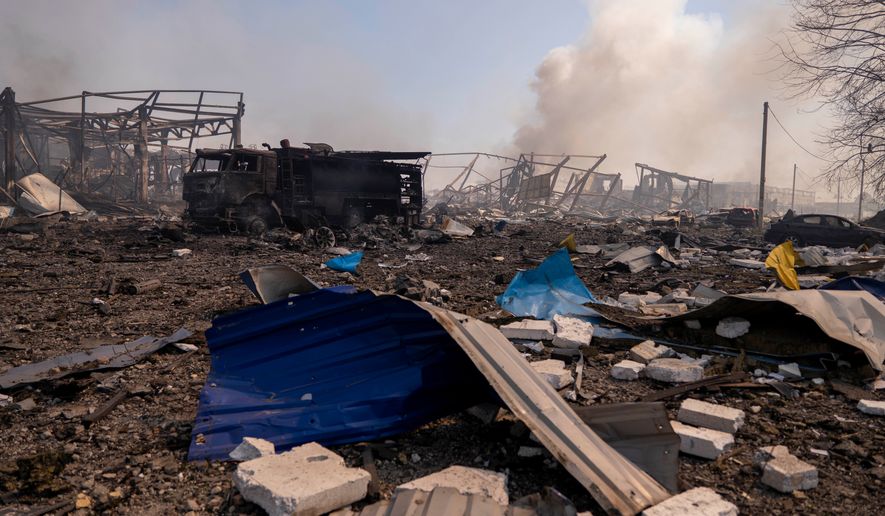
Russian strikes damaged four Fozzy Group distribution centers that supply the Silpo, Fora and Thrash supermarket chains. Novus’ main logistics center was hit again, while a Nova Poshta sorting hub in Kyiv and Rozetka’s largest distribution complex in nearby Brovary were destroyed. Rozetka said the highly automated facility had processed more than 100,000 orders a day and could not be rebuilt.
The Russian Defense Ministry openly said it had targeted logistics centers around Kyiv, alleging they were storing or distributing dual-use products and components for Ukraine’s drone industry. Reuters said it could not independently verify those claims.
The attacks have continued as retailers try to recover.
On Aug. 20, a Russian strike hit a fresh-produce warehouse in Martusivka, outside Kyiv, that Fora had begun using only the previous week after earlier attacks on its logistics network. The company said it was forced to reroute supplies again.
Another wave Thursday damaged distribution facilities belonging to Fora, electronics retailer Comfy and toy retailer Budynok Ihrashok and destroyed a Roshen warehouse in the Kyiv region.
The following night, Russian drones destroyed Nova Poshta’s sorting depot and its most advanced robotic fulfillment center in Sviatopetrivske, southwest of Kyiv.
Agriculture Minister Taras Vysotskyi estimated Friday that roughly 90% of the modern distribution and warehouse capacity operated by Ukrainian retail chains had been destroyed.
He cautioned that the figure did not mean the country was about to run out of food. Still, the damage has already forced retailers to reroute supplies and contributed to intermittent shortages of products, including fresh fruit and vegetables, dairy products and sugar in Kyiv stores.
Companies are changing how they operate.
Nova Poshta, which began decentralizing its sorting network after the first major attacks this month, said Sunday that its branches around the country will increasingly double as local warehouses. Inventory will be dispersed among numerous locations rather than concentrated in large fulfillment centers that can be crippled by a single strike.
The Ukrainian government now faces a similar adaptation problem on the scale of the capital itself.
Prime Minister Serhii Koretskyi said Saturday that officials were drafting procedures governing how businesses, government institutions, logistics networks and public transportation should operate during prolonged alerts. The government is also reviewing metro operations, curfew rules and how quickly residents receive information about different types of aerial threats.
“Prolonged air raid alerts affect not only people’s safety, but also the work of enterprises, logistics, transport, schools, kindergartens and other spheres of life,” Mr. Koretskyi said. Russia, he added, is trying to “paralyze economic activity” in Kyiv and other major cities.
The military is racing to solve the other half of the problem. Defense Minister Yevhenii Khmara said Sunday that Ukraine had tested four potential interceptor systems capable of shooting down the new jet-powered drones, but the successful designs were yet to be produced at scale.
The race is likely to become more urgent as winter approaches.
The Russian Defense Ministry threatened Sunday to launch another large-scale campaign against Ukraine’s energy infrastructure. Kyiv has spent months repairing and decentralizing its power system, but it must now defend that network while protecting logistics centers, businesses and cities from a growing variety of Russian weapons.
Patriot missiles remain particularly scarce. Mr. Zelenskyy says Ukraine needs at least 300 additional interceptors to make it through the winter, when Russia is expected to resume concentrated attacks on electricity and heating infrastructure.
Kyiv has repeatedly adapted to Russia’s air war, from mobile anti-drone teams to interceptor drones and decentralized power generation. The latest Russian tactic poses a different challenge. Ukraine must find a way to protect people without allowing a handful of incoming drones to repeatedly shut down the economic life of its capital.
With ballistic missiles still punching through depleted defenses and another winter bombing campaign looming, keeping Kyiv running may soon become almost as important as keeping out the drones.
Please read our comment policy before commenting.