


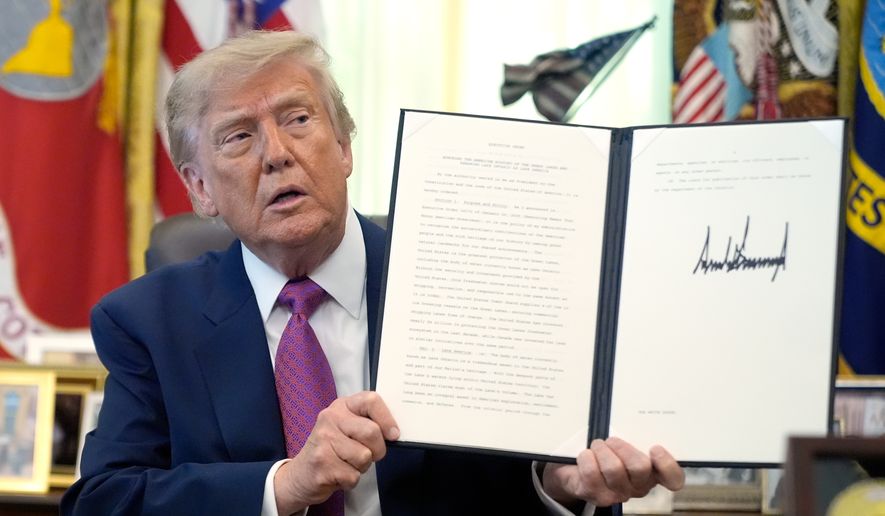

President Trump on Thursday ordered the Interior Department to update maps and databases to rename Lake Ontario as Lake America, following through on his threat during a trade spat with Canada.
Mr. Trump made the change by signing an executive order in the Oval Office next to a giant poster that said, “Making the Great Lakes even greater.”
“We’ve notified all the various people that you need to notify,” Mr. Trump said. “This is official, effective immediately.”
People were interested in these podcasts
Lake Ontario, one of the five Great Lakes, is located between the state of New York and the Canadian province of Ontario, which shares its name.
Though the surface area of the lake is split nearly evenly — 52% Canada and 48% U.S. — White House Staff Secretary Ben Moss said most of the lake’s volume is in the American half and that the deepest parts are on the U.S. side.
The president’s order directs Interior Secretary Doug Burgum, in conjunction with the Board on Geographic Names, to update the Geographic Names Information System “to reflect the renaming of the lake and remove all references to Lake Ontario from the GNIS.”
SEE ALSO: Trump’s tariffs shrank the trade deficit. They also raised your prices
That will make it official, though the executive order applies to U.S. federal agency usage and does not legally alter Canadian, state or international naming standards. The order directs federal agencies to complete database updates within 30 days.
Canadian Prime Minister Mark Carney rejected the change, saying the name comes from the indigenous Wendat word Ontari’io, which means “the lake is beautiful” or “the lake is big,” and predates the Confederation of Canada and the American Declaration of Independence.
“We know that America is changing. Their trading relationships, their foreign policies, their national monuments, their hydronyms,” Mr. Carney said on social media. “Canadians also know that naming reality means calling it Lake Ontario — then, now and always.”
Vermont Gov. Phil Scott, a Republican, called the name change “petty and disappointing.”
“We should be at the negotiating table, finding a path forward that strengthens both the U.S. and Canadian economies. Further escalating tensions does nothing to help American or Canadian families and businesses,” he said on X.
The decision to rename Lake Ontario echoes Mr. Trump’s decision to rename the Gulf of Mexico as the Gulf of America. Other countries still use the old name.
SEE ALSO: Canada sees progress in dispute over French language in U.S. trade talks
“We have a gulf, and we have a lake. Now, all we need is an ocean,” Mr. Trump said. “So maybe we’ll have to change the Atlantic and/or the Pacific. Maybe we’ll change them both.”
Mr. Trump decided to change the lake’s name after imposing 50% tariffs on about $20 billion worth of Canadian goods on Saturday. He slapped the levies on America’s northern ally after trade talks collapsed.
Mr. Carney said the U.S. made unacceptable demands, so his government retaliated Tuesday with “dollar-for-dollar” tariffs on American products, effective Sept. 8.
“They’re nasty people,” Mr. Trump said of Canadian officials. “I had them figured out in my first term, and I did some pretty strong things.
“Now, I’m coming back and finishing the job,” he said.
At the same time, a Canadian official said the U.S. might not make French language and cultural provisions a sticking point in trade talks, a potential sign of de-escalation between the nations.
Dominic LeBlanc, Canada’s minister responsible for Canada-U.S. trade, said he was “pleased” that officials in the Trump administration said those issues would not be included in trade measures imposed by the Americans.
“We look forward to further constructive U.S. clarifications on their other positions which would create the possibility of a mutually beneficial trade agreement that respects Canadian sovereignty,” Mr. LeBlanc said on social media.
Over the weekend, Mr. Carney said the U.S. wanted to water down rules requiring streaming services to promote Canadian and French-language content.
“It was unacceptable right from the start, but the Americans kept trying and trying, and we said no,” Mr. Carney said at a news conference.
Commerce Secretary Howard Lutnick said Thursday that the Canadians were playing tough as a political ploy ahead of Quebec’s provincial election and an Alberta referendum this fall.
“My guess would be as soon as [Mr. Carney’s] elections are over, you’re going to see a plane full of Canadian negotiators,” he told reporters.
Mr. LeBlanc signaled progress after U.S. Trade Representative Jamieson Greer said the American side wanted to highlight concerns about French-language rules without making them a deal-breaker.
Speaking to the Canadian Broadcasting Corp., Mr. Greer said the Trump administration recognizes the importance of the French language in Canada, particularly in Quebec and the Maritime Provinces.
“We know that this is quite sensitive and quite important. There is no way we would let a good deal go by for something like this,” Mr. Greer said. “It’s like the farthest thing from a red line.”
Mr. Trump says the tariffs, which are duties on foreign products brought to U.S. markets, are necessary to rebalance trade after Canada treated U.S. producers unfairly.
He is worried about the trade deficit, as the value of Canadian products sold to the rich American market exceeds the value of goods Canadians buy from U.S. producers.
“We’re losing $62 billion a year, on average, to Canada,” Mr. Trump said. “We don’t want to lose it anymore.”
Canada recently softened its retaliation, saying it would remove seafood from the list of targeted U.S. products after consulting with affected industries.
Sen. Susan M. Collins, Maine Republican, cheered the decision.
“These tariffs would have caused tremendous harm to Maine’s lobstermen, disrupting one of their most important markets during the fall fishing season,” she said. “I urge the U.S. to respond to this show of good faith from our Canadian friends by returning to the negotiating table and working to amicably resolve this trade dispute.”
Contact the author

Please read our comment policy before commenting.