


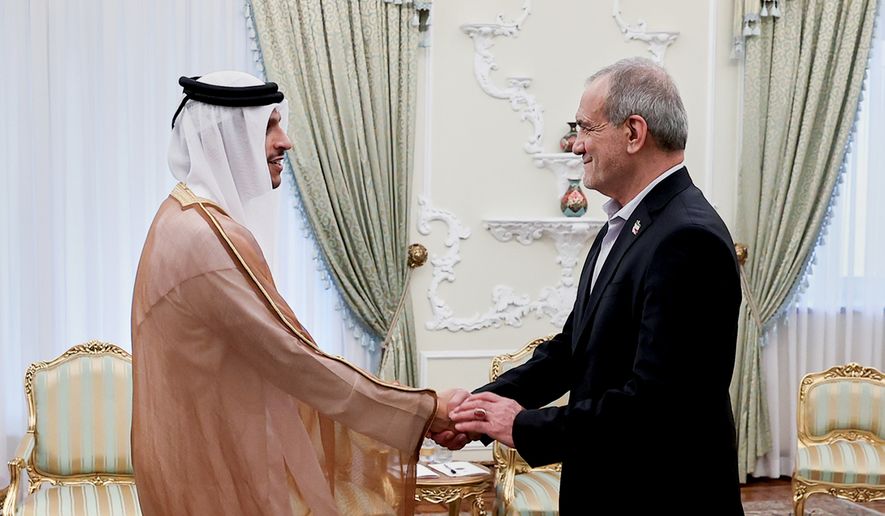

Qatar’s prime minister, Sheikh Mohammed bin Abdulrahman Al Thani, continued his Iran war mediation efforts, meeting Thursday with Iranian officials as the conflict nears its six-month mark.
Mr. Al Thani, whose country has served as one of the primary mediators between Iran and the U.S., met in Tehran with Iranian Foreign Minister Abbas Araghchi, Parliament Speaker Mohammad Bagher Ghalibaf, President Masoud Pezeshkian and Supreme National Security Council Secretary Mohsen Rezaei.
Mr. Al Thani underscored that diplomacy remains the only path to peace, according to Qatari government spokesman Majed al-Ansari.
People were interested in these podcasts
“Qatar believes that dialogue and diplomatic solutions remain the optimal path for addressing disputes and overcoming crises,” Mr. Al Thani wrote on X.
The officials also discussed an emerging framework aimed at future control of the Strait of Hormuz, negotiated between Iran and Oman the past two months. The deal would reportedly establish temporary maritime routes for commercial vessels and launch a joint mine-clearing operation.
The strait has been disrupted since the U.S. and Israel launched joint strikes on Iran in February. That’s driven a rise in global oil and gas prices, with Brent crude trading at $84 a barrel Thursday, $15 above prewar levels. At least one-fifth of the world’s oil and natural gas flowed through the strait before the war began.
Even as Iranian and Omani officials say both sides have agreed on the proposed shipping routes, Tehran insists the deal alone will not reopen the strait. Iran is also demanding that the U.S. lift its naval blockade and sanctions before the waterway can be considered safe for commercial traffic.
The Qatari visit is the second major diplomatic mission to Tehran this week following a Pakistani delegation led by Field Marshal Asim Munir and Interior Minister Mohsin Naqvi on Monday. That visit focused on improving bilateral relations, according to Iran’s Foreign Ministry, though some reports indicated the Pakistani officials also relayed a U.S. diplomatic proposal to senior Iranian officials.
The flurry of diplomatic activity comes even as the White House insists there are no planned talks with Iran. White House press secretary Karoline Leavitt told Fox News on Thursday that no negotiations are underway and that “all options remain on the table.”
Still, the U.S. has signaled it’s stepping back from kinetic action in the region for the foreseeable future. Earlier this week, Treasury Secretary Scott Bessent announced Operation Economic Outcast, an expansion of secondary sanctions targeting countries that maintain trade ties with Iran. The sanctions are part of a broader economic pressure campaign that includes a blockade of Iran’s ports.
It remains unclear how effective the operation will be without buy-in from U.S. allies in the region, or from rival powers like China, still Iran’s largest trading partner and its most important link to the global economy.
Pakistan said Thursday it’s won’t follow U.S. sanctions against Iran unless they’re formally adopted by the United Nations. And China indicated earlier this week that it will not cut off trade with Iran.
Iran has warned that continued U.S. pressure could prompt attacks on American interests in the region.
“We do not trust the United States, and they have repeatedly betrayed diplomacy and negotiations,” Mr. Rezaei told Mr. Al Thani. “If the United States starts any mischief against Iran, we will inflict such damage on their military and economic interests that it will go down in history.”
Mr. Pezeshkian likewise insisted that Iran will not “submit to bullying,” adding that Iran wants nothing “beyond its legal rights.”
The current U.S. posture of economic pressure follows several weeks of fighting over control of the Strait of Hormuz. President Trump, who initially launched the war against Iran vowing to topple the regime, called off further military strikes this month, citing diplomatic progress.
Contact the author

Please read our comment policy before commenting.