



A version of this story appeared in the daily Threat Status newsletter from The Washington Times. Click here to receive Threat Status delivered directly to your inbox each weekday.
The Trump administration desperately needs Western Hemisphere partners to help battle powerful drug cartels and stem the tide of Chinese influence across the Americas.
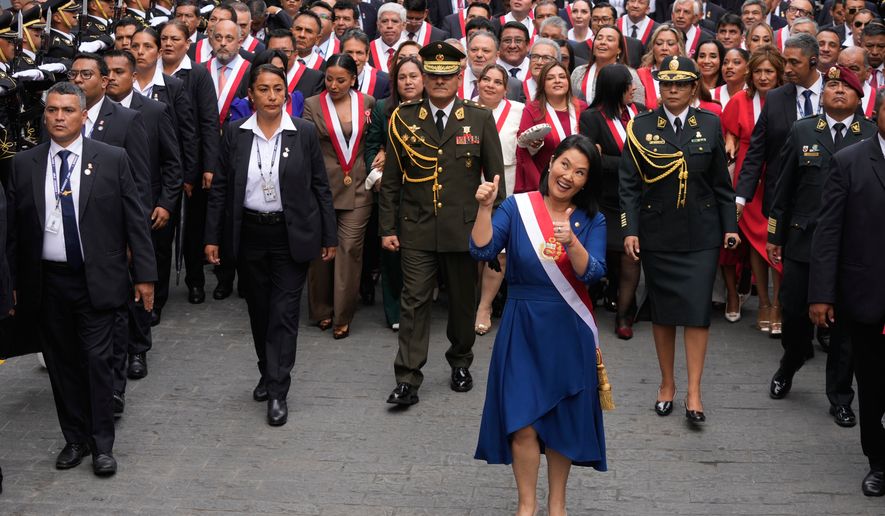
It may have a new one in Keiko Fujimori, Peru’s recently inaugurated president.
The election of Ms. Fujimori, the latest conservative to rise to political power in Latin America, was driven largely by her focus on security and crime, which have become central concerns for voters across the region. Combating drug cartels and transnational gangs is also a leading policy priority for the Trump administration and a key piece of the “Donroe Doctrine,” President Trump’s laserlike focus on asserting U.S. leadership across the Western Hemisphere, including using military force in some instances.
People were interested in these podcasts
American military muscle helped Mr. Trump pull socialist Venezuela into alignment with U.S. policy. On Friday, Mr. Trump announced a deal that could result in the United States taking control of 65 billion barrels of Venezuelan oil reserves.
Now analysts say a more diplomacy-based opportunity exists for Peru and the U.S. to work together.
“I think Fujimori genuinely wants closer cooperation here,” Judit Arenas, a Latin America adviser at the communications firm Apco, said in an interview with The Washington Times. “She has said herself there is ’very significant space’ to work with the Trump administration, and she has talked about Peru joining the Shield of the Americas initiative.”
Law enforcement cooperation
Mr. Trump’s Shield of the Americas, an alliance of Western Hemisphere governments that aims to confront dangerous drug cartels, is a central tenet of the administration’s outreach to Latin America.
Representatives from 12 other countries attended the initiative’s launch in Florida in March. Since then, seven other nations, including Peru and Colombia, have said they would join.
Member governments are expected to share intelligence, coordinate military and law-enforcement operations, and request assistance from other members in countering cartels and armed groups. Ecuador has emerged as an early test case, with American and Ecuadorian forces conducting joint counternarcotics operations earlier this year.
New Colombian President Abelardo de la Espriella is also closely aligned with Mr. Trump. Mr. de la Espriella has expressed openness to U.S. assistance in fighting the National Liberation Army, or ELN, a communist guerrilla organization and the oldest active insurgent group in the Americas. The ELN has been battling Colombia’s government since 1964.
Similarly, Ms. Fujimori has placed internal security at the core of her presidency. She has promised to treat Peru’s remnant Maoist insurgents, cocaine networks, illegal miners, illegal loggers and extortion gangs as interconnected threats to state authority.
“Fujimori will support training rotations, counternarcotics cooperation, disaster-response logistics and intelligence sharing on organized crime with the United States,” Ms. Arenas said. “What she will resist is anything that sounds permanent or exclusive.”
Counternarcotics is just one important issue in the evolving U.S.-Peruvian relationship. Another is China. Ms. Fujimori’s election is likely to intensify Washington’s efforts to draw Peru away from Beijing and to stop Beijing’s growing influence across the Americas.
“China has become Peru’s most important trading partner and a major investor, but Peru does not seek an exclusive relationship with Beijing,” Peruvian lawyer and policy expert Juan Pedro van Hasselt said in an interview with The Times.
“The country’s long-standing policy is to welcome investment from any nation. If the United States wants a closer economic relationship with Peru, it must be present, with investment in infrastructure, manufacturing, technology and other sectors that improve public welfare,” he said.
Mr. Trump designated Peru a major non-NATO ally in January, opening the door to closer security ties between Lima and Washington. Peru’s selection of 12 American-made F-16 Block 70 fighter jets — a purchase now under review by the Fujimori government — represents a potential step toward greater military interoperability between the two countries. In August, U.S. defense company L3Harris said Peru will equip its new F-16s with the company’s Viper Shield electronic warfare system. Peru’s F-16 pilots will train at a Romanian F-16 facility that is also used by Ukrainian F-16 pilots. The first F-16 deliveries to Peru will arrive in 2030.
China’s growing footprint
Meanwhile, China has made its own investments.
Peru is home to Beijing’s flagship Belt and Road Initiative in Latin America. Beijing uses the initiative as a geopolitical instrument, employing strategic investments to increase its political leverage. Chinese President Xi Jinping opened Peru’s coastal port of Chancay during a 2024 ceremony. China’s state-owned COSCO Shipping Ports holds a 60% stake in the facility.
“For decades, Chancay was a quiet town north of Lima, Peru, better known for its fishing community and slow rhythm,” the state-run China Daily said in a 2025 social media post. “Built in just three years through Chinese-Peruvian collaboration, the port shortens the shipping time across the Pacific by nearly one-third [and] reduces logistics costs by 20 percent.”
The natural harbor has an unusually deep draft of more than 58 feet. It is now one of the few ports on South America’s Pacific coast capable of accommodating ultra-large container vessels. Its draft could also accommodate large naval vessels.
“This is not a hypothetical worry. Chinese control of Chancay is a real concern. It sits close to a planned $1.5 billion U.S.-funded naval base upgrade, and both American officials and independent analysts have flagged that, in a real conflict scenario, the port’s deepwater berths could in theory support Chinese naval resupply, on top of the more routine monitoring risk,” Ms. Arenas said.
A Peruvian court ruling this year stripped Peru’s infrastructure regulator, Ositran, of oversight authority over the Chancay port. The ruling prompted a sharp public warning from the State Department. In July, an appellate court reversed the decision and restored Ositran’s authority over the port.
Analysts warn that the port could eventually host Chinese warships. Chancay is just 50 miles up the coast from a Peruvian naval facility at Callao. The State Department approved a possible $1.5 billion sale of equipment and services to Peru in January to support the relocation and expansion of that site.
Although Chinese warships have not arrived yet, Chinese foreign direct investment certainly has. Chinese state-directed financing in Peru has focused on two major copper mines: Las Bambas and Toromocho. Those two mines are some of the world’s largest. The Las Bambas mine alone produces about 2% of the world’s mined copper.
Not all of the copper flowing to China from Latin America does so legally. As Mining.com reported earlier this year, organized criminal gangs in Chile stole an estimated $917 million worth of copper from 2020 to 2025, with much of it destined for China.
The stolen metal was disguised as scrap and inserted into Chile’s legitimate export system. With copper prices reaching record highs, such activity is likely to continue. China is also a major destination for minerals produced by illegal mining operations in Peru. On Thursday, Peru, Chile, Argentina and Bolivia signed a joint declaration to improve regional cooperation on strategic minerals, including copper.
“In Peru, there are criminal gangs and organizations dedicated to mineral theft, which has led to China becoming a free market for illicit operations,” Peruvian security analyst Pedro Yaranga said in an interview with the media outlet Dialogo Americas.
Please read our comment policy before commenting.