



A federal judge declined Wednesday to order Texas to immediately extradite an ICE officer to Minnesota, ruling that Gov. Greg Abbott has statutory authority to review the request and refusing to impose a deadline on the process.
Minnesota fears that the officer, Christian Castro, will flee to Mexico if given the chance. Minnesota said Mr. Abbott, a Republican ally of President Trump, is being obstinate in refusing to carry out the extradition, which in most other cases would be a routine matter.
Judge Fernando Rodriguez Jr., a Trump appointee to the U.S. District Court for the Southern District of Texas, said the law allows Mr. Abbott time to review the extradition request. He said he will not impose an artificial deadline on the governor.
People were interested in these podcasts
“Ample caselaw supports Governor Abbott’s decision to investigate whether Castro is a fugitive for purposes of the Extradition Clause and the statutes,” the judge wrote.
The case has become a symbol of the divide between Democratic and Republican states, mixing immigration enforcement and government program fraud.
Mr. Abbott has said he would not act on the extradition request until Minnesota Gov. Tim Walz acknowledges culpability in the massive amount of pandemic and Medicaid assistance fraud federal authorities have said is taking place in the Democratic-dominated state.
“While they’re making demands, I got a demand of my own, and that is: It’s time for Minnesota to step up and repay the United States of America and Americans for all the fraud that they have committed in their state under federal programs,” the governor said this month.
Officer Castro was part of the surge of U.S. Immigration and Customs Enforcement personnel who went to Minnesota late last year and earlier this year as part of Mr. Trump’s mass deportation agenda.
On Jan. 14, Officer Castro fired a shot from his gun through the front door of a home, wounding an occupant, Judge Rodriguez said.
The shooting occurred between two other incidents in which U.S. citizens were killed.
Initially, ICE said men had attacked Officer Castro, and the shooting occurred as he was fending off the attack.
Officer Castro is now accused of fabricating that story.
The man who was shot, Julio Sosa-Celis, was initially charged with beating the ICE officer. Those charges were dropped in February after the Justice Department said the evidence did not support Officer Castro’s version of events.
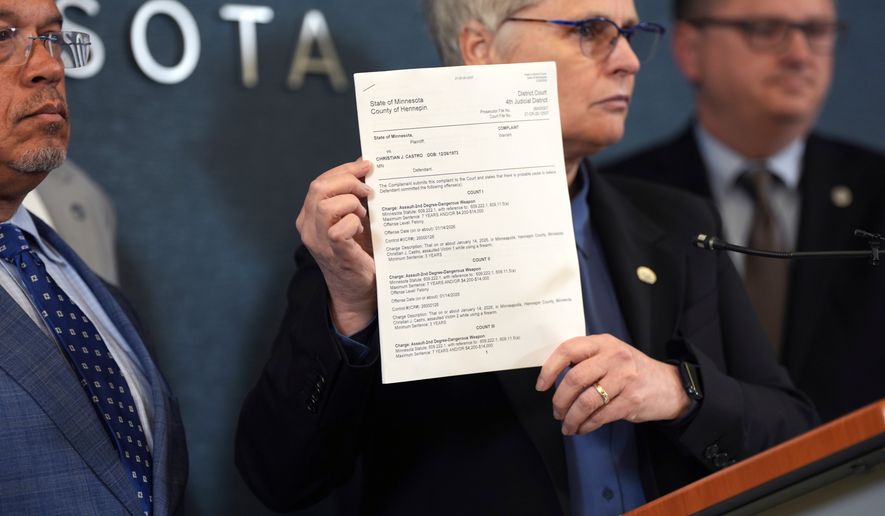
Minnesota state prosecutors indicted Officer Castro on four counts of second-degree assault and one count of falsely reporting a crime. The state issued a warrant for Officer Castro’s arrest the same day.
Texas Rangers arrested Officer Castro in Cameron County on May 29, and on June 2, Mr. Walz, a Democrat, formally requested extradition. Officer Castro has remained in custody in Cameron County since his arrest.
Minnesota Attorney General Keith Ellison, also a Democrat, said Mr. Abbott had a duty to carry out the extradition and said the law did not allow him any discretion.
Under Texas law, Officer Castro can be held for 90 days pending the extradition request. That time expires Thursday.
Minnesota authorities have cited jail phone calls from Officer Castro to a woman in Mexico, they say, who described a romantic relationship — and a reason for him to flee the country.
Mr. Abbott has questioned whether Officer Castro is subject to extradition.
Texas has argued that he is not a fugitive because he did not flee Minnesota. Instead, he was ordered back to Texas, his regular duty station, by his superiors at ICE.
The Trump administration this week weighed in with documentation backing up that version of events.
Mr. Ellison said Mr. Abbott is “playing with constitutional fire.”
“By refusing to extradite Castro, Greg Abbott is turning Texas into a sanctuary state for violent criminals. Regardless of today’s ruling, I will keep fighting so that Agent Castro will face justice in Minnesota,” Mr. Ellison said on X.
Contact the author

Please read our comment policy before commenting.