


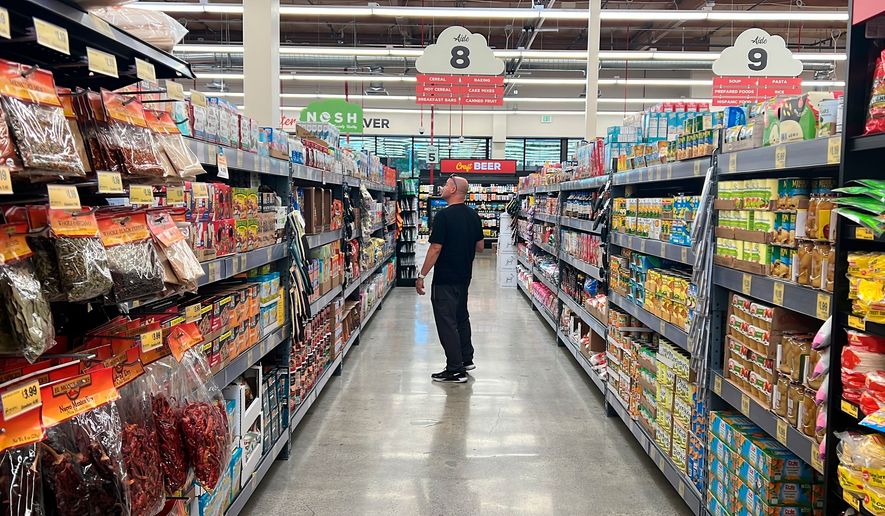

Consumer advocates are calling out “trickflation” — the repackaging of goods in taller or fancier containers that are priced higher than previous packages but offer less substance.
Food companies have quietly embraced the practice since the coronavirus pandemic to hide price hikes and dissuade customers from switching to cheaper generic brands, advocates say.
“Trickflation is an example of product marketing where firms are attempting to distract consumers from price increases by changing the shape or dimensions of the product,” said Joshua Berning, a Colorado State University food economist.
People were interested in these podcasts
Business analysts said companies use market research to develop packaging and slogans aimed at lulling customers into sticking with brand names as prices gradually rise.
“It will undoubtedly get worse,” said Andre Inverdale, founder and managing business consultant at Ardinal Strategy Group in Atlanta. “The entire efficacy of trickflation relies on incrementalism, the corporate strategy of spacing out micro-adjustments just below the consumer’s threshold of awareness.”
Mr. Inverdale offered as an example a redesigned beverage container that costs 50 cents more this year, an extra $1 next year and another $2 the following year to distract people from paying an extra $3.50 over three years for “a drastically reduced volume of product.”
“Trickflation is an unhealthy trend for consumers seeking to maximize value amid rising costs,” he said. “It erodes consumer trust and forces shoppers to continuously audit product sizes, shapes and weights, creating an adversarial relationship between brands and the public.”
The Washington Times reached out to leading food companies and FMI — The Food Industry Association for comment. None responded.
Angelica Gianchandani, a New York University marketing professor, said more companies have deployed trickflation to avoid the customer backlash that transparent price hikes would trigger. She blamed Trump administration tariffs and rising labor costs for accelerating the trend over the past year.
“It manages rising costs for packaging, labor and tariffs while avoiding the reputational risk of a visible hike,” Ms. Gianchandani said. “Trickflation works because it is hard to notice.”
However, she warned that customers who catch a brand practicing trickflation come to “distrust the whole shelf” of its products.
“Canada and parts of the EU now require disclosure of quantity adjustments,” Ms. Gianchandani said. “The U.S. has no federal requirement yet, so companies here have more room to do it quietly.”
Shrinking toward trickery
Trickflation builds on shrinkflation, in which companies reduce packaging to sell less food at the same price.
In 2012, PepsiCo market-tested Gatorade’s transition of its flagship 32-ounce sports drink bottles into 28-ounce “aerodynamic hourglass” bottles with narrow midsections. The company expanded the rollout in 2022 as pandemic-era supply issues drove up costs, charging the same amount to mask a 14% price increase.
While some praised the Gatorade hourglass bottle as easier to hold, others cited the shrinkage as part of a broader marketing tactic to sell people less for their money.
The term trickflation first appeared in a viral 2024 Reddit post that shared a photo comparing two 12-ounce Coca-Cola cans, one standard and short, the other tall and slim. It pointed out that the taller, fancier can carried a much higher price for the same volume of soda.
The user asked: “We all know about shrinkflation, can I coin the term ’Trickflation’?”
Consumer rights advocate Edgar Dworsky, who founded the website Consumer World in 1995 to track food price increases, shared several examples of post-pandemic trickflation. They include a 2023 photo of Kellogg’s Corn Pops cereal morphing from a 14.6-ounce “large” box to a narrower 13.1-ounce box that looks taller, despite containing “a full serving less of the cereal.”
He also pointed to heart-shaped boxes of Valentine’s Day chocolates growing in size while shrinking to “less than 6 ounces of candy.”
“I personally would broaden the definition to include any packaging trick used by a manufacturer to mislead consumers about the package’s content, particularly if the result is consumers getting less than they expect for their money,” Mr. Dworsky said.
Last month, a reader sent Mr. Dworsky a photograph of Raw Sugar Moisturizing Hand Wash, which changed its watermelon mint packaging from a 16.9-ounce bottle to a larger-looking bottle with only 12 fluid ounces.
There is no national entity that tracks trickflation.
A Statistics Canada analysis found that 29.6% of eligible grocery products experienced downsized packaging in that country between 2021 and 2023. A large share of the downsized products came from American multinational corporations, including snack and breakfast cereal producers.
An InvestorsObserver study published in April estimated that American families now spend $741 more a year on the most popular name brands than in 2020, with $41 of that increase due to shrinking packages.
The study singled out Frosted Flakes, Doritos, M&M’s and Cheerios for raising prices while shrinking packages. For example, it noted that a box of Frosted Flakes costs 51% more per serving in 2026 than in 2020 and contains fewer servings.
Warning signs
Consumer rights advocates urge shoppers to pay attention to package sizes and price-per-unit shelf labels, and to switch brands when they get fed up with rising prices.
Last month, grocery prices were up 2.7% from July 2025. That’s lower than a 13.1% jump in July 2022, which was the largest 12-month increase since March 1979, but comes on top of several years of steep increases.
According to Bureau of Labor Statistics data, prices for food at home rose by roughly 31% cumulatively between January 2020 and June 2026.
Meanwhile, the marketing automation company Omnisend found that 65% of 1,075 U.S. consumers it surveyed in March described grocery prices as “out of control,” topping gasoline and transportation as their top inflation concern.
Among the shoppers it surveyed, 56% said they stopped buying brands that raised prices. Another 67% said price hikes changed how they viewed brands they previously favored and 22% said their trust had fallen. The survey had a margin of error of plus or minus 3 percentage points.
Marty Bauer, an Omnisend ecommerce and retail expert, said the rise of trickflation over the past few years shows an “economy under pressure.”
“These tactics distort price signals, make comparing costs needlessly complicated, and, most importantly, damage transparency and consumer trust,” Mr. Bauer said Wednesday in an email. “Consumers have good reason to be angry.”
Several consumer advocates noted that customers have paid closer attention to food prices since the pandemic. They predicted that only increased government regulation requiring transparent pricing changes could slow the trend, and said that such action would take years to formulate and enforce.
Officials at the website PissedConsumer.com shared complaints that irate shoppers recently posted to their platform.
“I received a frozen mega meal with only half a serving size in the package,” one customer wrote in a Banquet Meals product review. “Very disappointing!”
An Ohio reviewer noted in March that she found only 23 jelly beans inside a plastic Brach’s bag that used to contain more.
“The way it looks [to] me, they will be out of business in the next 5 years,” she wrote.
Michael Podolsky, CEO and co-founder of PissedConsumer.com, said companies will only get away with shrinkflation and trickflation until more customers revolt.
“They definitely notice when they are paying the same amount or more and getting less in return,” Mr. Podolsky said Wednesday.
“From a consumer’s perspective, the issue is not only higher prices, but the feeling that value is quietly disappearing,” he said in an email.
Contact the author

Please read our comment policy before commenting.