


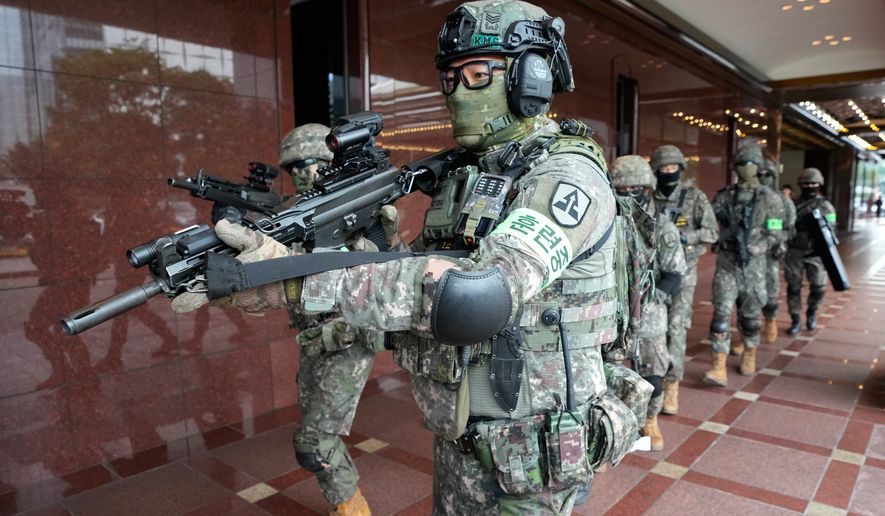

SEOUL, South Korea — The sister of North Korean dictator Kim Jong-un engaged in some weapons-grade propaganda Thursday, trolling President Trump in an attempt to exacerbate regional fallout over his last-minute downscaling of a summer war game conducted by the South Korean and U.S. militaries.
“Trump issued a sudden order to reduce the scale of the drill,” Kim Yo Jong, the sister, who has often taken on an attack dog role for her brother’s regime during recent years in state media commentaries about the U.S.-South Korea alliance.
Ms. Kim did not hold back on Thursday, asserting that Mr. Trump’s surprise move — announced earlier this week via the president’s Truth Social platform — has “placed Seoul in a poor plight of canceling ’war games’ it liked very much.”
People were interested in these podcasts
She made the comments in a statement, according to a report by the South Korea-based Yonhap News Agency, which noted how North Korea, in a separate action on the same day, test-fired a barrage of ballistic missiles into the Sea of Japan, a customary response to joint drills south of the DMZ.
The developments come in the wake of Mr. Trump’s Truth Social post, sent late Sunday Washington, D.C., time, ordering the reduction of the U.S.-South Korea joint military drills that commenced on a smaller-than-planned scale Monday morning Korea time.
Mr. Trump’s announcement threw Seoul, which had not been consulted on the matter, into confusion. Multiple South Korean government agencies have responded to the announcement with different messages during recent days.
The joint war games are set to conclude Aug, 21, well ahead of their planned end date of Aug 27.
Ms. Kim strikes
Ms. Kim is Director of the General Affairs Department of the Workers’ Party of Korea, where she manages administrative and other internal operations for the North Korean regime. She is also a member of the party’s Central Committee and an alternate member of the Politburo.
Her background is in propaganda, and there is little doubt that she is in close coordination with her elder brother.
Pundits have noted that, for decades, a core North Korean tactic has been to try to drive a “wedge” between Seoul and Washington.
While avoiding direct criticism of Mr. Trump, Ms. Kim’s tactic on Thursday was to twist the knife into Seoul, saying South Korean leaders have been “blinded by their firm belief in the U.S. master.”
Her agitprop tactics are timely.
The U.S.-South Korea security alliance is among the strongest Washington has in Asia.
But Seoul was humiliated by Mr. Trump’s sudden orders on the joint military drills, and is presently at odds with its ally on multiple fronts.
Washington is unhappy with the lack of progress on a $350 billion investment pledge Seoul made a year ago, and insists U.S. firms are being discriminated against in South Korea. Mr. Trump has also slammed the South Korean government for not assisting his military campaign in the Middle East.
Seoul is unhappy with the lack of progress on a nuclear attack submarine deal that it was promised by the U.S. side, and claims that Coupang, a firm that does most of its business in South Korea but is listed in the U.S and lobbies there, is out of line with local laws.
Ms. Kim’s sarcastic Thursday comments differed in tone from the incandescent – even apocalyptic — invective that North Korean state media usually unleashes against joint U.S.-South Korea military exercises.
Pyongyang did, however, stick to its tried-and-tested playbook with another customary response: A barrage of missile tests.
South Korea’s Joint Chiefs of Staff monitored the launch of short-range ballistic missiles (SRBMs) that splashed into the Sea of Japan after being fired by North Korea late Thursday afternoon.
It cannot be proven that Thursday’s SRBM launches were a signal of displeasure with the U.S.-South Korea drills, but North Korea has been able to test such missiles in arguably a better laboratory than the open ocean: live combat in Ukraine.
According to an August report published by 38 North, a North Korea-focused publication based in Washington, the reliability and accuracy of the North Korean military’s road-mobile, solid-propellant KN-23 SRBM has been significantly improved.
“The KN-23 initially demonstrated reliability and accuracy problems,” the report read. “Both issues seem to have been resolved since then … with multiple allegations that Russian assistance helped improve the missile’s accuracy.”
Citing Ukrainian sources, 38 North found that in-flight reliability has massively improved, while on-target accuracy has been compressed from 1,000-3,000 meters to 50-100 meters — from more than a mile down to less than 300 feet.
With that as a backdrop, segments of the now-reduced U.S.-South Korea military drills were designed to counter North Korea’s improving capabilities.
“Certainly we ensure that the threats we seek to counter in defense of South Korea reflect increased use of [drone] technologies, and the understanding that North Korea has contemporary battlefield experience,” Australian General Scott Winter, deputy commander of the South Korea-based United Nations Command, told reporters last week.
Mr. Trump’s decision to scale back the drills appeared driven by a desire to revitalize his relationship with Mr. Kim, a diplomatic highlight of the president’s first term in office.
Trump aims for Kim win
Mr. Trump made international headlines after a historic summit with Mr. Kim in 2018 by ordering an indefinite halt to joint U.S.-South Korea military drills.
The relationship between the two men cooled after a 2019 summit fizzled without a breakthrough on Mr. Trump’s then goal of getting North Korea to abandon its nuclear weapons program.
Both Pyongyang-Washington and Pyongyang-Seoul relations have since frozen.
North Korea in 2024 found a new benefactor: Russian President Vladimir Putin.
Moscow is offering generous terms to maintain its relationship with Pyongyang, which has become a key ally in Russia’s military assault on Ukraine. In return, the Kim regime has buttressed Moscow’s battered armed forces with both arms and troops.
With Mr. Trump currently bogged down by the U.S. war against Iran, and with November U.S. midterm elections looming, many believe the president wants to open a new diplomatic front with Mr. Kim.
In recent days, Mr. Trump has teased the idea of a meeting with the North Korean dictator. On Wednesday, he told reporters he planned to meet Mr. Kim later this year.
That could feasibly be around Nov. 18-19, when Mr. Trump is likely to be in the region, attending the Asia Pacific Economic Cooperation Summit in Shenzhen, China.
Still, that could be too late to gain political traction ahead of the U.S. midterms, which are set for Nov. 3.
And many question whether Mr. Trump can squeeze a geopolitical win out of Mr. Kim, even if he scores good optics.
The North Korean dictator’s alliance with Mr. Putin has eased the pressure Pyongyang feels from U.S. sanctions, perhaps lessening Mr. Kim’s thirst for U.S goodwill.
Pyongyang has also repeatedly made clear, since 2019, that it is absolutely unwilling to discuss Washington’s priority of North Korean denuclearization.
South Korea’s liberal Hankyoreh newspaper asked in a headline Thursday: “Last time they met, Kim needed Trump. Have the tables turned?”
Contact the author

Please read our comment policy before commenting.