



ISTANBUL — Conflict with Arab neighbors is nothing new for Israel and Prime Minister Benjamin Netanyahu, but growing tensions between the Jewish state and regional power Turkey threaten to superheat a Middle East that’s already close to boiling.
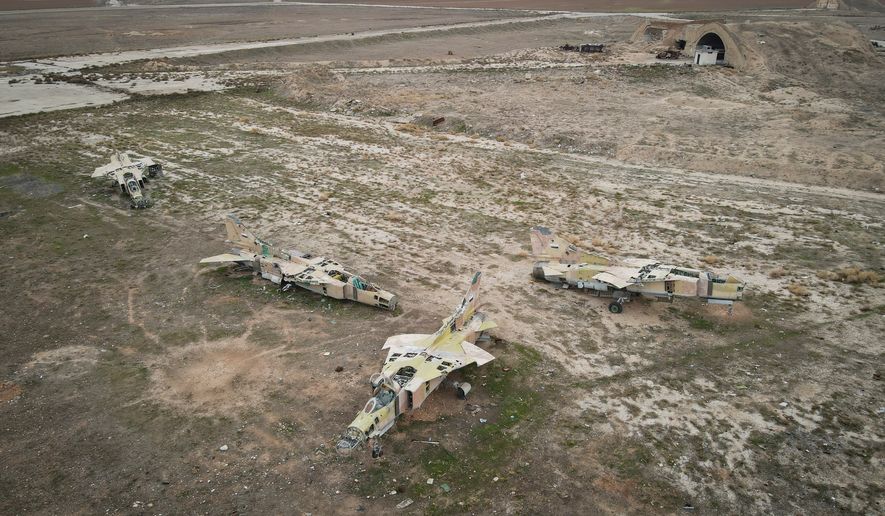
Israel on Tuesday bombed an older Syrian air base that Jerusalem said was being retrofitted to host a deployment of Turkish forces — a development Turkey explicitly denied, but one that the Netanyahu government nevertheless views as a serious threat to Israeli security. Ankara condemned the Israeli strikes as “reckless” overreach.
The bombing, followed 36 hours later by an Israeli incursion of about 100 soldiers into a Syrian village in Quneitra province, drew condemnation from Ankara, Riyadh, Cairo, Doha and, perhaps most notably, from Jerusalem’s closest ally — Washington.
Israel is pursuing two separate tracks in Syria, said Ahmed Al-Kinani, a security and political affairs analyst in Damascus.
“The airstrikes do not affect either the southern track or the track of targeting strategic weapons,” Mr. Al-Kinani told The Washington Times. “The incursions will continue until there are real negotiations to put an end to the Israeli aggression in the south.”
Eight strikes hit the runway and storage buildings at Abu al-Duhur in eastern Idlib province, Syrian state media said. No casualties were reported.
Israel confirmed the attack a day later. The Prime Minister’s Office said Israel and Syria had agreed to maintain a security status quo that Damascus was about to breach by permitting Turkish troops to deploy at “an air base near Aleppo.”
The base is in Idlib, about 45 miles from the Turkish border and about 186 miles north of the Israeli border.
In Jubata al-Khashab in northern Quneitra province, Israeli troops arrived after midnight Wednesday in nine or 10 vehicles, said Hassan Ahmed, a 42-year-old farmer. They searched the homes of three brothers and remained for about two hours.
The soldiers detained two young men. One was released later that morning. The other, Muadh Faisal Suleiman, about 32, remains in Israeli custody.
Mr. Ahmed said the soldiers ransacked the houses, beat one of the detained men and confiscated his phone. He said he can no longer reach farmland near Israeli military positions.
“I feel absolute fear of approaching my land,” he said.
The raid was part of an established Israeli ground campaign in southern Syria.
Sijil al-Mustaqill, a Syrian monitoring organization, documented 65 Israeli incursions in Quneitra province in July and 52 more from Aug. 1 through Aug. 18, manager Hamza Al-Ghadban said. The organization counted 147 detentions this year, including 133 in Quneitra, and said 49 Syrians remain in Israeli custody.
Israeli forces have occupied territory inside Syria beyond the 1974 disengagement line since December 2024. The Armed Conflict Location & Event Data project, a U.S.-based nonprofit watchdog, has counted nine Israeli military positions established there since the fall of Bashar Assad.
The northern track is newer and potentially more combustible because it brings Israel into direct military competition with Turkey, a NATO member and American ally.
Turkey and Israel have operated a military deconfliction channel in Syria since 2025. Azerbaijan brokered the arrangement after Israeli strikes on the T4, Palmyra and Hama sites that Ankara had planned to use.
Israel did not notify Turkey before its aircraft headed for Abu al-Duhur.
Turkish forces did not know the aircraft were approaching or what they intended to strike, said Tom Barrack, the U.S. ambassador to Turkey and special envoy for Syria. That raised the danger that Turkey might scramble its own aircraft in the belief that its forces were under attack.
“Thankfully, calm heads were able to prevent the situation from deteriorating further,” Mr. Barrack said.
The deconfliction channel is technical and intended to keep Israeli and Turkish aircraft apart in Syrian airspace. Ankara says it does not imply normalization with Israel, and neither side is required to provide advance warning of an attack.
The United States is holding discussions about reviving a separate deconfliction cell between Israel and Syria, Mr. Barrack said. Turkey could be invited to participate directly or indirectly.
He said the cell should operate around the clock with personnel who speak Hebrew, Arabic, English and Turkish.
Turkey has not said whether it would participate.
Turkish Foreign Minister Hakan Fidan said Israeli attacks on Syria’s sovereignty and territorial integrity are among the greatest threats to the rebuilding country’s stability.
Damascus and Ankara offered conflicting accounts of who was at Abu al-Duhur before the attack.
Syrian Foreign Minister Asaad al-Shaibani said Turkish military officers visited the base several days earlier as part of continuing cooperation in training and the exchange of expertise. He said there was no plan to establish a Turkish base, permanent presence or troop deployment at the site, which he described as largely empty.
Mr. Shaibani also defended Syria’s right to establish military cooperation with any country it chooses.
Turkey’s Defense Ministry said at its weekly briefing Thursday that no Turkish military delegation was at the base before or during the attack. It called on Israel to end what it described as reckless attacks and said Turkey would continue supporting Syria’s military capacity under a “one army” principle.
Roman Gofman, the head of Israel’s Mossad intelligence agency, and Mr. Shaibani spoke by phone Friday, four days before the strike. Three people familiar with the call told Reuters that Turkish military support for Syria dominated the conversation.
Mr. Gofman asked about Turkey’s provision of arms, weapons sales and drone deliveries to the Syrian military, they said.
That exchange revealed the central dispute, Mr. Al-Kinani said.
“These Israeli statements clearly revealed agreements preventing any Turkish operation of Syrian military sites, especially airports and air defense systems,” he said.
Mr. Al-Kinani said Syria and Israel had reached a tacit understanding. Israel is serious about negotiations, he said, but only on terms that would deny Syria air defenses and strategic weapons while excluding Turkey, even though Damascus and Ankara have joint defense arrangements.
Tal Beeri, research director at the Israeli Alma Research and Education Center and a former officer in Israel’s Military Intelligence Directorate, said available evidence did not indicate a permanent Turkish presence at Abu al-Duhur.
Striking the runway would temporarily put the base out of operation and send a message to the government of Syrian President Ahmed al-Sharaa, and possibly also to a third country, Mr. Beeri said.
ALMA has observed an acceleration of Turkish military activity across Syria since May.
The target was chosen for what it was not yet, said Nir Boms, chairman of the Syria Research Forum at Tel Aviv University’s Moshe Dayan Center. Israel struck a base before Turkish forces were established there rather than targeting Turkish positions already operating on Syrian soil, he said.
That “lets you ask a question about the justification.”
“What we’ve seen is a message to Damascus that relates to the Damascus-Ankara cooperation,” Mr. Boms told The Times.
Israeli concern about the volume of Turkish weapons entering Syria is genuine, Mr. Boms said. Turkish training of a Syrian special forces unit in Damascus has also increased distrust within Israel’s security establishment.
He said he did not believe Israel and Syria were close to an agreement.
Israeli Defense Minister Israel Katz posted a message in Hebrew and Turkish on Thursday saying Israel would not allow any entity to threaten its security. President Recep Tayyip Erdogan should continue making speeches against Israel in the Turkish parliament rather than “testing Israel’s resolve to defend itself,” Mr. Katz said.
Turkey’s Communications Directorate said Mr. Netanyahu’s recent remarks reflected expansionist policies ahead of Israel’s elections.
Turkey began training Syrian military personnel in October 2025 under an agreement signed that August. Syria participated in Turkey’s Efes military exercise for the first time this spring.
At the NATO summit in Ankara in July, U.S. President Trump said he would consider selling F-35 fighter jets to Turkey despite Israeli objections.
Mr. Shaibani spent more than three hours with journalists and officials at Tishreen Palace on Thursday. He called Israel an expansionist “bad neighbor” and said nearly a year of negotiations had helped the two sides understand each other’s positions.
He left later that day for Islamabad, making the first visit to Pakistan by a Syrian foreign minister in 19 years.
On the southern track, Mr. Al-Kinani said, no such understanding exists.
“In the southern region, it is quite the opposite,” he said. Israel wants Syria to formally recognize the security arrangements it is imposing in the south, and until that happens the incursions will continue.
For residents of Jubata al-Khashab, that imposed security reality means Israeli patrols, inaccessible farmland and men taken from their homes.
“I have never seen the presence of any gunmen in Jubata al-Khashab,” Mr. Ahmed said.
Please read our comment policy before commenting.